


Orange Economy, also known as the Creative Economy, is an economic framework that encompasses industries based on creativity, culture, and Intellectual Property (IP). The color 'orange' is used conceptually to symbolize culture, creativity, and identity.
- Definition and Core Principles
The fundamental principle of the Orange Economy is the transformation of ideas and cultural activities into goods and services that carry significant economic value.
- Basis of Production: This economy considers human capital, creative input, and Intellectual Property as the main productive assets, rather than industrial or natural resources.
- Value Protection: The value of the goods and services created within this economy is primarily safeguarded by Intellectual Property Rights (IPR), such as copyrights, patents, and trademarks.
- Sectors Included
The Orange Economy includes a wide array of sectors based on innovation and creativity that are directly linked to the production, distribution, and consumption of ideas. These include:
- Arts and Heritage: Fine arts, performing arts, museums, and historical sites.
- Media and Publishing: Film, television, radio, music, newspapers, and books.
- Creative Services: Design (fashion, graphic, industrial), architecture, advertising, and specialized software development.
- Digital and Tech Fields: Gaming, animation, Virtual Reality (VR), and digital content creation.
- Significance
The Orange Economy is rapidly becoming vital for modern economies because:
- Economic Growth: It holds the potential to drive economic growth faster than traditional industries.
- Job Creation: It generates high-value job opportunities for young and skilled labor forces.
- Cultural Promotion: It helps preserve and promote a nation's cultural identity, strengthening tourism and international relations.
Thus, the Orange Economy reflects the growing role of culture and innovation as a global economic powerhouse.
National Commission for Safai Karamcharis (NCSK) is a dedicated body operating under the Ministry of Social Justice and Empowerment. It advocates for the rights, welfare, and rehabilitation of Safai Karamcharis (sanitation workers), particularly aiming to eradicate the inhuman practice of manual scavenging.Karamcharis (sanitation workers), particularly aiming to eradicate the inhuman practice of manual scavenging.
- Formation and Status
NCSK was initially set up in 1994 under the NCSK Act, 1993. However, since 2004, it functions as a Non-Statutory Body, operating through government resolution after the Act lapsed.
Commission's structure includes a Chairperson (with Minister of State status), a Vice-Chairperson, and Five Members (including one woman). Crucially, the Union Cabinet recently approved extending the NCSK's tenure for three years, until March 31, 2028, ensuring continuity in its critical work.
- Core Mandate and Functions
The NCSK plays a vital monitoring and advocacy role:
- Legislative Oversight: It supervises the effective implementation of the landmark Prohibition of Employment as Manual Scavengers and their Rehabilitation Act, 2013, which is central to the mission's goal.
- Policy Recommendations: It advises Central and State governments on policies for the empowerment and rehabilitation of sanitation workers.
- Grievance Redressal: It investigates complaints, policy deficiencies, and can take Suo Motu (on its own motion) action on reported issues concerning their rights.
- Compensation Enforcement: Following a 2023 Supreme Court directive, the NCSK ensures dependents receive ₹30 lakh in compensation for death during sewer work, and ₹10 to ₹20 lakh for permanent disability.
- Supporting Initiatives
NCSK’s mission is supported by key governmental initiatives:
- NAMASTE Scheme: This initiative focuses on the safety and profiling of sewer/septic tank workers, providing them with Occupational Safety Training, protective kits, and health insurance under AB-PMJAY to promote mechanization.
- NSKFDC (National Safai Karamcharis Finance and Development Corporation): This corporation provides concessional loans and financial aid to Safai Karamcharis and their families, assisting them in adopting alternative, dignified livelihoods.
Through these measures, the NCSK is a key institutional tool driving the national effort toward ensuring safety, dignity, and socio-economic inclusion for all sanitation workers.
World Bank was originally established in 1944 as the International Bank for Reconstruction and Development (IBRD). It is a specialized agency of the United Nations, with the primary mission of reducing poverty and promoting shared prosperity through sustainable solutions in developing countries worldwide.
- Structure : The Five Pillars
World Bank Group is a unique partnership of five institutions that work together:
- IBRD – International Bank for Reconstruction and Development
Provides long-term loans and analytical services to middle-income and creditworthy low-income countries. - IDA – International Development Association
Offers interest-free loans (credits) and grants to the world’s poorest nations. - IFC – International Finance Corporation
Focuses on promoting private sector development in developing countries. - MIGA – Multilateral Investment Guarantee Agency
Provides insurance against political risks to encourage investment. - ICSID – International Centre for Settlement of Investment Disputes
Handles dispute resolution between investors and states.
(Note: India is not a member of ICSID.)
- Membership and Voting Power
World Bank has 189 member countries, including India. Voting power is linked to shareholding. The United States is the largest single shareholder, holding 16.41% of the votes. - Key Reports
The Bank publishes several influential reports that track global development, such as:- Human Capital Index
- World Development Report
(It also used to publish the Ease of Doing Business Report, which has now been discontinued.)
Government of India launched the Biosphere Reserve Programme in 1986 with the aim of conserving ecosystems, protecting diverse species of flora and fauna, and preserving their genetic diversity. The programme is guided by UNESCO’s Man and the Biosphere (MAB) Programme, of which India is a signatory.
- Financial Provisions
- For the North-Eastern states and the three Himalayan states, financial assistance is shared between the Centre and the states in the ratio of 90:10.
- For all other states, the sharing pattern is 60:40.
- This assistance is primarily used for maintenance, infrastructure improvement, and development activities.
- Management Framework
- The State Government is responsible for preparing a Management Action Plan for each biosphere reserve.
- The plan is approved and monitored by the Central MAB Committee.
- The programme is implemented by the Ministry of Environment, Forest and Climate Change (MoEFCC).
- Three Zones of a Biosphere Reserve
- Core Zone
- The most protected and strictly preserved area of the biosphere reserve.
- It contains endemic species of plants and animals.
- Only non-invasive research and monitoring activities are permitted.
- Most core areas overlap with National Parks or Wildlife Sanctuaries under the Wildlife (Protection) Act, 1972.
- This zone is kept free from human interference.
- Buffer Zone
- Lies around the core zone.
- Activities are managed to protect and support the core area.
- Limited human activities such as eco-tourism, grazing, fishing, and controlled forestry are allowed.
- Research, education, and awareness programmes are encouraged here.
- Transition Zone
- The outermost part of the biosphere reserve.
- It is a zone of cooperation where conservation and sustainable human activities go hand in hand.
- Includes villages, agricultural fields, managed forests, economic activities, and recreational areas.
- Strong local community participation is encouraged.
- Core Zone
- The Biosphere Reserve Programme is not only about conserving biodiversity but also about creating a model of harmonious coexistence between humans and nature. It reflects India’s commitment to environmental protection, sustainable development, and global responsibilities under UNESCO’s MAB framework.
Recently, the Union Minister of Commerce and Industry highlighted the India-Middle East-Europe Economic Corridor (IMEC) as a pivotal transcontinental initiative poised to redefine global trade dynamics.
What is IMEC?
IMEC is a strategic multi-modal connectivity initiative launched during the G20 Summit in 2023. The signatories to this memorandum of understanding include India, the USA, Saudi Arabia, the UAE, France, Germany, Italy, and the European Union.
The project aims to be a viable alternative to China's Belt and Road Initiative (BRI), focusing on promoting transparent, sustainable, and debt-free infrastructure. The corridor is divided into two sections:
- Eastern Corridor: connecting India to the Arabian Gulf.
- Northern Corridor: connecting the Gulf to Europe.
The goal is to establish an integrated network of ports, railways, roads, shipping lanes, and digital infrastructure to boost trade among India, the Middle East, and Europe.
Significance of IMEC for India
- Trade and Time Savings: IMEC is projected to cut logistics costs by up to 30% and reduce transit time by 40% compared to the Suez Canal maritime route. This will make Indian exports more globally competitive.
- Energy Cooperation: The corridor aligns with India's "One Sun, One World, One Grid" (OSOWOG) initiative, enabling India to leverage solar and green hydrogen energy from the Middle East.
- Investment and Economic Growth: It is expected to attract Foreign Direct Investment (FDI) to India, particularly in infrastructure, logistics, and clean energy. This will help India access low-cost renewable energy and transition to a low-carbon economy.
The project faced significant delays due to the Israel-Hamas conflict in 2023, as geopolitical instability in the Middle East slowed down its momentum. Despite this, diplomatic engagement continues. India and the UAE signed an Inter-Governmental Framework Agreement (IGFA) in 2024 to focus on operational collaboration and the creation of a joint logistics platform for IMEC.
DefenseTech refers to advanced technologies used in the fields of defense and security. In India, this sector has become a crucial hub for promoting innovation and self-reliance. The government's "Make in India" initiative and the increased involvement of the private sector have significantly strengthened the Indian defense ecosystem.
Development of DefenseTech in India
The key points in the development of DefenseTech in India include:
- Self-Reliance (Atmanirbharta): India aims to reduce its dependence on imports for defense equipment and technologies by focusing on indigenous research and development.
- Role of the Private Sector: The government has opened up the defense sector to private companies, providing an opportunity for startups and MSMEs to innovate. Initiatives like iDEX (Innovations for Defence Excellence) and ADITI (Aiding Development of Innovative Technologies for Defence Excellence) have enabled over 600 startups to advance indigenization in defense manufacturing.
- Key Technologies: Indian DefenseTech encompasses several key technologies, such as:
- Artificial Intelligence (AI) and Machine Learning: To improve decision-making processes and develop autonomous systems.
- Drones and Unmanned Vehicles: For surveillance, reconnaissance, and combat purposes.
- Cybersecurity: To protect military networks and data.
The growth of DefenseTech is not only strengthening India's defense capabilities but also contributing to economic growth and job creation.
SpaceTech, or space technology, refers to all technologies and services related to the exploration and use of outer space. In India, reforms enacted after 2020 have opened up this sector to private participation, triggering a new wave of innovation and growth. This shift has led to the emergence of over 300 space startups in the country.
Role of the Private Sector
Private companies like Skyroot Aerospace and Agnikul Cosmos are leading this revolution. They are developing cost-effective and efficient solutions for launching small satellites, making India's space program more dynamic and accessible.
- Cost Reduction: Private sector involvement is expected to bring down the cost of satellite launches, making space services more accessible to a wider range of users.
- Driving Innovation: These startups are introducing new technologies and business models, fostering innovation in space technology.
- Global Competitiveness: The entry of private players has made India more competitive in the global space market.
This transformation is not only strengthening India's space capabilities but also creating new employment opportunities and establishing the country as a major player in space technology.
The judicial approach to the admissibility of DNA evidence in India has evolved over time, recognizing it as a crucial scientific tool in criminal and paternity disputes. Various court rulings and recent legal provisions have defined its legal validity and application.
Key Judicial Decisions and Legal Provisions
- Kunhiraman vs. Manoj Case (1991): This case was the first in India to use DNA technology to resolve a paternity dispute. The decision paved the way for the future use of DNA evidence in civil matters.
- Sharda vs. Dharmpal Case (2003): In a landmark judgment, the Supreme Court upheld the admissibility of DNA evidence in civil and matrimonial disputes. The court clarified that undergoing a DNA test does not violate Article 21 (Right to life and personal liberty) or Article 20(3) (Right against self-incrimination), as it is a scientific examination and not a forced testimony.
- Bhartiya Nagarik Suraksha Sanhita, 2023 (Section 51): This new law provides legal backing for the medical examination of arrested persons. It authorizes a registered medical practitioner to conduct DNA profiling and other necessary tests, ensuring scientific rigor and transparency in the investigation process.
- Rahul vs. State of Delhi, Ministry of Home Affairs (2022): In this case, the DNA evidence was rejected because the sample was kept in police custody for two months. The court raised doubts about its authenticity due to the possibility of tampering. This ruling highlights the critical importance of maintaining a proper chain of custody for DNA evidence to ensure its admissibility.
- Devkar Case (2025): In this recent case, DNA evidence was categorized as opinion evidence under Section 39 of the Bhartiya Sakshya Adhiniyam, 2023. The court's decision stated that the authenticity of DNA evidence depends on the facts of each case and requires both scientific and legal validation to be accepted in court.
Overall, the Indian judiciary has accepted DNA evidence as a powerful tool but has consistently emphasized the need for strict scientific protocols and legal safeguards to ensure its reliability and integrity.
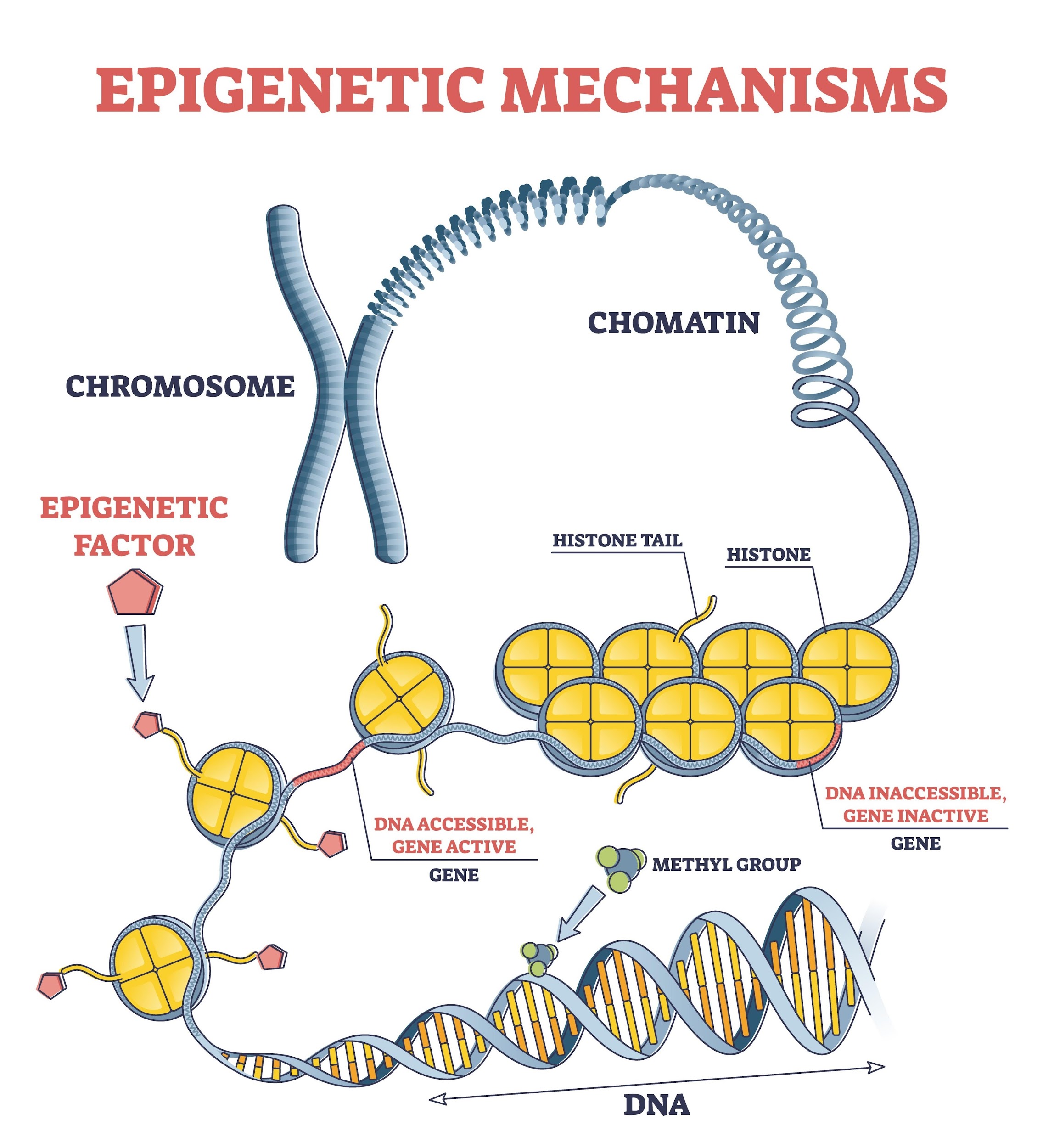
Epigenetics is the study of how your genes are expressed without changing the underlying DNA sequence. It's a field of biology that looks at how certain genes are turned "on" or "off," which controls which proteins are made, when, and where.
Key Points
Epigenetic changes happen when chemical tags—known as epigenetic tags—attach to your DNA. These tags can either tighten or loosen the DNA's winding, making it easier or harder for certain genes to be read. This process essentially controls when and how genes are activated.
- Environmental and Lifestyle Influence: Epigenetic tags can be influenced by various external factors, such as diet, stress, smoking, and environmental chemicals. These factors can change the tags, leading to long-term health effects like an increased or decreased risk of certain diseases.
- Heritability: Some epigenetic changes can be passed down to the next generation. This means that a parent's life experiences can have an effect on their children's health, even though the fundamental DNA code remains the same.
- The study of epigenetics helps us understand why individuals with the same genetic makeup (like identical twins) can have different health outcomes. It's a revolutionary field in medicine and healthcare.
Recently, the Bureau of Indian Standards (BIS) celebrated its 78th Foundation Day on January 6, 2025. This statutory national standards body of India oversees the standardization, quality certification, and marking of goods in the country. It was originally established as the Indian Standards Institution (ISI) on January 6, 1947, and was later transformed into BIS under the Bureau of Indian Standards Act, 2016. It functions under the Ministry of Consumer Affairs, Food and Public Distribution.
Functions and Initiatives of BIS
- Product Certification: BIS issues the ISI mark for various products, which ensures their quality and safety.
- Hallmarking: It is responsible for the hallmarking of gold and silver jewelry, which certifies their purity and quality. To date, over 442.8 million pieces of gold jewelry and artifacts have been hallmarked.
- ECO Mark Scheme: This scheme provides labeling for products that are environmentally friendly, helping consumers choose greener options.
- Standards National Action Plan (SNAP) 2022-27: This plan provides a strong standardization framework to address emerging technologies and global concerns like climate change. Its objective is to promote a robust "Quality Culture" within the nation.
BIS has made significant efforts to align its standards with global ones. 94% of Indian Standards are now in line with the standards of the International Organization for Standardization (ISO) and the International Electrotechnical Commission (IEC). This makes India a reliable partner in global trade and innovation.
Article 26 of the Indian Constitution is a crucial provision that grants every religious denomination the right to manage its own religious affairs, subject to certain limitations. This right is conditional upon maintaining public order, morality, and health, which are important state interests.
Key Provisions
According to Article 26, every religious denomination or any of its sections has the right:
- To establish and maintain institutions for religious and charitable purposes: This allows religious communities to set up and manage institutions to promote their faith and charitable objectives.
- To manage its own affairs in matters of religion: This provision gives denominations the freedom to conduct their religious rites, rituals, and traditions.
- To own and acquire movable and immovable property: Religious denominations have the right to purchase, hold, and manage property to smoothly run their activities.
- To administer such property in accordance with law: While denominations have the freedom to administer their property, this administration must be carried out in accordance with the laws of the country.
- This article extends religious freedom from an individual right (under Article 25) to a collective one, providing autonomy and identity to religious denominations.
Brown pollution is a term that primarily refers to the contamination originating from industrial and urban areas. This includes chemical waste, smoke, dust particles, heavy metals, and solid waste released from factories. This type of pollution contaminates the air, water, and land, leading to severe negative impacts on human health, biodiversity, and ecosystems.
Key Sources of Brown Pollution
Main sources of brown pollution are human activities, especially those related to industrial and urban development:
- Industrial Waste: Toxic chemical waste from factories and industrial units is often released into rivers and water sources.
- Vehicular Emissions: Smoke and particles from vehicles in cities pollute the air and cause respiratory illnesses.
- Solid Waste: Improperly disposed urban and industrial solid waste contaminates land and water.
- Heavy Metals: Heavy metals like lead, mercury, and cadmium from batteries, paints, and certain industrial processes contaminate the soil and water, posing a serious health risk.
Effects and Solutions
Brown pollution has severe consequences:
- Human Health: It leads to respiratory diseases, cancer, nervous system problems, and other health risks.
- Environmental Damage: It destroys aquatic life by contaminating water sources, reduces soil fertility, and disrupts the balance of ecosystems.
- Economic Impact: The health costs and expenses of cleaning up environmental damage caused by pollution are substantial.
To reduce brown pollution, it is essential to implement strict environmental regulations, adopt better waste management systems, and use pollution control technologies. It is a global challenge that requires a collective effort from the industrial, governmental, and individual sectors.
Online gaming refers to games played on electronic or digital devices, powered by software and accessed via the internet or other electronic communication technologies. It allows players to interact and compete in real-time, regardless of their physical location.
- Classification of Online Games
Online games are broadly classified into two main categories based on their nature:- Skill-Based Games: These are games where the outcome depends primarily on the player's skill, knowledge, and experience, rather than on pure chance. These games are considered legal in India.
- Examples: Fantasy sports platforms like Game 24X7, Dream11, and Mobile Premier League (MPL).
- Games of Chance: In these games, the outcome is determined entirely or predominantly by luck or chance. These games, especially when played for monetary prizes, are considered illegal in India.
- Examples: Roulette and other casino-style games.
- Skill-Based Games: These are games where the outcome depends primarily on the player's skill, knowledge, and experience, rather than on pure chance. These games are considered legal in India.
- India's Online Gaming Market
Online gaming market in India is experiencing rapid growth, making it one of the largest in the world.- Market Size: In 2023, India became the world's largest gaming market with over 568 million players and 9.5 billion app downloads.
- Economic Value: The market was valued at an estimated 2.2 billion USD in 2023 and is projected to reach 8.6 billion USD by 2028.
This growth highlights the immense popularity and economic potential of online gaming in India, though the legal distinction between skill-based and chance-based games remains a critical issue.
Katchatheevu is a small, uninhabited island located in the Palk Strait, which has been a subject of a long-standing dispute between India and Sri Lanka.
- Geographic and Historical Context
- Location: This island is situated about 19 km from Rameswaram, Tamil Nadu, and approximately 24 km from the Jaffna Peninsula in Sri Lanka. It spans an area of roughly 285 acres.
- Historical Dispute: Historically, the island was part of the Madras Presidency during the British Raj, with Indian fishermen traditionally using its surrounding waters.
- 1974 Maritime Boundary Agreement
- Cession of the Island: The dispute was considered settled after India and Sri Lanka signed the 1974 Maritime Boundary Agreement. Under this agreement, India ceded the island to Sri Lanka.
- Fishermen's Rights: This agreement initially granted Indian fishermen certain rights, such as resting on the island, drying nets, and visiting the St. Antony's Church. However, Sri Lanka later restricted these privileges.
This issue remains a sensitive topic for Indian fishermen, who are often detained by the Sri Lankan Navy for fishing in the area, highlighting the ongoing tension despite the diplomatic agreement.
Hornbill is a large and striking bird known for its massive, curved beak with a distinctive 'casque' or horn-like protrusion on top. This bird is a native of the tropical forests of Asia and Africa.
- Key Features:
- Appearance: They have a very large and often brightly colored beak. The 'casque' on top of the beak is a hollow structure that resembles a crown.
- Diet: While they primarily eat fruits, especially figs, they also prey on insects and small animals.
- Unique Breeding: The female hornbill seals herself inside a tree cavity for nesting. The male feeds her and her chicks through a small slit in the wall until they are ready to emerge.
- Cultural and Ecological Importance:
- Cultural Significance: The hornbill is a sacred and revered bird for many tribes. Nagaland's famous Hornbill Festival is named after this bird, celebrating its symbolic importance in Naga culture.
- 'Farmers of the Forest': They are known as 'farmers of the forest' because they disperse seeds from the fruits they eat, which helps in the regeneration of forests.
- Great Indian Hornbill:
- The Great Indian Hornbill (Buceros bicornis) is one of the most well-known species. It is the state bird of Arunachal Pradesh and Kerala.
- India is home to nine species of hornbills, with the greatest diversity found in the northeastern part of the country.
Human African Trypanosomiasis, commonly known as "Sleeping Sickness," is a parasitic disease caused by a microscopic protozoan called Trypanosoma brucei. The disease is transmitted to humans through the bite of an infected tsetse fly.
- Types and Symptoms of the Disease
There are two main types of this disease, which are found in different geographical areas:- Gambiense: This is the slow and chronic form of the disease, found in West and Central Africa. The initial symptoms are mild and can appear months or even years after infection.
- Rhodesiense: This is the acute and more severe form of the disease, found in East and Southern Africa. Its symptoms appear suddenly and progress quickly.
- Stages and Naming of the Disease
The disease progresses in two main stages:- Early Stage: Initial symptoms appear after the tsetse fly bite, and can include fever, headaches, joint pain, and skin rashes.
- Advanced Stage: If left untreated, the parasites leave the bloodstream and invade the central nervous system. This leads to serious symptoms like confusion, mental disturbances, and severe sleep cycle disruption.
In this second stage, the person may experience excessive sleepiness during the day and sleeplessness at night, which is why the disease is called "Sleeping Sickness." This stage can be fatal if not treated in time.
Green Chemistry is a specialized branch of chemistry focused on designing environmentally friendly and sustainable chemical processes and products. Its main goal is to minimize environmental harm from chemical activities, ensure the efficient use of resources, and develop products that are safe and harmless to human health. It's a way of thinking that emphasizes making chemistry "clean" and responsible.
12 Principles of Green Chemistry
American scientists Paul Anastas and John Warner laid out 12 core principles that form the basis of green chemistry:
- Waste Prevention: It's better to prevent waste than to clean it up after it's been created.
- Atom Economy: Incorporate all the atoms used in a process into the final product to minimize waste.
- Less Hazardous Synthesis: Use and produce less toxic or non-toxic substances in chemical synthesis.
- Safer Chemicals: Design products that are non-toxic after use.
- Safer Solvents: Avoid the use of harmful solvents and separation agents.
- Energy Efficiency: Reduce the energy consumption in chemical processes.
- Renewable Feedstocks: Use renewable resources instead of fossil fuels whenever possible.
- Reduce Derivatives: Avoid unnecessary chemical derivatives that require additional steps and resources.
- Catalysis: Use small, effective amounts of catalysts to promote reactions.
- Degradable Products: Design products that can easily break down in the environment after use.
- Real-Time Analysis: Monitor and control processes in real-time to prevent pollution.
- Safer Chemistry: Choose safer chemicals and processes to reduce the potential for accidents.
Importance of green chemistry goes beyond just protecting the environment; it is also economically beneficial. It reduces the costs of waste disposal, promotes the efficient use of resources, and creates a safer work environment for employees. It's an important innovation in industries such as pharmaceuticals, plastics, paints, and energy.
Neural Network Theory is a core foundation of Artificial Intelligence (AI) inspired by how the human brain works. It involves creating a network of artificial neurons that are interconnected and process information through multiple layers.
How a Neural Network Works
This theory is based on a learning process that consists of a few key layers:
- Input Layer: This is where data or information enters the network. It's the point of contact with the outside world.
- Hidden Layers: Between the input and output layers are one or more hidden layers. These layers perform the analysis and processing of the input data to identify complex patterns.
- Output Layer: This is the final layer that presents the network's conclusion or decision.
The network learns from the input data and gradually adjusts its connections to provide the most accurate output possible.
Applications of Neural Networks
This theory is fundamental to many modern technologies:
- Pattern Recognition: Used for facial recognition, fingerprint identification, and recognizing handwritten characters.
- Image and Speech Understanding: Powers voice assistants like Siri and Alexa, and helps applications like Google Photos understand what's in a picture.
- Prediction and Decision-Making: Utilized to predict stock prices in financial markets or to forecast weather patterns.
- Robotics and Automation: Enables robots to learn and make decisions based on their environment.
Neural networks help us solve complex problems that are unfeasible with traditional programming methods. They are a significant step toward making AI more intelligent and practical.
Industrial Revolution 4.0 is a new industrial phase that integrates digital technologies into manufacturing and services. It's a fundamental shift, using technologies like Artificial Intelligence (AI), the Internet of Things (IoT), robotics, Big Data, and cyber-physical systems to transform factories into 'smart factories'.
Brief History of the Industrial Revolutions
- First Industrial Revolution (1.0): In the 18th century, mechanical production began with the use of water and steam power.
- Second Industrial Revolution (2.0): The late 19th and early 20th centuries saw the advent of electricity, enabling mass production and assembly lines.
- Third Industrial Revolution (3.0): Starting in the 1970s, automation began with the use of computers and electronics.
- Fourth Industrial Revolution (4.0): The current era, where the digital and physical worlds are merging, making production processes more intelligent, efficient, and autonomous.
- Key Components of Industry 4.0
- Artificial Intelligence (AI): AI analyzes data to control and optimize production processes.
- Internet of Things (IoT): Machines, devices, and sensors are connected to the internet to exchange data and allow for constant monitoring.
- Robotics and Automation: Advanced robots and automated systems increase precision and efficiency in production.
- Big Data: It analyzes vast datasets from production to help in making better, more informed decisions.
The goal of Industrial Revolution 4.0 is to make production more flexible, efficient, and personalized, which in turn lowers costs and promotes innovation. It's not just about machines; it's about creating a new coexistence between humans and technology.
England's history is not just a tale of kings and queens, but a series of profound conflicts, wars, and political upheavals that paved the way for the nation's modern democracy. These historical events have left an indelible mark not only on England but on the entire world.
- Key Historical Events
- English Civil War (1642 AD): This conflict began during the reign of King Charles I and lasted for seven years. It was a decisive turning point in English history, bringing the struggle for power between Parliament and the Crown to a head.
- Factions: The King's supporters were known as Cavaliers, while Parliament's supporters were called Roundheads.
- Outcome: The most shocking result of this conflict was the execution of Charles I, an unprecedented event for a European monarch.
- Glorious Revolution (1688 AD): This was a bloodless revolution in which King James II was overthrown. It brought about a major political change in the country without a large-scale war.
- Significance: This revolution firmly established that Parliament's power was supreme over the monarch's. It laid the foundation for a constitutional monarchy, where the king or queen rules within the limits of law and the constitution.
- English Civil War (1642 AD): This conflict began during the reign of King Charles I and lasted for seven years. It was a decisive turning point in English history, bringing the struggle for power between Parliament and the Crown to a head.
- Important Wars and Charters
- The Hundred Years' War: This was a long-running conflict between England and France that lasted for decades, highlighting the historical rivalry between the two nations.
- The Wars of the Roses: An internal civil war fought within England for control of the throne between two royal houses, the House of York (represented by a white rose) and the House of Lancaster (represented by a red rose).
- The Magna Carta (1215 AD): Not a war, but a landmark document that the barons forced King John to sign. It is considered a declaration of the rights of ordinary people and is one of the foundational documents of modern human rights.
- Influence of Dynasties
- Tudor Dynasty: During the reign of powerful rulers like Elizabeth I, Parliament often acted as their puppet, bowing to their authority. This dynasty provided England with a strong, centralized power.
These events show how England gradually moved towards democratic values by shaping its monarchy into a limited and constitutional role.
Initial Public Offering (IPO) is the process through which a private or government-owned company offers its shares to the public for the very first time in order to raise capital. Once an IPO is issued, the company becomes a publicly listed entity, and its shares can be traded on the stock exchange.
- Role of Stock Exchange
A stock exchange is an organized marketplace for the buying and selling of securities such as shares, stocks, and bonds. After being listed on the exchange, a company can raise further funds through a Follow-on Public Offering (FPO) to finance expansion, diversification, or future growth. - Process of Issuing an IPO
Before launching an IPO, the company must file a Draft Red Herring Prospectus (DRHP) or proposal document with the Securities and Exchange Board of India (SEBI), which acts as the market regulator.
The offer document contains all essential details, including:
- Company background and promoters
- Projects and business model
- Financial statements and performance
- Purpose of raising funds
- Terms and conditions of the issue
This ensures transparency, allowing investors to make informed decisions.
- SEBI – The Market Regulator
- Established in 1992 under the Securities and Exchange Board of India Act, 1992.
- Functions as a statutory body responsible for regulating the securities market.
- Its objectives include:
- Protecting investors’ interests
- Regulating IPOs, FPOs, and capital market activities
- Ensuring fair practices and reducing market malpractices
Thus, SEBI plays a central role in maintaining the credibility and efficiency of the IPO process.
An IPO is not just a fundraising tool but a transformational step for a company. It provides capital for business growth while offering investors an opportunity to become part-owners of the enterprise. By ensuring regulation and transparency, SEBI helps build trust in the IPO process, making it a cornerstone of India’s capital market and investment ecosystem.
Software Technology Parks of India (STPI) was established in 1991 as an autonomous society under the Societies Registration Act, 1860 functioning under the Ministry of Electronics and Information Technology (MeitY). It serves as a key institutional mechanism to promote IT exports, provide infrastructural support, and strengthen India’s position as a global digital hub. Over the years, STPI has become a central pillar of India’s digital economy and a facilitator of innovation and entrepreneurship.
- Objectives of STPI
- To implement STP (Software Technology Park) and EHTP (Electronics Hardware Technology Park) schemes.
- To establish and manage high-quality infrastructure for IT and electronics industries.
- To promote software exports and position India as a global outsourcing destination.
- To nurture entrepreneurship and start-ups by providing incubation facilities.
- Key Initiatives of STPI
- Centres of Entrepreneurship (CoE):
- Established across various domains such as IoT, AI, FinTech, and Healthcare.
- Provide mentorship, R&D support, and ecosystem collaboration.
- Next Generation Incubation Scheme (NGIS):
- Designed to empower new-age innovators and start-ups.
- Provides funding support, incubation facilities, and market access.
- Digital Platforms:
- SayujNet: Networking and resource discovery platform.
- STPI-Workspace: Facilitates workspace allocation, collaboration, and management.
- Centres of Entrepreneurship (CoE):
- Ananta: India’s Indigenous Hyperscale Cloud
- Recently, STPI announced “Ananta”, a cloud infrastructure built by Indians for Indians.
- Services include:
- IAAS (Infrastructure as a Service)
- PAAS (Platform as a Service)
- SAAS (Software as a Service)
- GPU-based services for advanced computing.
- Aims to reduce dependence on foreign cloud systems and promote digital sovereignty.
DeepTech Knowledge Report
- STPI unveiled a report titled “Forging India as a Software Product Nation”.
- Highlights the potential of DeepTech innovation in making India a global hub of R&D, start-ups, and product development.
- Functions as a policy and knowledge tool to align India’s digital strategy with its entrepreneurial ecosystem.
Significance of STPI
- Economic Impact: Boosts IT and electronics exports, creating employment and revenue.
- Entrepreneurship: Facilitates start-ups and SMEs in scaling globally.
- Digital Self-Reliance: Reduces technological dependence on foreign platforms.
- Innovation Ecosystem: Encourages collaboration among government, industry, and academia.
STPI is more than just an infrastructural agency; it is a strategic enabler of Digital India and Atmanirbhar Bharat. By fostering entrepreneurship, indigenous cloud infrastructure, and deep technology innovation, it is transforming India into a knowledge-based economy. For scholars and policymakers, STPI reflects the convergence of technology, governance, and economic development, making it a critical study area in ICT and digital economy discourse.
In the 19th century, the spirit of nationalism swept across Europe and gave rise to the unification movements in Italy and Germany. Like Italy, Germany too was fragmented into numerous small states. The driving force behind German unification was Prussia, the most powerful German state, and the architect of this process was Otto von Bismarck, famously known as the “Iron Chancellor.”
- Background
- From 1815 to 1850, Austria maintained dominance over the German Confederation.
- Napoleon Bonaparte sowed the seeds of German nationalism during his campaigns.
- Friedrich List, regarded as the father of German economic nationalism, strengthened unity through the Zollverein (customs union).
- In 1848, the Frankfurt Parliament was convened to demand unification, but it failed.
- Prussia, under King William I and his Prime Minister Otto von Bismarck, emerged as the leader of unification.
- Role of Bismarck
- Appointed Chancellor of Prussia on 23 September 1862.
- Advocated the policy of “Blood and Iron”, emphasizing war and military power.
- King William I called him a “magician” for his political shrewdness.
- The reorganization of the Prussian army was led by War Minister von Roon and General von Moltke.
- Major Wars and Treaties
- Danish War (1864)
- Prussia and Austria defeated Denmark.
- Secured Schleswig and Holstein.
- Austro-Prussian War (Battle of Sadowa, 1866)
- Prussia decisively defeated Austria.
- Treaty of Prague (23 August 1866): Austria was excluded from German affairs.
- Established the North German Confederation under Prussian leadership.
- Franco-Prussian War (Battle of Sedan, 15 July 1870 – 1 September 1870)
- France was Bismarck’s biggest threat.
- On 1 September 1870, Emperor Napoleon III surrendered at Sedan.
- This victory encouraged southern German states to join Prussia.
- Danish War (1864)
- Unification and Coronation
- On 18 January 1871, in the Hall of Mirrors at Versailles Palace (France), King William I of Prussia was proclaimed the German Emperor (Kaiser).
- On 10 May 1871, the Treaty of Frankfurt was signed between France and Prussia:
- France ceded Alsace and Lorraine to Germany.
- France had to pay heavy war indemnity.
- Thus, a unified German Empire emerged as a dominant European power.
The unification of Germany was the result of Bismarck’s unmatched diplomacy, Prussia’s military might, and a series of strategic wars. The establishment of the German Empire in 1871 altered the balance of power in Europe, transforming Germany into both an industrial and military giant, and shaping the future course of world politics.
Self-Respect Movement was launched in 1925 in Tamil Nadu by E. V. Ramasamy (Periyar). The primary objective of this movement was to promote rationalism, social equality, and anti-caste ideology. Periyar, who was influenced by great social reformers like Jyotirao Phule and B. R. Ambedkar, sought to dismantle Brahminical dominance and establish individual dignity in society. He was also an active participant in the Vaikom Satyagraha. He later founded the political organization Dravidar Kazhagam and started the Tamil weekly, ‘Kudi Arasu’ (Republic).
Objectives and Features
Self-Respect Movement introduced several significant reforms aimed at giving society a new, progressive outlook.
- Abolition of Casteism: The movement challenged the rigid rules of the caste system and aimed to eliminate the discrimination prevalent in society.
- Self-Respect Marriages: Periyar initiated priest-less marriage ceremonies known as Self-Respect Marriages. These ceremonies were later legally recognized, helping to reduce unnecessary expenses and religious rituals associated with social functions like marriage.
- Struggle Against Social Evils: This movement raised its voice against several social evils, such as the Devadasi system, the ban on widow remarriage, and other forms of caste-based discrimination.
- Empowerment of Women: The Self-Respect Movement encouraged women's freedom and leadership. Prominent women like Annai Meenambal and Veerammal were key members. It was Meenambal who bestowed the title ‘Periyar’ (great person) upon E. V. Ramasamy, and she was addressed by B. R. Ambedkar as "My sister Meena."
This movement continues to hold a significant place in India's social history, having established the values of rational thought and self-respect.
PM-JANMAN (PM-Janjati Adivasi Nyay Maha Abhiyan) is a scheme launched by the Government of India. It focuses on the social and economic upliftment of Particularly Vulnerable Tribal Groups (PVTGs).
- Key Objectives
- Access to Basic Amenities: The mission aims to ensure that PVTGs have access to essential facilities such as housing, safe drinking water, education, health, and roads.
- Promoting Economic Development: It seeks to enhance skill development, employment, and income-generating opportunities within tribal communities.
- Cultural Preservation: The mission also strives to preserve and promote the distinct cultural identity and traditions of PVTGs.
- Multi-Dimensional Approach: PM-JANMAN covers 11 critical areas through nine different ministries, including housing, education, health, and livelihoods.
- Main Components of the Scheme
- Housing: Construction of safe houses under the Pradhan Mantri Awas Yojana-Gramin.
- Drinking Water: Providing safe drinking water through the Har Ghar Jal scheme.
- Road Connectivity: Linking these communities to the mainstream through road construction.
- Electricity: Extending electricity access under rural electrification schemes.
- Health and Nutrition: Improving access to health services and nutrition facilities.
- Education: Building Ashram Shalas and other educational facilities.
- Livelihood: Offering skill development training and employment opportunities.
PM-JANMAN scheme adopts a comprehensive and coordinated approach to improve the quality of life for PVTGs, ensuring they are not left behind in the development process.
Indian government has launched the 'Cotton Productivity Mission' to strengthen the country's textile value chain and enhance global competitiveness. This initiative aligns with Textile Vision 2030, which aims to establish India as a global textile manufacturing hub with a $250 billion industry and achieve $100 billion in textile exports by 2030.
- What is the Cotton Productivity Mission?
This mission is a five-year initiative announced by the Government of India in the Union Budget 2025-26. Its primary goal is to significantly boost cotton production in the country. The mission is in line with the government's 5F Vision: Farm to Fiber, Fiber to Factory, Factory to Fashion, Fashion to Foreign.
- Nodal Agency and Objectives:
- The Department of Agricultural Research and Education (DARE) is the nodal agency for implementing this mission, with the Ministry of Textiles as a key partner.
- The mission aims to increase farmers' income while ensuring a continuous supply of high-quality cotton, which is crucial for revitalizing India's traditional textile industry.
- Key Objectives
- Increase Productivity: The mission seeks to increase cotton productivity by adopting advanced scientific methods and developing climate-resilient, pest-resistant, and high-yielding varieties, including Extra Long Staple (ELS) cotton. ELS cotton is known for its long fibers, superior strength, softness, and durability.
- Improve Fiber Quality: It aims to improve fiber quality using advanced breeding techniques and biotechnology tools.
- Empower Farmers: The mission will equip farmers with cutting-edge technologies to help them effectively cope with climate-related and pest-induced challenges.
This mission is a crucial step toward positioning India as a major player in the global textile industry.
At Semicon India 2025, the Prime Minister of India was presented with the indigenously developed “Vikram 3201” launch vehicle grade microprocessor. This marks a significant step in India’s journey towards self-reliance in the semiconductor sector and space technology.
- Development Background
- Developed by:
- ISRO’s Vikram Sarabhai Space Centre (VSSC)
- Semiconductor Laboratory (SCL), Chandigarh
- Designed alongside KALPANA-3201, a 32-bit microprocessor compatible with open-source software tools.
- Advanced version of VIKRAM1601 (16-bit microprocessor), which has been in use since 2009 in ISRO’s launch vehicle avionics.
- Developed by:
- Key Technical Features
- 32-bit microprocessor capable of handling complex computations.
- Extreme temperature resilience: operates from -55°C to +125°C.
- Custom Instruction Set Architecture, tailored specifically for the Ada programming language used in safety-critical systems.
- Equipped with floating-point computation capabilities to handle advanced navigation and control tasks.
- Testing and Validation
- Initial space testing conducted during the SpaDeX mission (PSLV-C60 mission).
- The test confirmed its reliability and robustness for future Indian space missions.
- Significance and Impact
- Enables self-reliance in navigation, guidance, and control systems of launch vehicles.
- Reduces dependency on imported microprocessors.
- Strengthens “Make in India” and Atmanirbhar Bharat missions.
- Enhances cost-effectiveness, security, and technological sovereignty of India’s space missions.
“Vikram 3201” is not just a microprocessor but a symbol of India’s technological independence in both the semiconductor and space sectors. It strengthens India’s position in global semiconductor manufacturing while ensuring strategic autonomy in space exploration.
In 1983, Howard Gardner proposed the Theory of Multiple Intelligences. According to him, intelligence is not a single, uniform mental ability, but rather it manifests in diverse forms. Each type of intelligence is independent of the others, meaning that excelling in one area does not necessarily imply strength or weakness in another.
Gardner also emphasized that in solving real-life problems, different intelligences interact and work together. Based on his research, he identified nine distinct intelligences.
- Nine Intelligences Described by Gardner
- Naturalist Intelligence
This intelligence allows individuals to recognize, classify, and interact sensitively with the natural world—plants, animals, weather, rocks, and ecological systems. Biologists, environmentalists, and farmers often exhibit strong naturalist intelligence. - Musical Intelligence
It enables people to perceive, appreciate, and create rhythms, melodies, and harmonies. Musicians, composers, and singers demonstrate this ability. Musical intelligence is deeply connected with emotions and also shares certain processes with mathematical thinking. - Logical-Mathematical Intelligence
This intelligence involves the capacity to calculate, reason abstractly, form hypotheses, and derive logical conclusions. It is typically well developed in mathematicians, scientists, engineers, and detectives. - Existential Intelligence
This form of intelligence reflects the ability to ponder profound questions about life, death, and existence. Questions like “Why are we here?” or “What is the meaning of life?” fall under this domain. Philosophers and spiritual seekers often exhibit this intelligence. - Interpersonal Intelligence
The ability to understand and effectively interact with others, including sensitivity to their moods, feelings, and intentions. It involves both verbal and non-verbal communication. Teachers, leaders, social workers, and actors are strong examples. - Bodily-Kinesthetic Intelligence
This is the ability to control one’s body movements skillfully and handle objects effectively. It involves coordination, balance, timing, and physical expression. Athletes, dancers, artisans, and craftspeople demonstrate this intelligence. - Linguistic Intelligence
The capacity to think in words, use language effectively, and express complex meanings through speaking, writing, and storytelling. Poets, novelists, journalists, and effective speakers are prime examples. - Intra-personal Intelligence
The ability to deeply understand oneself—one’s emotions, thoughts, strengths, and weaknesses—and to use this self-awareness to guide decision-making and life direction. Psychologists, philosophers, and spiritual leaders often possess this intelligence. - Spatial Intelligence
This intelligence involves the ability to visualize, think in three dimensions, and manipulate mental images. It includes skills in design, drawing, mapping, and imaginative visualization. Painters, sculptors, pilots, architects, and sailors often excel here.
Gardner’s theory of multiple intelligences highlights that every individual is unique and possesses a distinct combination of abilities. Recognizing and nurturing these diverse intelligences in education, work, and society fosters not only individual growth but also collective progress.
- Naturalist Intelligence
India’s BioE3 Policy (Biotechnology for Economy, Environment, and Employment), launched in 2024, aims to position biotechnology as a major driver of sustainable growth, innovation, and employment. To strengthen this vision, the Ministry of Science & Technology inaugurated the National Biofoundry Network, comprising six premier institutions that bridge research and industry, promote high-value bio-manufacturing, and provide shared infrastructure for startups, SMEs, and researchers. The initiative aligns with India’s broader green development goals, supporting eco-friendly, circular, and inclusive economic growth.
- National Biofoundry Network:
- 6 institutions collaborating to scale innovations from lab to industry and strengthen bio-manufacturing
- Support for startups, SMEs, and researchers via shared pilot & pre-commercial facilities
- Bioeconomy (Bioeconomics):
- Definition: Using science, technology, and innovation to produce, utilize, and conserve biological resources for sustainable products, processes, and services
- Growth: USD 10B (2014) → USD 165.7B (2024), target USD 300B by 2030
- Significance:
- Bio-agriculture: Climate-smart crops, biofertilizers, biopesticides, precision farming
- Energy security: Ethanol blending 20% by 2025 → reduces crude imports, CO₂ emissions; saves ₹1.36 lakh crore
- Entrepreneurship: Biotech startups grew from 50 → 10,000+, boosting innovation & employment
- BioE3 Policy Highlights:
- Promote advanced bio-manufacturing and high-value bio-products
- Establish BioEnablers (AI hubs, biofoundries, manufacturing hubs)
- Train skilled human resources in interdisciplinary biotechnology
- Impact Areas:
- Biopharma: Vaccine production, India supplies 65% of global vaccines
- Bio-agriculture: Climate-resilient crops, Biotech-KISAN enhances farmer income
- Bioenergy: Ethanol blending → rural livelihoods, reduced imports
- Challenges:
- Limited funding, high initial investment
- Regulatory, ethical, and environmental concerns
- Skills gap in bioinformatics & bio-manufacturing
- Way Forward:
- Simplify regulations, encourage private investment & PPP
- Promote commercialization and innovation
- Strengthen human capital and Centers of Excellence
BioE3 Policy and the National Biofoundry Network are pivotal in shaping a sustainable, innovation-driven bioeconomy in India. By fostering research, commercialization, entrepreneurship, and green technologies, these initiatives aim to enhance economic growth, energy security, ecological balance, and India’s global biotech presence, while creating inclusive opportunities across sectors and regions.
The foundations of British colonial rule in America were laid during the reign of James I in 1607, with the establishment of the first colony in Virginia. Over time, thirteen colonies emerged. However, Britain’s exploitative policies, especially harsh taxation and trade restrictions, created growing resentment among the colonists.
- Beginning of the War of Independence
The immediate cause of the struggle was the Boston Tea Party (16 December 1773), where colonists dumped British tea into the harbor in protest against unfair taxation. This incident, led by Samuel Adams, sparked a nationwide movement. The popular slogan of the time was: “No taxation without representation.” - Declaration of Independence and Outcome
- On 4 July 1776, the thirteen colonies formally declared independence.
- George Washington led the American forces and later became the first President of the United States.
- In 1781, British commander Lord Cornwallis surrendered.
- The war officially ended with the Treaty of Paris in 1783, which recognized America’s independence.
- The new nation became the first modern republic and the first secular state.
- In 1789, the world’s first written constitution came into effect.
- Human Rights and Slavery
America was the first country to proclaim the principles of human equality and fundamental rights. The import of slaves was declared illegal in 1808, though slavery still persisted, particularly in the southern states. - American Civil War (1861–1865)
- Abraham Lincoln became President in 1860.
- The Civil War began on 12 April 1861 in South Carolina.
- The Northern states opposed slavery, while the Southern states supported it.
- On 1 January 1863, Lincoln issued the Emancipation Proclamation, abolishing slavery.
- The war ended on 26 May 1865, resulting in the complete abolition of slavery.
- Lincoln’s Contribution
- Lincoln famously defined democracy as: “Government of the people, by the people, and for the people.”
- He was assassinated by John Wilkes Booth on 14 April 1865.
- Other Contributions
- Benjamin Franklin founded the American Philosophical Society, promoting science, philosophy, and political thought.
American War of Independence laid the foundation for modern democracy, secularism, and human rights, while the Civil War abolished slavery, turning the U.S. into a truly equal nation. Together, these historic struggles established America as the pioneer of modern democratic republics.
In the early 19th century, Italy was fragmented into nearly 13 independent states, heavily influenced by foreign powers, especially Austria. Italians longed for political independence and cultural unity. The struggle for national unification spanned several decades and was driven by visionary leaders, revolutionary movements, and military campaigns. Finally, in 1871, Rome was declared the capital, marking the successful unification of Italy.
Leaders and Their Contributions
- Giuseppe Mazzini
- Known as the “Father of Italian Unification.”
- Founded the Young Italy (1831) movement to inspire revolutionary nationalism.
- Believed that youth must lead the revolution—his famous quote being: “If you want to bring revolution, entrust it to the youth.”
- Provided the ideological and democratic foundation of Italian nationalism.
- Count Camillo di Cavour
- Prime Minister of Sardinia-Piedmont; regarded as the “Brain of Italian Unification.”
- Strengthened Sardinia through economic and administrative reforms.
- Internationalized the Italian question and secured an alliance with France against Austria.
- His diplomatic strategy paved the way for Italy’s consolidation.
- Giuseppe Garibaldi
- Revered as the “Sword of Italy.”
- Organized the Red Shirts militia and led daring military campaigns.
- Liberated Sicily and southern Italy, later handing them over to Victor Emmanuel II to strengthen national unity.
- Symbolized courage, patriotism, and people’s participation in the unification struggle.
- Victor Emmanuel II
- King of Sardinia-Piedmont and later the first King of unified Italy.
- Played a unifying role by consolidating territories under a constitutional monarchy.
- Other Contributions
- Carbonari Society, founded by Giverti, provided a secret revolutionary network.
- Napoleon Bonaparte is considered a “forerunner of Italian unity” for spreading modern administrative ideas and nationalist sentiments in Italy.
Process of Unification
- Began with the merger of Sardinia and Lombardy.
- Garibaldi’s campaigns in 1860 brought southern Italy and Sicily into the fold.
- April 2, 1860 is marked as the symbolic birth of the Italian nation.
- In 1871, Rome was declared the capital, completing the unification.
The unification of Italy was not the work of a single leader but the combined efforts of Mazzini (the Ideologue), Cavour (the Diplomat), Garibaldi (the Warrior), and Victor Emmanuel II (the Monarch). Their collective vision, strategy, and sacrifice transformed Italy from a fragmented region into a modern nation-state and a symbol of rising nationalism in 19th-century Europe.
In 2025, South Australia witnessed a massive ecological disaster when Karenia mikimotoi, a bloom-forming dinoflagellate, triggered a large-scale toxic algal bloom. This event extended over 150 kilometers of coastal waters, severely affecting biodiversity hotspots such as Kangaroo Island, Yorke Peninsula, and Fleurieu Peninsula. The bloom led to the death of more than 200 marine species, including fish, shellfish, and other ecologically sensitive organisms. Such harmful algal blooms (HABs) highlight the growing vulnerability of marine ecosystems under the influence of climate change, warming oceans, and nutrient enrichment.
Causes of Marine Mortality
- Spread: Covered ~150 km of coastline, impacting sensitive biodiversity regions.
- Mechanism of Toxicity:
- Damages gills, leading to suffocation.
- Attacks red blood cells, impairing oxygen transport.
- Disrupts nervous system, causing abnormal behavior and mass die-offs.
- Marine Heatwaves (MHWs):
- Raised sea surface temperature by +2.5°C.
- Reduced dissolved oxygen levels (hypoxia).
- Accelerated algal growth, intensifying mortality.
Marine Heatwaves (MHWs)
- Defined as extreme warming events in oceans, where temperatures remain 3–4°C above normal for at least 5 consecutive days (sometimes weeks).
- Effects include altering species distribution, triggering algal blooms, and increasing ecological stress.
- Frequency and intensity are rising due to global climate change.
Algal Bloom – Concept
- Definition: Rapid population increase of algae in freshwater, brackish, or marine waters.
- Appearance: Green, blue-green, red, or brown patches on water surface.
- Types:
- Harmless blooms → Support aquatic food webs.
- Harmful Algal Blooms (HABs) → Produce toxins, kill marine life, threaten humans.
- Causes: Excess nutrients (nitrogen, phosphorus), stagnant warm waters, climate change.
Red Tide (Special Case)
- Caused by species like Karenia brevis.
- Turns water red/brown.
- Produces toxins dangerous to marine organisms, fisheries, and humans (via seafood or aerosols).
Karenia mikimotoi bloom in South Australia serves as a stark reminder of the destructive potential of harmful algal blooms. It not only devastated marine biodiversity but also disrupted fisheries, tourism, and local livelihoods. With climate change driving more frequent marine heatwaves and nutrient pollution intensifying, the risk of such ecological crises is increasing worldwide. Continuous monitoring, strict nutrient management, and adaptive climate strategies are urgently required to protect marine ecosystems and the communities that depend on them.s
Indian Constitution lays down detailed provisions for the appointment of judges to the Supreme Court and High Courts. These provisions aim to uphold the independence, efficiency, and credibility of the judiciary. Articles 124, 217, 126, 127, and 128 collectively explain the process of appointment as well as arrangements in special circumstances.
1. Appointment of Supreme Court Judges (Article 124)
- Judges are appointed by the President of India.
- Before the appointment, the President consults the Chief Justice of India (CJI) and other judges deemed necessary.
- This article forms the constitutional foundation of the Collegium System.
2. Appointment of High Court Judges (Article 217)
- Judges are appointed by the President.
- The President consults:
- The Chief Justice of India (CJI)
- The Governor of the concerned State
- The Chief Justice of the concerned High Court
3. Ad-hoc Judges – Article 127
- If the required quorum of Supreme Court judges is not available:
- The CJI, with the President’s consent, may request a High Court judge to sit temporarily in the Supreme Court.
4. Acting Chief Justice of India – Article 126
- When the office of the CJI is vacant or the CJI is unable to perform duties:
- The President may appoint the senior-most judge of the Supreme Court as the Acting CJI.
5. Retired Judges – Article 128
- With the consent of the President, the CJI may request a retired judge of the Supreme Court to sit and act as a judge for a specified period.
The constitutional framework places the power of judicial appointments in the hands of the President, but only after mandatory consultations. In practice, however, the process operates through the Collegium System (CJI + four senior-most judges of the Supreme Court). This system was evolved and strengthened through the First, Second, and Third Judges’ Cases, which emphasized judicial primacy to ensure the independence of the judiciary.
Bonded labour represents one of the gravest violations of human rights and dignity. In India, it is linked with issues of social justice, poverty, caste-based discrimination, and labour rights—all of which are relevant for Human Rights, Governance, Social Justice, and Research Aptitude themes in UGC NET Paper–1. The Indian Constitution, legal provisions, and international commitments together form a comprehensive framework to abolish bonded labour.
- Constitutional Safeguards
- Article 21 – Right to life and personal liberty; interpreted to include the right to live with dignity.
- Article 23 – Explicitly prohibits human trafficking, begar, and forced labour; any contravention is unconstitutional.
- Article 24 – Prohibits employment of children below 14 years in factories, mines, and hazardous occupations.
- Directive Principles of State Policy (DPSPs):
- Article 42 – Ensures just and humane conditions of work and maternity relief.
- Article 43 – Calls for living wages and decent working conditions.
- Article 46 – Promotes educational and economic interests of SCs, STs, and weaker sections—most vulnerable to bonded labour.
- Statutory Provisions
- Bonded Labour System (Abolition) Act, 1976 – Abolishes bonded labour, frees workers from obligations, and criminalizes such practices.
- Child Labour (Prohibition & Regulation) Act, 1986 (amended 2016) –
▪ Prohibits employment of children under 14 in any occupation.
▪ Restricts adolescents (14–18 years) from hazardous work. - Juvenile Justice (Care and Protection of Children) Act, 2015 – Provides care, rehabilitation, and reintegration for exploited children.
- Bharatiya Nyaya Sanhita (BNS), 2023 – Criminalizes unlawful compulsory labour and forced labour practices.
- International Commitments
- UN Convention on the Rights of the Child (CRC), 1989 – Article 32 protects children from economic exploitation and hazardous work.
- ILO Convention 182 (1999) – Prohibits worst forms of child labour; ratified by India.
By the end of the 15th century, there was a great demand in Europe for the spices, silk, valuable metals, and luxury goods of the Eastern countries. The Italian city-states—especially Venice and Genoa—had become extremely prosperous through maritime trade. Inspired by this prosperity, the Portuguese also wished to establish direct trade relations with India. At that time, the traditional land routes and the Mediterranean Sea route were under the control of the Turks, due to which European traders had to pay heavy taxes. Therefore, it became necessary to discover a new sea route to reach India.
With this objective, the King of Portugal, Immanuel (King Manuel I), sent the famous navigator Vasco da Gama to find a sea route to India. This voyage, which began from Lisbon in July 1497, proceeded along the western coast of Africa and then around the Cape of Good Hope. After a difficult sea journey of about ten months, Vasco da Gama reached the Indian port of Calicut (modern Kozhikode) on 20 May 1498. This date is considered a significant milestone in European maritime history.
In Calicut, Vasco da Gama held discussions with the Zamorin (the local ruler) and succeeded in obtaining permission to conduct trade. Thus, the arrival of the Portuguese opened the door to direct European trade and eventually paved the way for European colonial influence in India.
PM e-VIDYA is a comprehensive digital education initiative launched by the Government of India to realize the vision of “One Nation, One Digital Platform.” This scheme brings together students, teachers, and schools on a unified platform and paves the way for making education digital, inclusive, accessible, and multilingual. It has enabled the democratization of education, ensuring that learners from all sections of society and with diverse abilities have access to quality educational resources.
- Key Components
1) DIKSHA (Digital Infrastructure for Knowledge Sharing)
- A national digital infrastructure for school education.
- Provides quality e-content and QR-coded textbooks for classes 1–12.
- Offers teacher training modules and interactive learning resources.
2) DIKSHA Portal and Mobile App
- Functions as a digital library.
- Repository of e-books and resources uploaded by States/UTs and national bodies.
3) PM e-VIDYA DTH TV Channels
- Expanded from 12 channels to 200 channels.
- Covers classes 1–12.
- Provides content in multiple Indian languages, respecting linguistic diversity.
4) CBSE Podcast – “Shiksha Vani”
- Disseminates knowledge via Radio, Community Radio, and Podcasts.
- Includes study materials, exam tips, and interactive discussions for students.
5) DAISY (Digitally Accessible Information System)
- Special e-content designed for visually and hearing-impaired students.
- Sign language-based content available on NIOS website and YouTube.
- Ensures inclusiveness in digital education.
6) Virtual Labs and Skill e-Labs
- 750 Virtual Labs for Science and Mathematics (classes 6–12).
- 75 Skill e-Labs to promote vocational learning, creativity, and critical thinking.
- A separate vertical available on the DIKSHA platform.
7) Samagra Shiksha (ICT Initiative)
- A centrally sponsored scheme.
- Provides ICT-based education for government and aided schools (classes 6–12).
8) SATHEE Portal
- Developed in collaboration with IIT Kanpur.
- Acts as a support platform for students preparing for competitive examinations.
PM e-VIDYA initiative is a step towards realizing “One Nation, One Digital Platform for Education.” Its primary goal is to make education digital, accessible, multilingual, and inclusive, so that every learner can access quality content with equal opportunity. The direct beneficiaries include students, teachers, visually/hearing-impaired learners, as well as aspirants of competitive examinations. Ultimately, this scheme ensures the democratization of education by making high-quality educational content available to all across the country.
The revenue system in India during the colonial period underwent significant changes as the British sought to maximize their revenue from the subcontinent. The primary focus was on land revenue, which was the main source of income for the British administration.
- Important Facts about the Colonial Revenue System in India:
- Permanent Settlement (1793):
Introduced by Lord Cornwallis in Bengal, Bihar, and Odisha, the Permanent Settlement, also known as the Zamindari system, fixed the land revenue permanently. Zamindars, or landowners, were made responsible for collecting taxes from the peasants and paying a fixed amount to the British government. While it ensured a stable revenue for the British, it often led to the exploitation of peasants, as Zamindars demanded high rents to meet their obligations. - Ryotwari System:
Introduced primarily in Madras and Bombay presidencies by Thomas Munro, the Ryotwari system was based on direct settlement between the government and the individual cultivators (ryots). Land revenue was assessed based on the land's potential productivity, and cultivators were responsible for paying taxes directly to the government. This system provided some flexibility and direct contact with farmers but often led to high tax burdens and frequent reassessments. - Mahalwari System (1822):
Implemented in the North-Western Provinces, Punjab, and parts of Central India, the Mahalwari system was introduced by William Bentinck and modified by Holt Mackenzie. In this system, the revenue settlement was made with entire villages (mahals) rather than individuals. The village headmen or landlords were responsible for collecting and paying the taxes. This system aimed to combine the benefits of both the Zamindari and Ryotwari systems but often resulted in over-assessment and increased burden on peasants. - Economic Impact:
The colonial revenue systems had a profound economic impact on Indian agriculture and rural society.- High and inflexible revenue demands led to widespread indebtedness among farmers, reduced agricultural productivity, and frequent famines.
- The emphasis on cash crops for export, such as indigo and opium, further destabilized traditional agricultural practices and food security.
- Social Consequences:
- The British revenue policies exacerbated social inequalities.
- The Zamindari system strengthened the power of landlords at the expense of peasants, leading to increased social stratification.
- In many regions, the loss of traditional rights and communal landholding practices disrupted rural communities and led to social unrest.
- Legacy:
The legacy of the colonial revenue systems persisted long after independence in 1947, influencing post-colonial land reforms and agricultural policies. Efforts to abolish Zamindari and redistribute land were partly aimed at addressing the deep-seated issues created during the colonial period.
- Permanent Settlement (1793):
The colonial revenue systems in India were designed to serve British economic interests, often at the cost of the Indian agrarian economy and society. They left a lasting impact on India's rural landscape, influencing both the economic conditions and social structures of the time.
All living organisms are made up of cells. Based on their structural organization, cells are classified into two main types – Prokaryotic cells and Eukaryotic cells.
1) Prokaryotic cells are the most ancient, simple, and primitive types of cells. They lack a nuclear membrane and membrane-bound organelles. Examples: Bacteria, Cyanobacteria (Blue-green algae).
2) Eukaryotic cells are complex and highly organized. They possess a true nucleus and well-developed cell organelles. Examples: Plants, Animals, Fungi, Protists.
- Features of Prokaryotic Cells
Simple, small-sized, primitive.- Cell Wall – Made up of proteins and carbohydrates.
- Organelles – Mitochondria, ER, Golgi body, lysosomes, nucleolus, and centrioles absent.
- Ribosomes – Small, of 70S type.
- DNA – Single, circular strand (plasmids may also be present).
- Flagella – Simple, single filament.
- Respiration – Occurs through the plasma membrane.
- Reproduction – Only asexual (binary fission), no sexual reproduction.
- Photosynthesis – Takes place in thylakoids (in cyanobacteria).
- Cell Division – By amitosis (simple division).
- Features of Eukaryotic Cells
Larger, complex, advanced.- Cell Wall – Present in plants (made of cellulose), absent in animals.
- Organelles – All major membrane-bound organelles present (Mitochondria, ER, Golgi body, lysosomes, nucleolus, centrioles).
- Ribosomes – Larger, 80S type.
- DNA – Well-organized, double-stranded, enclosed within a nuclear membrane.
- Flagella – Complex structure, with 11 filaments (9+2 arrangement).
- Respiration – Takes place in mitochondria.
- Reproduction – Both sexual and asexual types present.
- Photosynthesis – Occurs in chloroplasts (plants only).
- Cell Division – By mitosis (equational) or meiosis (reductional).
In conclusion, prokaryotic cells are small in size, structurally simple, and lack a nuclear membrane, which is why they are found only in primitive organisms such as bacteria and cyanobacteria. In contrast, eukaryotic cells are larger, more complex, and contain a true nucleus along with all major organelles, making them the fundamental units of higher organisms such as plants, animals, and fungi.
Deepfake refers to synthetic media created through artificial intelligence (AI) techniques where a person’s likeness, voice, or identity is digitally manipulated and replaced with that of another. The term comes from the use of deep learning and generative adversarial networks (GANs) to generate highly realistic but fake images, videos, or audio.
- Applications of Deepfake
Deepfake technology has positive uses in multiple fields:- Entertainment and Film: It enables realistic dubbing and lip-syncing for movies, making them accessible across languages.
- Education: Teachers can use it to recreate historical figures, such as Abraham Lincoln delivering the Gettysburg Address, for immersive learning.
- Art and Creativity: Artists employ deepfakes to experiment with styles or resurrect iconic personalities, like the Salvador Dalí museum project.
- Advocacy and Awareness: Celebrities’ deepfakes have been used to spread messages in multiple languages, for example, David Beckham campaigning for malaria eradication.
- Public Safety: Deepfakes are used in training simulations, such as preparing teachers for school shooting emergencies.
- Risks and Challenges
Despite its potential, deepfake technology presents serious ethical, social, and security concerns:- Misinformation and Fake News: Deepfakes of politicians or celebrities can influence elections and public opinion.
- Harassment and Exploitation: They are misused for revenge porn, blackmail, or reputational damage, disproportionately harming women.
- Fraud and Scams: Fraudsters use deepfake audio or video to impersonate CEOs or officials, leading to financial losses.
- False Evidence: Manipulated content can mislead legal investigations and threaten national security.
- Legal Measures in India
The government has introduced IT Act 2000 and IT Rules 2021 to regulate deepfakes:- Platforms must remove impersonated or fake content within 24 hours of complaint.
- Under Section 66D, cheating by impersonation through computer resources is punishable with up to 3 years’ imprisonment and ₹1 lakh fine.
In summary, while deepfake technology can foster creativity, education, and innovation, it poses grave risks to privacy, security, and democracy. Strict regulations and public awareness are essential to balance its benefits and dangers.
Ozone is a special form of oxygen, also known as triatomic oxygen (O₃). It exists in very small amounts in the atmosphere, mainly concentrated in the stratosphere at higher altitudes.
- Characteristics of Ozone
- Found between 10 km and 50 km altitude in the form of the Ozone Layer.
- Absorbs a significant portion of harmful ultraviolet (UV) radiation coming from the Sun.
- Acts as a protective shield for life on Earth.
- Consequences of Ozone Depletion
If the concentration of ozone in the atmosphere decreases, more ultraviolet radiation reaches the Earth’s surface. This leads to severe effects, such as:- Increased risk of skin cancer and eye disorders (e.g., cataracts).
- Negative impact on plant growth and crop productivity.
- Damage to marine ecosystems, especially planktons (the base of aquatic food chains).
- Disturbance of climate balance and ecological stability.
- Protection of the Ozone Layer
- Reduce or eliminate the use of harmful chemicals like Chlorofluorocarbons (CFCs), halons, and methyl bromide.
- Promote eco-friendly technologies and green products.
- Global agreements such as the Montreal Protocol (1987) have been implemented to control ozone-depleting substances.
Thus, the Ozone Layer acts as Earth’s protective shield, safeguarding all forms of life, and its conservation is a shared responsibility of humankind.
A cell is the fundamental structural and functional unit of life. The body of every living organism is made up of one or more cells. The study of cells is known as Cytology.
- Discovery of Cell
- The term "Cell" was first introduced by Robert Hooke in 1665.
- While observing thin slices of cork under a microscope, Hooke noticed small compartments resembling honeycomb structures, which he called cells.
- This observation laid the foundation of Cytology (Cell Biology).
- Special Examples of Cells
- Smallest Cell → Mycoplasma gallisepticum (a bacterium).
- Largest Cell → Ostrich egg.
- Longest Cell → Nerve cell (Neuron).
- Cell Theory
- Cell Theory was formulated by Matthias Schleiden (1838) and Theodor Schwann (1839). It revolutionized biological sciences.
- Main Postulates:
- (i) Every living organism originates from a cell.
- (ii) The body of every organism is made up of one or more cells.
- (iii) Each cell is an independent unit, yet all cells work together to form an organism.
- (iv) The nucleus plays a central role in cell formation and functioning.
- Types of Cells
1. Prokaryotic Cell- They lack a well-defined nucleus; only a naked DNA thread functions as a chromosome.
- Histone proteins are absent, so chromatin is not formed.
- No nuclear membrane is present.
- Contain only simple cell organelles.
- Examples: Bacteria, Cyanobacteria (blue-green algae).
- 2. Eukaryotic Cell
- Possess a well-defined nucleus surrounded by a double-layered nuclear membrane.
- DNA combines with histone proteins to form chromatin.
- Nucleolus is present inside the nucleus.
- Contain well-developed cell organelles such as mitochondria, endoplasmic reticulum, Golgi bodies, etc.
- Examples: Plant and animal cells.
World Meteorological Organization (WMO) is a specialized agency of the United Nations, responsible for international cooperation in the fields of weather, climate, water resources, and related geophysical sciences. It has 192 member states and territories, including India.
- Origin and Historical Development
- The roots of WMO lie in the International Meteorological Organization (IMO), which was established in 1873 following the Vienna International Meteorological Congress.
- To modernize and strengthen this institution, the WMO Convention was ratified on 23 March 1950, officially creating the WMO.
- In 1951, WMO became a formal specialized agency of the United Nations.
- Structure and Headquarters
- Headquarters – Geneva, Switzerland
- Foundation Day – 23 March (celebrated annually as World Meteorological Day)
- Core Functions and Roles
- Weather and Climate Services – Facilitates global data exchange, forecasting, and climate monitoring.
- Disaster Risk Reduction – Assists member states in early warning systems for cyclones, floods, droughts, and extreme weather events.
- Water Resource Management – Promotes sustainable use of water resources, operational hydrology, and scientific research.
- Climate Change Response – Monitors greenhouse gases, sea-level rise, and temperature variations, and contributes to international climate policies.
- Scientific Collaboration – Strengthens cooperation among member nations through data sharing, research, training, and technical assistance.
- Significance
- WMO is one of the most vital global institutions for climate change, disaster preparedness, and sustainable development.
- It provides technical expertise, scientific data, and policy guidance to its members.
- In the context of global warming and increasing extreme weather events, WMO’s role has become more crucial than ever.
WMO serves as the global hub for weather and climate information, disaster risk reduction, and sustainable development, ensuring international collaboration for the safety and progress of humanity.
Union Cabinet has approved the implementation of the MERITE scheme (Multidisciplinary Education and Research Improvement in Technical Education) to enhance quality standards across 275 institutions in alignment with the National Education Policy (NEP) 2020.
- Key Facts:
- Full Form: Multidisciplinary Education and Research Improvement in Technical Education
- Type: Central Sector Scheme
- Implementation Period: 2025–26 to 2029–30
- Total Budget: ₹4,200 crore
- Includes ₹2,100 crore financial assistance from the World Bank.
- Target Institutions:
- National Institutes of Technology (NITs)
- State Engineering Colleges
- Affiliated Technical Universities
- Polytechnic Institutions
- Beneficiaries:
- Approximately 7.5 lakh students across all States and Union Territories.
- Implementation Partners:
- Leading Institutions: IITs, IIMs
- Regulatory Bodies: AICTE (All India Council for Technical Education), NBA (National Board of Accreditation)
- Major Focus Areas:
- Digital transformation of education.
- Development of multidisciplinary academic programs.
- Enhancement of student learning capacity and employability.
- Strengthening of research and innovation.
- Improvement in quality assurance and expansion of accreditation coverage.
- Curriculum alignment with labour market demands.
- Promotion of future academic leadership, with special emphasis on women leaders.
- Significance:
MERITE scheme aims to create a future-ready technical education ecosystem in India by integrating digital learning, multidisciplinary approaches, and global best practices, thereby improving the quality of graduates and aligning education with evolving industry needs.
In the history of the Indian freedom struggle, the Kakori Train Conspiracy holds a special place. It was not merely a train robbery but a bold and organized act of defiance against the British Empire. This daring action by the Hindustan Republican Association (HRA) brought the revolutionary movement into the national spotlight and added new intensity to India’s independence struggle.
- Incident
- In August 1925, the No. 8 Down Train was running between Shahjahanpur and Lucknow.
- Near Kakori station, revolutionary Rajendra Nath Lahiri pulled the emergency chain to halt the train and overpowered the guard.
- The train was carrying a treasure chest filled with government funds, which were to be deposited in the Lucknow treasury.
- The revolutionaries believed this money rightfully belonged to Indians since it was collected through heavy taxes, and thus should be used for the cause of independence.
- Their goal was to finance HRA’s activities and to draw the public’s attention to the revolutionary movement.
- Objectives of the Conspiracy
- To challenge the economic control of the British.
- To generate funds for the activities of the HRA.
- To create awareness among the masses about the revolutionary movement.
- To send a strong message that Indians were ready to openly challenge colonial authority.
- Aftermath and Repression
- Following the incident, the British government launched a massive crackdown.
- Around 40 revolutionaries were arrested in connection with the case.
- Four great revolutionaries were sentenced to death:
- Rajendra Nath Lahiri (17 December 1927)
- Ram Prasad Bismil (19 December 1927)
- Ashfaqulla Khan (19 December 1927)
- Thakur Roshan Singh (19 December 1927)
- Many others were given life imprisonment and long jail terms.
- Chandrashekhar Azad was the only key leader who escaped arrest and later went on to lead the revolutionary movement.
- Significance
- The Kakori incident showcased courage, planning, and sacrifice of the revolutionaries.
- It elevated the revolutionary movement in India’s freedom struggle and inspired countless youth.
- The conspiracy also highlighted that India’s independence would demand sacrifice and fearless struggle in addition to non-violent efforts.
- Kakori Train Conspiracy was not just a robbery; it was a symbol of defiance and sacrifice. The martyrdom of Ram Prasad Bismil, Ashfaqulla Khan, Rajendra Nath Lahiri, and Thakur Roshan Singh immortalized the revolutionary spirit in India’s freedom struggle. Their courage continues to inspire generations with the message that true freedom comes at the cost of sacrifice and relentless determination.
Sports governance in India has long faced challenges of transparency, accountability, and fairness. Against this backdrop, the National Sports Governance Bill, 2025 has been introduced. This bill seeks to reform the structure, powers, and accountability of sports bodies, while protecting the interests of athletes and positioning India as a global sports powerhouse.
- Key Provisions
- Establishment of the National Sports Board (NSB)
- The Central Government will have the authority to establish the NSB.
- It will oversee the creation of the National Olympic Committee, National Paralympic Committee, and National Sports Federations (NSFs).
- Powers of NSB include:
- Granting, suspending, or revoking recognition of sports bodies (including BCCI).
- Conducting inspections and audits of sports bodies.
- Framing a Code of Ethics and Safe Sports Policy.
- Regulating elections through the National Sports Election Panel.
- Ensuring compliance with international sports standards.
- Structure of National/Regional Sports Federations
- All federations must follow a uniform governance model:
- General Assembly as the apex decision-making body.
- 15-member Executive Committee, including:
- At least 2 eminent athletes.
- At least 4 women members.
- Mandatory committees:
- Ethics Committee
- Dispute Resolution Committee
- Athletes Committee
- National Sports Tribunal
- A 3-member tribunal will be established.
- Chairperson: Sitting/retired Supreme Court Judge or former Chief Justice of a High Court.
- Powers: Equivalent to a Civil Court for speedy resolution of disputes.
- Excluded matters:
- Doping cases
- Internal disputes within bodies
- International event matters (directly appealable to the Supreme Court).
- Financial & Administrative Transparency
- Recognized sports bodies will fall under the Right to Information Act, 2005, only if they receive government grants or financial aid.
- All bodies must maintain accounts audited by the CAG.
- Prior approval is required for the use of “India” or the National Emblem.
- Special Powers of the Central Government
- Authority to frame rules and relax eligibility conditions.
- Power to restrict national teams from participating in foreign events for reasons of security, public order, or national safety.
- Constitutional Context
- Sports is a State subject under Entry 33, List-II, Seventh Schedule of the Indian Constitution.
- The bill is designed to ensure coordination between the Centre and States in the governance of sports.
- Establishment of the National Sports Board (NSB)
National Sports Governance Bill, 2025 ensures transparency, accountability, athlete welfare, and professionalism in Indian sports institutions. By strengthening governance and aligning with international best practices, the bill represents a historic step toward transforming India into a global sports superpower.
Government of India launched the Member of Parliament Local Area Development Scheme (MPLADS) in 1993 to empower Members of Parliament (MPs) to recommend developmental works in their constituencies. The scheme focuses on the creation of durable community assets tailored to local needs. Recently, the Ministry of Statistics and Programme Implementation (MoSPI) issued the Revised Guidelines 2023 to ensure its effective implementation.
|
Aspect |
Details |
|
Launch Year & Type |
1993, Central Sector Scheme |
|
Recommendation Authority |
Lok Sabha MPs – within their constituency; Rajya Sabha MPs – anywhere in their state; Nominated MPs – anywhere in the country |
|
Implementing Agency |
State’s nodal department supervises; District Authorities approve, allocate funds, and oversee execution |
|
Funding |
₹5 crore per MP annually (released in two installments of ₹2.5 crore each) by MoSPI to District Authorities |
|
Nature of Funds |
Non-lapsable – unused funds can be carried forward to the next year |
|
SC/ST Allocation |
Minimum 15% for Scheduled Castes and 7.5% for Scheduled Tribes asset creation |
|
Special Provisions |
Up to ₹25 lakh/year outside constituency or state for projects promoting national unity Up to ₹1 crore anywhere in India for disaster relief |
|
- Key Features of the Scheme
- Convergence with Other Schemes
- Swachh Bharat Mission (SBM)
- MGNREGS – for asset creation
- Khelo India – for sports infrastructure
- Eligible Works
- Construction of immovable assets on government land.
- Movable assets for government-owned/controlled or grant-in-aid institutions.
- Construction on land owned by a registered social welfare society (with ≥3 years of existence; MP/family involvement prohibited).
- Bar Association buildings in court complexes (no recurring expenditure).
- Significance
- Decentralized Development – MPs can directly address local needs.
- Community Participation – Builds sustainable assets at the grassroots level.
- Disaster Relief & National Unity – Enables swift and targeted assistance in crises.
- MPLADS stands as a powerful tool for localized development, enabling MPs to initiate projects aligned with the priorities of their constituents. With the Revised Guidelines 2023, the scheme has become more transparent, flexible, and result-oriented, ensuring its benefits reach every part of the country efficiently.
- Establishment & Purpose:
- Founded in 1957.
- Primary objectives:
- Promote the peaceful use of nuclear energy.
- Prevent the misuse of nuclear materials for weapons or military purposes.
- Originated under the "Atoms for Peace" programme (proposed by US President Dwight D. Eisenhower in 1953).
- Foundational Basis:
- Operates under its founding treaty — IAEA Statute.
- Independent organisation with a special agreement with the United Nations.
- Reports to both the UN General Assembly and the UN Security Council.
- Headquarters & Structure:
- Headquarters — Vienna, Austria (Vienna International Centre).
- Main bodies:
- General Conference – Annual meeting of all member states.
- Board of Governors – Policy-making and oversight of safeguards.
- Secretariat – Led by the Director General for implementation.
- Membership:
- 178 Member States (as of 2025).
- India – Founding member and a leading participant in technical cooperation programmes.
- Major Functions:
- Safeguards: Ensure nuclear material is used only for peaceful purposes.
- Nuclear Safety: Set standards for nuclear power plants, laboratories, and radioactive waste management.
- Technical Cooperation: Provide training, research support, equipment, and scientific assistance.
- Emergency Response: Coordinate international assistance during nuclear accidents or radioactive leaks.
- India and the IAEA:
- India is a founding member, but after the 1974 Pokhran nuclear test, it stayed outside some special safeguard agreements.
- In 2008, as part of the India–US Civil Nuclear Agreement, India signed a special safeguards agreement with the IAEA.
- Actively promotes peaceful uses of nuclear energy in medicine, agriculture, and industry through IAEA projects.
- Achievements & Recognition:
- In 2005, the IAEA and Director General Mohamed ElBaradei were awarded the Nobel Peace Prize.
- Supports implementation of the Nuclear Non-Proliferation Treaty (NPT) and the Comprehensive Nuclear-Test-Ban Treaty (CTBT).
- Challenges:
- Non-cooperation from certain states (e.g., North Korea, Iran).
- Difficulty controlling dual-use nuclear technology.
- Rising threats of nuclear terrorism and illicit trafficking.
- Motto: "Atoms for Peace and Development" – promoting safe, sustainable, and development-oriented nuclear energy.
India has five Zonal Councils.
- Constitution & Leadership: These councils are constituted by the President of India.
- Union Home Minister or a Union Minister nominated by the President acts as the Chairperson.
- Chief Ministers of the member states act as Vice-Chairpersons on a rotation basis (changed annually).
List of Zonal Councils and Member States/UTs
|
No. |
Zonal Council |
Member States / Union Territories |
|
1 |
Northern Zonal Council |
Punjab, Haryana, Rajasthan, Jammu & Kashmir, Himachal Pradesh; UTs – Chandigarh, Delhi |
|
2 |
Central Zonal Council |
Uttar Pradesh, Madhya Pradesh, Uttarakhand, Chhattisgarh |
|
3 |
Eastern Zonal Council |
Bihar, West Bengal, Odisha, Jharkhand, Assam, Sikkim, Manipur, Tripura, Meghalaya, Nagaland, Arunachal Pradesh, Mizoram |
|
4 |
Western Zonal Council |
Gujarat, Maharashtra, Goa; UTs – Daman & Diu, Dadra & Nagar Haveli |
|
5 |
Southern Zonal Council |
Andhra Pradesh, Kerala, Karnataka, Tamil Nadu; UT – Puducherry |
- Key Points for Exams
- Total: 5 Zonal Councils.
- Purpose: Promote interstate cooperation, coordination, and dispute resolution.
- Chairperson: Union Home Minister or nominated Union Minister.
- Vice-Chairperson: Chief Ministers of member states (rotational).
India observes 8 August every year as Quit India Movement Day or August Kranti Day, commemorating the historic moment when Indians sent a clear message to the colonial rulers—“Quit India Now!”
- Beginning and Objective
During World War II, Britain dragged India into the war without consulting Indian leaders, sparking nationwide anger. After the failure of the Cripps Mission, Mahatma Gandhi, at the All India Congress Committee session in Mumbai’s Gowalia Tank Maidan (now August Kranti Maidan) on 8 August 1942, made the historic call—“Do or Die”. The primary goal was the immediate and complete end of British rule. - Inspiring Slogans and Symbols
The slogan “Quit India” was coined by socialist leader Yusuf Meherally, who had earlier coined “Simon Go Back.” Aruna Asaf Ali unfurled the national flag at the Gowalia Tank Maidan, symbolising open defiance of British authority. - Leadership and Public Participation
This was not just a leaders’ movement—it was a people’s uprising. Young leaders like Dr. Ram Manohar Lohia and Jayaprakash Narayan emerged during this period. Women played a crucial role—Matangini Hazra was martyred carrying the tricolour, and Sucheta Kriplani actively participated, later becoming the first woman Chief Minister of Uttar Pradesh. - Key Features
Unlike earlier movements, this was a more intense mass uprising. While Gandhi emphasised non-violence, some places saw defensive violence, sabotage, and guerrilla attacks. After the arrest of Congress leaders, spontaneous strikes, protests, and administrative disruptions erupted across the country. - Major Causes
- Forced involvement of India in World War II without consent
- Failure of the Cripps Mission (1942)—Gandhi dismissed it as a “post-dated cheque on a crashing bank”
- War-time economic exploitation and the devastating Bengal Famine of 1943
- Japanese occupation of Burma and the threat of invasion
- Intensification of the freedom struggle by Netaji Subhas Chandra Bose and the Indian National Army (INA)
- Impact and Outcomes
- Despite severe British repression, parallel governments emerged in Ballia (U.P.), Tamluk (Bengal), and Satara (Maharashtra)
- Strengthened the spirit of national unity in the independence struggle
- Exposed communal divisions as the Muslim League largely stayed away
- Created the political and psychological groundwork for India’s independence in 1947
Quit India Movement was a decisive turning point in the freedom struggle—a bold call that united millions under the spirit of “Freedom or Sacrifice”. It convinced the British Empire that its hold on India was no longer permanent and that independence was only a matter of time.
- Gautamiputra Satkarni was the greatest ruler of the Satavahana dynasty. His father's name was Shivasvati.
- Information about his conquests is derived from the Nasik inscription of his mother, Gautami Balashri, where he is referred to as an Ekabrahmana (a unique Brahmin). According to this inscription, his horses drank the waters of three oceans, symbolizing the vastness of his empire.
- In the Nasik Prashasti, he is praised as being equal in strength to Rama, Krishna (Keshava), Arjuna, and Bhima, and as radiant as Nahusha, Janamejaya, Sagara, Yayati, Rama, and Ambarisha.
- He adopted several titles, including ‘Venkataka Swami’, ‘Rajaraja’, and ‘Vindhya Naresh’, and is credited with founding a city named Venkataka.
- He made significant religious donations, including the village of Ajakalkiya to the Buddhist Sangha, and Karjak to the monks of Karle.
- His empire likely extended from Malwa in the north to Karnataka in the south.
- Gautamiputra Satkarni defeated the Shaka ruler Nahapana, a major military achievement. Evidence of this is supported by the discovery of 13,250 coins at Jogalthambi (Nashik).
- He re-struck the coins of Nahapana, marking them with a Chaitya symbol and the legend ‘Rano Gotamiputasa’. These coins also carried traces of inscriptions in Brahmi, Kharosthi, and Greek scripts.
- The Nasik cave inscription of his successor Pulumavi also records Gautamiputra's military successes, stating that he was the destroyer of the Shakas, Yavanas, and Pahlavas, and that he crushed the Kshaharata dynasty, restoring the prestige of the Satavahana lineage.
- According to this inscription, he ruled directly from Malwa and Kathiawar in the north to the Krishna River in the south, and from Vidarbha in the east to the Konkan in the west.
- The overall evidence confirms that Gautamiputra had effective control over the entire region south of the Vindhya Mountains.
India's ancient religious and historical scriptures are not just spiritual guides but also rich sources of cultural, social, and political history. Among them, the Vedas hold a supreme place.
Vedas – The Oldest Sacred Scriptures
The Vedas are considered the most ancient and revered religious texts of India, compiled by Maharishi Krishna Dwaipayana Vedvyas. The four Vedas are:
- Rigveda
- Yajurveda
- Samaveda
- Atharvaveda
Rigveda – The Oldest Pillar of Knowledge and History
The Rigveda is a systematic collection of Vedic hymns (Richas) and is the earliest source of Aryan life and polity.
- Structure:
- 10 Mandalas
- 1,028 Suktas (including 11 from the Valakhilya Patha)
- 10,462 Richas
- Key Features:
- Hotri: The priest who recites Rigvedic hymns is called Hotri.
- Historical Significance: Provides insight into the political structure, social organization, and early history of Vedic Aryans.
Notable Highlights:
- Gayatri Mantra:
Found in 3rd Mandals, composed by Rishi Vishwamitra, dedicated to Sun God Savitri. It is one of the most revered Vedic mantras. - Soma Deity:
9th Mandals extensively praises Soma, the divine nectar and deity. - Khil Richas:
Supplementary hymns found in 8th Mandals, known as Khil. - Varna System:
The Purusha Sukta in 10th Mandals lays the foundation of the fourfold Varna system:- Brahmin – Originated from the mouth of Brahma
- Kshatriya – from the arms
- Vaishya – from the thighs
- Shudra – from the feet
- Dharmasutras further elaborate duties, rights, and roles of each Varna.
- Vamana Avatar:
The earliest reference to Vishnu’s Vamana incarnation and his three strides is found here. - Glory of Deities:
- Around 250 hymns are dedicated to Indra
- Around 200 hymns to Agni
After the Rigveda, the Shatapatha Brahmana holds the second-most importance in Vedic literature as a historical source.
The Rigveda is not only a spiritual cornerstone but also an authentic documentation of India’s earliest civilization, governance, and belief systems. Its hymns nourish the foundation of Indian culture, making its study vital for a deep understanding of ancient Indian history and traditions.
Anti-Defection Law, enshrined in the Tenth Schedule of the Indian Constitution, was introduced through the 52nd Constitutional Amendment Act, 1985. It emerged as a response to increasing political defections post-independence, particularly the infamous “Aaya Ram, Gaya Ram” episode of 1967, which symbolized rampant party-switching and undermined the stability of elected governments.
The primary objective of this law is to deter opportunistic political defections for personal or political gain, and to uphold the sanctity of the electoral mandate. The provisions apply equally to both Parliament and State Legislatures.
- Grounds for Disqualification under the Tenth Schedule:
- Voluntarily giving up the membership of a political party.
- Voting or abstaining from voting contrary to the party whip without prior permission.
- An independent member joining a political party after election.
- A nominated member joining a political party after six months of nomination.
- Exceptions (Exemptions from Disqualification):
- A valid merger of political parties is permissible if two-thirds of the members of a legislature party consent.
- The Speaker, Deputy Speaker, Chairman, or Deputy Chairman, who resigns from party membership to remain impartial, is exempt.
- 91st Constitutional Amendment Act, 2003:
- Abolished the provision of disqualification exemption on one-third split.
- A disqualified member cannot hold ministerial or remunerative political office until re-election.
Anti-Defection Law serves as a vital constitutional mechanism to ensure legislative accountability, political discipline, and stable governance. However, concerns over the discretionary powers of the Speaker and the limited scope for intra-party dissent continue to invite debate.
Renaissance was a cultural, intellectual, and artistic revival that began in Florence, Italy, during the 14th century. It marked the transition from the medieval to the modern world.
Key Figures and Contributions of the Renaissance
- Dante Alighieri
- Known as the forerunner of the Renaissance.
- Wrote the famous poem "Divine Comedy" in the local Italian language (Tuscan), not Latin.
- Described an imaginary journey through Heaven and Hell.
- Francesco Petrarch (1304–1374)
- Known as the Father of Humanism.
- Promoted the values of human reasoning and classical learning.
- Giovanni Boccaccio (1313–1375)
- Called the Father of Italian prose.
- Famous for his work "Decameron", a collection of stories.
- Niccolò Machiavelli (1469–1527)
- Considered the first modern political thinker.
- Wrote "The Prince", which described how rulers should govern.
- Great Artists of the Renaissance
- Leonardo da Vinci
- A multi-talented genius: painter, sculptor, scientist, engineer, and poet.
- Famous works: "Mona Lisa" and "The Last Supper".
- Michelangelo
- Renowned sculptor and painter.
- Created "The Last Judgement" and "The Fall of Man".
- Painted the ceiling of the Sistine Chapel in the Vatican.
- Raphael
- Another great Italian painter.
- Known for his beautiful painting of Mother Mary (Madonna).
- Giotto
- Known as the founder of modern painting during the Renaissance.
- Leonardo da Vinci
- Writers and Thinkers of the Renaissance Period
- Francis Bacon (England)
- Called the greatest essayist of the Renaissance period.
- Erasmus (Holland)
- Wrote "The Praise of Folly", criticizing the corrupt life of priests.
- Thomas More (England)
- Wrote "Utopia", describing an ideal society.
- Martin Luther (Germany)
- Translated the Bible into the German language.
- Leader of the Protestant Reformation (16th century).
- William Shakespeare (England)
- Wrote the famous romantic tragedy "Romeo and Juliet".
- Francis Bacon (England)
- Scientific Developments During the Renaissance
- Roger Bacon (England)
- Known as the Father of Modern Experimental Science.
- Nicolaus Copernicus (Poland)
- First to propose that Earth is not the center of the universe, but revolves around the Sun.
- Galileo Galilei (Italy)
- Supported Copernicus’s heliocentric theory.
- Made discoveries using the telescope.
- Johannes Kepler (Germany)
- Used mathematics to explain how planets move around the sun.
- Isaac Newton (England)
- Discovered the law of gravity.
- Made great contributions to physics and mathematics.
- Roger Bacon (England)
- Reformation Movement (Religious Reforms)
- Started in the 16th Century
- Led by Martin Luther in Germany.
- Opposed the corruption in the Church and wanted reforms.
- Translated the Bible into German for common people to read.
- Spread to England
- The movement also reached England and influenced major religious changes.
Renaissance was the rebirth of knowledge, art, and science. It started in Italy but spread across Europe. Thinkers, writers, scientists, and artists changed how people saw the world. It gave birth to modern science, literature, political thought, and human values.
- The movement also reached England and influenced major religious changes.
- Started in the 16th Century
The evolution of humans is one of the most remarkable sagas in natural history. It is a slow yet powerful journey, spanning millions of years, where biological adaptations, environmental challenges, and emerging intelligence collectively shaped the modern human being—Homo sapiens.
- Ramapithecus – The Earliest Ancestor
- Believed to have lived around 12–14 million years ago.
- Walked primarily on all fours, resembling modern apes.
- Considered one of the earliest links between apes and humans.
- Fossils found in parts of Africa and the Indian subcontinent.
- Australopithecus – The First Upright Walker
- Appeared around 4 million years ago in Africa.
- Stood on two legs, but with a stooped posture.
- Marked the first major step towards bipedalism.
- Used rudimentary stone tools for basic survival.
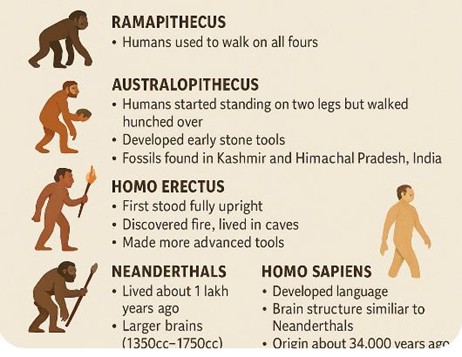
-
- Fossil remains discovered in Kashmir and Himachal Pradesh in India suggest early migration.
- Homo Erectus – The Toolmaker and Fire Discoverer
- Lived roughly 1.5 to 0.5 million years ago.
- First to stand fully upright with a more human-like body structure.
- Discovered and used fire, lived in caves, and created sharper stone tools.
- Showed early signs of community living and hunting strategies.
- Neanderthals – The Intelligent Forerunners
- Thrived around 100,000 years ago across Europe and parts of Asia.
- Had a brain size of 1350cc to 1750cc, often larger than modern humans.
- Practiced burial rituals, art, and were the first to build watercraft.
- Their existence hints at emotional depth and symbolic thinking.
- Homo Sapiens – The Modern Human
- Emerged approximately 34,000 years ago.
- Showed complex thought, developed language, art, religion, and societies.
- Created agriculture, led to settled life, and built the foundation of civilizations.
- Although brain size was similar to Neanderthals, abstract thinking, innovation, and cultural expression set Homo sapiens apart.
Key Evolutionary Traits Across Time
|
Species |
Time Period |
Key Traits |
|
Ramapithecus |
14 million years ago |
Quadrupedal, primitive |
|
Australopithecus |
4–2 million years ago |
Bipedal, basic tool usage |
|
Homo Erectus |
1.5–0.5 million years ago |
Fire use, upright posture, caves |
|
Neanderthal |
100,000 years ago |
Large brain, rituals, early arts |
|
Homo Sapiens |
34,000 years ago |
Language, agriculture, societal life |
From the primal forests of ancient Earth to the complex digital societies of today, the evolution of mankind is not merely a biological process—it is a cultural revolution. Each stage was a stepping stone in the making of a being capable of reason, emotion, imagination, and morality.
- Inamgaon is a significant archaeological site located on the banks of the Ghod River in the Pune district of Maharashtra. It represents the Late Jorwe culture, dating approximately from 1600 BCE to 700 BCE.
- Excavations at the site have uncovered evidence of an agrarian society including residential structures, granaries, burials, pottery, tools, and ornaments. These findings offer crucial insights into the rural life, social systems, and cultural development of prehistoric India.
- Spanning around 5 hectares, the site was continuously inhabited through three major cultural phases:
- Malwa Phase (1600–1400 BCE)
- Early Jorwe Phase (1400–1000 BCE)
- Late Jorwe Phase (1000–700 BCE)
- Notably, public architecture has also been discovered here. These include a fortification wall, a moat, an irrigation canal, and a large dam—all believed to have been constructed during the Early Jorwe Phase.
- Although no direct evidence of human habitation has been found within the large central structure, it contains a pit-like granary, a circular platform-based granary, and two large fire pits, indicating its probable use for storage and communal functions.
- Adjacent to this structure is Inamgaon’s largest residential house, featuring five rooms. In its courtyard, archaeologists found a four-legged jar containing a cross-legged male skeleton with intact feet—a distinctive burial type when compared to other burials at the site where bodies lack feet.
- A similar four-legged jar from an earlier level was discovered without a human skeleton, containing only animal bones and sealed with a bangle lid—interpreted as a symbolic burial.
- In another remarkable burial, two nested clay jars were found containing the skeleton of a two-year-old girl, adorned with a jasper and copper bead necklace—a rare example of ascribed or hereditary status in burial practices.
- In the Late Jorwe Phase, dwellings were primarily circular huts. However, a rectangular four-chambered structure was discovered on the eastern edge of the settlement, containing a double burial (male and female) with intact feet.
Pottery culture refers to a specific archaeological tradition characterized by distinct pottery styles. Based on varying pottery styles and associated tools, pottery cultures in ancient India are classified into the following major types:
- Ochre Coloured Pottery (OCP) Culture (c. 2000–1500 BCE)
- The Ochre Coloured Pottery (OCP) culture is believed to be contemporaneous with the Copper Hoards, and there are indications of interrelation between the two.
- These utensils are fragile, easily break upon touch, and are typically ochre-coloured, hence the name.
- Important Sites: Atranjikhera, Ahichhatra, Saifai, Bisauli, Rajpur, Parsu, Lal Qila, Nasirpur.
- The first copper tools were discovered in 1822 at Bithoor (Kanpur, Uttar Pradesh).
- A significant artefact, ‘Matsyabhaala’, was unearthed at Saifai (Etawah, UP).
- Animal bones have been found at Saifai and Lal Qila (Bulandshahr), along with a bull motif on pottery from Lal Qila.
- OCP evidence has been found at Hastinapur, Shringaverpur, and Noh.
- Five cultural phases emerged from the excavation at Hastinapur:
- Ochre Coloured Pottery Culture
- Painted Grey Ware Culture
- Northern Black Polished Ware (NBPW) Culture
- Kushan Period
- Medieval Period
- The largest copper hoard (424 items) was discovered in Gungeria (Madhya Pradesh).
- Black and Red Ware (BRW) Culture (c. 2000–200 BCE)
- Characterised by the dominance of microlithic tools.
- BRW evidence spans various regions and overlaps with other cultural zones:
- Harappan sites: Rangpur, Lothal (Gujarat)
- Painted Grey Ware overlap: Punjab, Haryana
- OCP and PGW sites: Atranjikhera (UP), Noh (Rajasthan)
- NBPW overlaps: Ujjain, Maheshwar (MP)
- BRW-only sites: South India, Bihar
- Painted Grey Ware (PGW) Culture (c. 1000–600 BCE)
- First identified during 1940–44 excavations at Ahichhatra (Ramnagar, Bareilly, UP).
- This grey pottery tradition spread across Punjab, Haryana, northern Rajasthan, and the Upper Ganga Valley.
- Key Sites: Hastinapur is a notable centre of PGW culture.
- Iron tools have also been found alongside PGW at Bhagwanpura (Haryana) and Atranjikhera (UP).
- Northern Black Polished Ware (NBPW) Culture (c. 800–100 BCE)
- NBPW pottery is made using well-levigated clay and appears wheel-made, thin, and lightweight.
- Found at Hastinapur (Mawana tehsil, Meerut district, UP).
- This culture marks the Second Urban Revolution in ancient India and is linked with the development of iron technology.
- It represents a significant phase of urbanization and socio-economic transformation in early historic India.
Early Life and Background
- Born: August 18, 1700, in Sinnar, Maharashtra.
- Father: Balaji Vishwanath, the first Peshwa of the Maratha Empire under Chhatrapati Shahu.
- Bajirao was well-trained in military tactics, administration, and diplomacy from a young age.
Appointment as Peshwa
- Appointed Peshwa (Prime Minister) at the age of 20 by Chhatrapati Shahu in 1720.
- Chosen for his exceptional military capabilities despite young age and lack of experience.
Military Campaigns and Expansion
- Known for his lightning-fast cavalry tactics and strategic warfare.
- Never lost a single battle in his military career- won around 41 battles.
- Extended Maratha influence beyond Maharashtra into:
- Malwa, Gujarat, Bundelkhand, Delhi and the Deccan.
- Key victories:
- Battle of Palkhed (1728) – Defeated the Nizam of Hyderabad; considered a masterpiece of military strategy.
- Assisted Chhatrasal of Bundelkhand, who rewarded him with land and his daughter Mastani’s hand in marriage.
- Advanced Maratha power up to the Yamuna and Ganges.
Administrative Abilities
- Reorganized revenue collection systems.
- Maintained a strong intelligence network.
- Promoted capable leaders like Malhar Rao Holkar and Ranoji Shinde.
Bajirao and Mastani
- His relationship with Mastani, a Muslim princess, was controversial and opposed by orthodox Brahmins and his own family.
- Despite opposition, he gave Mastani a respected place in his life and court.
Death and Legacy
- Died on April 28, 1740, at Raverkhedi due to illness and exhaustion.
- Left a strong and expanded Maratha Empire for his son Balaji Baji Rao (Nana Saheb).
- Remembered as one of India’s greatest cavalry generals and a key architect of Maratha ascendancy.
- Conservation of Water Bodies: Many rivers and lakes across India have fallen victim to pollution, rendering their water unsuitable for consumption. Untreated sewage stands as the primary source of pollution in these rivers and ponds. The role of ‘National River Conservation Directorate’, operating under the Ministry of Jal Shakti, is to offer financial support to State Governments for the preservation of rivers, lakes and wetlands through centrally sponsored schemes like the ‘National River Conservation Plan’ (NRCP) and the National Plan for Conservation of Aquatic Ecosystem (NPCA).
- Ganga Action Plan–GAP: The Ganga, once renowned for its self-purifying properties where viruses like Bacteriophage naturally consume bacteria, has now become polluted in nearly half of its course. Currently, untreated sewage from over 100 cities with populations exceeding 50,000 is being discharged into the Ganga, along with numerous dead bodies and cremation remains. Approximately 40% of India's population resides in the Ganga basin. In response to this crisis, the Ganga Action Plan (GAP) was initiated in 1985, establishing the Central Ganga Authority (CGA) under the Central Pollution Control Board.
- National River Conservation Plan- In 1995, the Central Ganga Authority (CGA) underwent a name change to become the ‘National River Conservation Authority’ (NRCA). As part of this transition, the Ganga Action Plan was amalgamated into the National River Conservation Plan (NRCP).
- Namami Gange Project- In June 2014, the Central Government allocated ₹20,000 crore for the flagship program named Namami Gange. The primary objective of this program is to conserve, restore and eliminate pollution in the River Ganga. The Namami Gange program focuses on the following key pillars-
- Sewerage Treatment
- Riverfront Development
- Afforestation
- Biodiversity Development
- Public Awareness
- Ganga Gram Scheme
- River Surface Cleaning
- Industrial Effluent Monitoring
In agriculture, green manure refers to subsidiary crops that are specifically cultivated to enhance soil fertility by increasing its nutrient content and adding organic matter. These crops are typically ploughed back into the soil in their green state before they mature. This practice helps replenish the nutrients lost due to continuous farming and improves the overall health and productivity of the soil.
When fresh green plants (especially leguminous crops) or their parts are incorporated into the soil, the process is termed green manuring. This enhances the nitrogen content in the soil and improves its physical, chemical, and biological properties. It also helps in supplying micronutrients and contributes to sustainable agriculture by reducing dependence on chemical fertilizers.
Benefits of Green Manure
- Rich source of nitrogen and other essential nutrients.
- Improves soil structure, aeration, and water retention capacity.
- Helps regulate soil pH and reduces soil erosion.
- Boosts the population and activity of beneficial soil microorganisms.
- Minimizes the incidence of soil-borne diseases.
- Supports sustainable farming practices.
Common Green Manure Crops
Crops such as Sunai (Sunhemp), Dhaincha, Lobia, Urad, Moong, and Guar are commonly used. These leguminous crops grow quickly, require minimal fertilizers and water, and provide abundant organic matter at low cost. Their roots harbor nitrogen-fixing bacteria, which play a vital role in enriching the soil.
Qualities of an Ideal Green Manure Crop
- Low cost of cultivation.
- Requires minimal irrigation and plant protection.
- Fast-growing, weed-suppressing, and adaptable to adverse conditions.
- Efficiently fixes atmospheric nitrogen in a short time.
Balaji Baji Rao, popularly known as Nana Saheb, was the third Peshwa of the Maratha Empire. He succeeded his father Peshwa Baji Rao I in 1740 and held office until his death in 1761.
Early Life and Succession
- Born in 1720 to Peshwa Baji Rao I and Kashibai.
- Educated in administration, military affairs, and statecraft from a young age.
- Became Peshwa at the age of 20, following the death of his father in 1740.
- Appointed with the support of Chhatrapati Shahu due to his father’s legacy.
Expansion of the Maratha Empire
- Played a major role in expanding Maratha power northwards and into central India.
- His tenure marked the peak of Maratha territorial expansion, extending from the Deccan to Delhi and beyond.
- Successfully annexed Bundelkhand, Orissa, Bengal, and parts of Rajputana.
- Under his leadership, Marathas collected Chauth and Sardeshmukhi from large areas of the Mughal empire.
Administration and Governance
- Shifted focus from warfare to administration and revenue collection.
- Promoted civil administration and financial reforms to stabilize the growing empire.
- Encouraged the rise of regional Maratha leaders like the Scindias, Holkars, and Gaekwads.
- Strengthened Maratha presence in Malwa, Gujarat, and North India.
Third Battle of Panipat (1761)
- Sent his cousin Sadashivrao Bhau to lead the Maratha campaign against Ahmad Shah Abdali.
- The defeat at Panipat led to a severe blow to Maratha power and prestige.
- The loss deeply affected Nana Saheb, both emotionally and politically.
Death and Legacy
- Died shortly after the Battle of Panipat, in 1761, due to shock and grief.
- Remembered as a visionary statesman and skilled administrator.
- His reign marked the zenith of Maratha power before its decline in the north.
- Balaji Vishwanath is regarded as the second founder of the Maratha Empire due to his pivotal role in consolidating Maratha power.
- He began his career as a councillor in Pune in 1696 and later rose to the post of Sarsubedar. Notably, during this period, Aurangzeb was stationed in the Deccan, and Balaji is believed to have assisted in logistical support, which might explain why Aurangzeb did not take any punitive action against him.
- After the coronation of Shahu as king, two power centers existed: Shahu ruled from Satara while Tarabai ruled from Kolhapur.
- Shahu created the new post of ‘Senakarte’ (Military Organizer) and appointed Balaji Vishwanath to the position, reflecting his growing influence.
- Balaji allied with the Sayyid Brothers to overthrow the Mughal Emperor Farrukhsiyar, leading to a significant treaty with the following key provisions:
- Swarajya of Shivaji Maharaj would be restored to Shahu.
- Territories conquered by the Marathas would be acknowledged as Shahu’s dominion.
- Marathas would receive rights to Chauth and Sardeshmukhi in the Deccan, in exchange for which 15,000 Maratha horsemen would serve under the Mughals.
- Shahu would not attack Shambhuji II of Kolhapur.
- The Marathas would pay an annual tribute of ₹10 lakhs to the Mughal Emperor.
- Shahu’s mother and other family members would be released.
- Following the coup, the Mughal ruler Rafi-ud-Rajat ratified this treaty.
- British historian Richard Temple referred to this agreement as the “Magna Carta of the Marathas”, signifying its historic importance.
- The treaty gave the Marathas leverage to intervene in Mughal politics, a turning point in Indian history. Balaji Vishwanath marched to Delhi with 15,000 troops to assist the Sayyid Brothers in deposing Farrukhsiyar.
- His cordial relations with Kanhoji Angre, the powerful Maratha naval commander, were instrumental in securing Maratha coastal dominance.
- Upon Balaji Vishwanath’s death in 1720, Shahu appointed his son, Bajirao I, as the next Peshwa, continuing the legacy of Maratha expansion.
- Carnatic music is a classical music tradition of South India, primarily devotional in nature. Most compositions are addressed to Hindu deities.
- In the Tamil language, the word ‘Karnataka’ signifies something ancient, traditional, and pure. The earliest usage of the term is found in ‘Brihaddesi’, a composition by Matanga Muni, where a raga named ‘Karnat’ is mentioned. Later, Nanyadeva used the term in his book ‘Bharatavartika’.
- During the Bhakti movement (13th century), thousands of devotional songs were composed in local languages like Telugu, Tamil, and Kannada, using regional ragas. The language was kept simple to ensure mass understanding.
- From the 14th to 16th century, scholars like Vidyaranya, Ramamatya, and Vitthala helped popularize this music. Bhadrachala Ramadasu, a 17th-century saint-poet, contributed significantly with his Telugu compositions.
- The 18th–19th centuries marked a revolutionary phase with the rise of the Trimurti (or Trimani) of Carnatic music:
- Tyagaraja (famous for Pancharatna Kriti, mostly in Telugu, praising Lord Rama)
- Muttuswami Dikshitar (dedicated many works to Lord Subramaniam)
- Shyama Shastri (composed in rare ragas like Manji and Chintamani, known for Navaratnamalika in praise of Goddess Meenakshi)
- Like the Mughal emperors in the north, southern kings also patronised music. Notably, Swati Tirunal Rama Varma (1813–1846) of Travancore composed varnams, padams, and javalis in Carnatic style.
- Padam expresses spiritual love, and Javali includes romantic themes, similar to bhajans and ghazals in Hindustani music.
- Tillana, a popular rhythmic piece, is comparable to Tarana in Hindustani style.
- Purandar Das (1484–1564) is regarded as the 'Pitamah of Carnatic music' and believed to be an incarnation of Narada.
- Most Carnatic compositions follow a three-part structure: Pallavi, Anupallavi, and Charanam.
- The main forms of Carnatic music include:
Alankaram, Lakshana Geetam, Swarajathi, Alapanam, Kalpana Swaram, Pallavi, Tillana, Padam, Javali, Bhajanam, Ragamalika, etc.
The Ramosi Revolt was a series of tribal uprisings by the Ramosi community in the Deccan region, particularly in parts of present-day Maharashtra. These revolts were directed primarily against British colonial policies and local exploitation. The revolt represents one of the early expressions of anti-colonial tribal resistance in India.
Background
- Who were the Ramosis?
The Ramosis (also known as Berads) were traditionally watchmen and soldiers in the Maratha military system. They served as local guardians of villages and forts during the Peshwa rule. - Post-Peshwa Decline:
With the decline of Maratha power after the Third Anglo-Maratha War (1818) and the establishment of British rule, the Ramosis lost their military and social status, leading to economic hardship and discontent.
Causes of the Revolt
- Loss of Employment:
The British disbanded the local militias, including Ramosis, depriving them of their traditional role and income. - Land Revenue Policies:
Harsh land revenue systems, coupled with famine and poverty, worsened their condition. - Disrespect for Traditional Rights:
British authorities failed to acknowledge the Ramosis’ earlier status, treating them as mere criminal tribes, thus fuelling resentment. - Tribal Solidarity:
The revolt was also driven by a desire to protect their tribal identity and autonomy.
Phases of Revolt
First Revolt (1822–29)
- Led by Chittar Singh, the Ramosis attacked British establishments and treasuries, particularly in Satara and Pune regions.
- Their revolt was guerrilla in nature, making it difficult for British forces to suppress.
- The British used military force and administrative repression to quell the uprising.
Second Revolt (1879)
- A renewed Ramosi uprising occurred under the leadership of Vasudev Balwant Phadke, a social reformer and revolutionary.
- Phadke attempted to mobilize the Ramosis and other marginalized groups to overthrow British rule and restore Swarajya.
- The revolt was suppressed, and Phadke was captured in 1883.
Significance
- One of the first tribal uprisings in the Deccan against the British.
- Highlights the impact of colonial economic and administrative policies on indigenous communities.
- The second phase connects tribal revolts with the emerging Indian nationalist movement.
- Reflects the resistance of marginalized communities to imperial rule and socio-economic exploitation.
- The Indian Institute of Mass Communication (IIMC) was established on 17 August 1965 with the assistance of UNESCO.
- It is India’s premier media training institute, functioning under the Ministry of Information and Broadcasting, Government of India.
- IIMC is an autonomous institution, registered under the Societies Registration Act, 1860.
Headquarters and Regional Campuses
- The headquarters of IIMC is located in New Delhi.
- It has five regional centers in:
- Aizawl (Mizoram)
- Amravati (Maharashtra)
- Dhenkanal (Odisha)
- Kottayam (Kerala)
- Jammu & Kashmir
Faculty and Infrastructure
- IIMC is widely recognized for its experienced and permanent faculty and state-of-the-art infrastructure.
- The faculty-to-student ratio is 1:8, which is considered superior to most media institutions in the country.
Academic Programs
- IIMC offers one-year Postgraduate Diploma courses in the following fields:
- Journalism in Hindi, English, and Oriya
- Advertising and Public Relations
- Radio and Television Journalism
- Photo Journalism
- Training is provided across all forms of media, including:
- Print Media
- Photo Journalism
- Radio and TV Journalism
- Communication Research
- Advertising and Public Relations
Specialized Training
- Indian Information Service (IIS) officers receive professional training at IIMC.
- It also conducts special courses in Development Journalism for participants from non-aligned and other developing countries.
Plastic pollution refers to the accumulation of plastic materials on land or in water. It has harmful effects on both wildlife and humans.
Types of Plastic
1. Microplastics or Microbeads
- These are plastic particles or fibers smaller than 5 mm.
- They are made from polythene, polypropylene, polyethylene terephthalate, and nylon.
- Commonly found in products like face wash, body lotion, toothpaste, soap, and scrubs.
- They are non-biodegradable and flow through drainage systems to seas and oceans, posing a threat to marine life.
2. Macroplastics
- These are plastic particles larger than 5 mm and up to 100 cm.
- Also known as long plastic particles, they are equally harmful to the marine ecosystem.
Plastic Pollution in India
According to the Supreme Court,
"We are sitting on a plastic bomb."
This was based on a report by the Central Pollution Control Board (CPCB), which states:
- India generates 5.6 million tons of plastic waste every year.
- Delhi alone contributes 689.5 tons daily.
Sources of Plastic Waste in India
- Chips & Confectionary Bags- 18.6%
- Bottles/Caps Lids- 11.9%
- PET Beads- 10%
- Supermarket/Retail Bags- 7.4%
- Straws- 7.0%
- Garbage Bags- 6.7%
- Packaging- 6.7%
- Food Bags- 5.2%
- Cling Wrap- 4.0%
- Fruit Juice Bottles- 3.4%
- Water/Soft Drink Bottles- 2.6%
- Cups/Utensils- 2.2%
- Food Containers- 1.7%
- Milk Bottles- 1.6%
- 6 Pack Rings- 1.4%
- Cigarette- 1.2%
Effects of Plastic Pollution
Plastic pollution affects humans, animals, land, and the natural environment.
Effect on the Environment
- Plastic debris is widely spread by wind, ocean currents, trade routes, and urban activities.
- This leads to widespread environmental damage and waste accumulation.
Effect on Land
- Caused by both physical blockage and chemical contamination.
- Plastic waste reduces soil fertility by blocking absorption of minerals, water, and nutrients.
Effect on Water and Air
- Burning plastic releases toxic gases like carbon monoxide, dioxin, and hydrogen cyanide.
- These gases negatively affect the respiratory system, nervous system, and immune function.
- When dumped into water bodies, plastic enters the food chain and poses serious risks to human health.
Effect on Marine Life
- Plastic in oceans severely affects marine ecosystems.
- Many aquatic animals such as birds, turtles, seals, and whales accidentally ingest plastic, mistaking it for food.
- This leads to internal blockage, toxic effects, and often death.
- The quantity and quality of water present in the lithosphere significantly affect the survival of plants and soil organisms. It helps form a soil solution by dissolving nutrients available in the soil.
- The amount of water in soil is determined by two main factors:
- Infiltration rate of rainwater or glacial meltwater into the soil
- Water retention capacity of the soil
Stages Based on Soil Water Content:
Depending on the proportion of solids, water, and air in the soil volume, three main stages are identified:
- Saturated Stage:
All pore spaces in the soil are completely filled with water, leaving no room for air. At this stage, the soil cannot absorb any more water. - Field Capacity Stage (Most Favourable):
When 50% of the pore spaces are filled with water and 50% with air, the soil is said to be at field capacity. This is the ideal condition for plant growth. - Wilting Stage:
After evaporation and absorption by plant roots, soil moisture drops to a level where it can no longer support plant life. This is called the wilting point, where plants begin to wilt due to lack of water.
Note: Both saturated and wilting stages are unfavorable for plants and soil organisms. The most suitable condition lies between the field capacity and wilting point.
Types of Soil Water:
- Gravitational Water:
After heavy rain, water that moves quickly through soil due to gravity is called gravitational water. It reaches deep underground and is not available to plants. - Capillary Water (Most Useful for Plants):
Water held in the pore spaces between soil particles due to surface tension. This water is readily absorbed by plant roots. - Hygroscopic Water:
A thin layer of water vapor tightly bound to soil particles. This water is not available to plants as roots cannot absorb it. - Chemically or Crystalline Combined Water:
Water that is chemically bonded within the mineral structure of soil particles. This water is also unavailable to plants.
Radiative forcing refers to the change in the energy balance of the Earth’s climate system due to internal or external factors. These changes can positively or negatively affect global temperatures. Radiative forcing is also known as climate forcing.
Climate Forcing Factors
Climate forcing can be both natural and anthropogenic (human-induced) in origin:
Natural Forcing
- Variations in the solar irradiance (amount of energy emitted by the sun)
- Gradual changes in Earth's orbit
- Volcanic eruptions that release ash and aerosols
Human-Induced Forcing
- Emissions of greenhouse gases (e.g., CO₂, CH₄)
- Aerosols released from the combustion of fossil fuels
- Land use changes, such as deforestation
Types of Climate Forcing
- Positive Forcing:
Leads to warming of the Earth.
Example: Increase in greenhouse gases and solar radiation. - Negative Forcing:
Leads to cooling of the Earth.
Example: Aerosols from volcanic eruptions and industrial pollution.
Factors Affecting Radiative Forcing
Aerosols
Aerosols are tiny atmospheric particles composed of dust, ash, sulphates, acids, or organic matter.
- They generally cause negative forcing, reducing solar radiation reaching the Earth’s surface.
- However, some dense or dark aerosols (e.g., black carbon) may contribute to positive forcing by absorbing sunlight.
Natural Aerosols
Produced by volcanic eruptions, these aerosols cool the atmosphere.
- Large eruptions can impact global temperatures for a year or more until sulphate aerosols settle.
Anthropogenic Greenhouse Gases
These are the main contributors to positive forcing.
- Carbon dioxide (CO₂) from fossil fuel burning is the largest contributor, accounting for over half of the total positive radiative forcing since the pre-industrial period.
Green Carbon and Blue Carbon are important types of carbon sinks, meaning they absorb and store atmospheric greenhouse gases, unlike Black and Brown Carbon, which contribute to pollution.
Green Carbon
Green Carbon refers to the carbon captured from atmospheric CO₂ through photosynthesis and stored in plants and soil. It forms the living component of the global carbon cycle.
- This carbon is temporarily stored in crops and plants, which have a short life span, and is released back into the atmosphere after their decomposition.
- However, forests, due to their long-lived biomass, can store green carbon for several centuries, making them significant in long-term carbon sequestration.
Blue Carbon
Blue Carbon is the carbon absorbed and stored by coastal and marine ecosystems, such as mangrove forests, seagrass beds, and intertidal salt marshes.
- These ecosystems trap atmospheric CO₂ through primary producers like aquatic plants, which then deposit the carbon into sediments, creating complex and long-lasting carbon reserves.
- According to a 2009 UNEP report, 55% of atmospheric carbon is absorbed by the oceans, and 50–71% of that is captured by marine vegetation, also known as Blue Carbon Habitats.
- These habitats, though covering less than 0.5% of the ocean floor, play a vital role in mitigating global climate change.
- Following UNEP’s findings, organizations like the IUCN and World Bank also released supporting reports, which led to the launch of the Blue Carbon Initiative under UNEP’s leadership.
The Bar Council of India (BCI) is a statutory body established by the Parliament under the Advocates Act, 1961.
The primary objective of its formation is to set standards for the legal profession and oversee the regulation of advocates across India.
It is also responsible for prescribing standards of legal education and providing financial assistance to universities offering law degrees.
Key Functions:
- Formulates procedures for the disciplinary committees of both the Bar Council of India and State Bar Councils.
- Ensures protection of the rights, privileges, and interests of advocates.
- Promotes legal reforms to improve the justice delivery system.
- Handles the resolution of cases referred by any State Bar Council.
- Organizes legal seminars and discussions, often with the participation of renowned judges.
- Works towards providing legal aid to the economically weaker sections of society.
Introduction
- Sir Mokshagundam Visvesvaraya was an eminent engineer, administrator, and a visionary who played a key role in shaping modern India.
- He made significant contributions to nation-building through his work in engineering and public administration.
Awards and Recognition
- Awarded the Bharat Ratna in 1955, India's highest civilian honour.
- 15th September, his birthday, is celebrated every year in India as Engineer’s Day.
Major Contributions in Engineering
- Implemented a complex irrigation system in South India, enhancing agricultural productivity.
- Developed an innovative block system using steel sluice gates to control dam water flow.
- This system was highly praised and is still used globally.
Key Infrastructure Projects
Despite limited resources and technology, he successfully executed the following landmark projects:
- Krishnaraja Sagar Dam
- Mysore Iron and Steel Works (now Visvesvaraya Iron and Steel Limited)
- Mysore Sandal Oil and Soap Factory
- Mysore Paper Mills
- State Bank of Mysore
- Federation of Karnataka Chambers of Commerce and Industry
Role as Diwan of Mysore (1912–1918)
- As the Diwan (Prime Minister) of Mysore, he encouraged private investment in industry.
- Known as the Father of Modern Mysore State for his developmental reforms and modernization efforts.
Other Contributions
- Contributed to the planning and construction of the road between Tirumala and Tirupati.
- Appointed to a British committee for irrigation reform, where he introduced technological advancements.
Literary Contributions
- Authored the following works, which guided India's economic thought:
- Reconstruction of India (1920)
- Planned Economy for India (1934)
The Pradhan Mantri Poshan Yojana is a centrally sponsored scheme that replaces the existing Mid-Day Meal Scheme in schools. It has been launched for an initial period of five years (2021–22 to 2025–26).
Key Coverage
- The scheme will cover 11.8 crore students enrolled from Classes I to VIII in more than 11.2 lakh schools across the country.
- Children in primary (Class 1–5) and upper primary (Class 6–8) currently receive 100 grams and 150 grams of foodgrains per working day respectively, providing a minimum of 700 calories.
- It also includes pre-primary or Balvatika students in government and government-aided schools.
Important Components
- Balvatikas: Introduced in 2020, these are pre-schools in government schools to integrate children under six years into the formal education system.
- Nutrition Gardens: Schools will establish nutrition gardens to supply additional micronutrients.
- Supplementary Nutrition: Focus on aspirational districts and anemic children, providing additional dietary support.
- No Central Funding Restrictions: Earlier limitations on funding ingredients like milk or eggs have been removed.
- Tithi Bhojan: A new concept where students of private schools are encouraged to share meals with marginalized children once a month.
- Community Participation: States are encouraged to organize community-led initiatives to provide special meals.
Administrative Reforms
- Direct Benefit Transfer (DBT): States/UTs are mandated to provide honorariums to cooks and helpers through DBT for transparency.
- Nutritionist Appointment: Every school is required to have a nutritionist responsible for monitoring BMI, weight and hemoglobin levels of students.
- Social Audit: Mandatory for every school, social audits will ensure regular monitoring and assessment of the scheme’s implementation.
- Involvement of Higher Education: Students from colleges and universities will be engaged in local-level monitoring of the program.
Hockey has always been a symbol of pride and tradition in India. Adding a new chapter to this legacy, Bihar is set to host the 12th Men’s Asia Cup Hockey Championship 2025 for the very first time. This event is not only a matter of honor for the state but also for the entire nation, as the tournament will serve as a qualifier for the 2026 Hockey World Cup.
- Key Highlights
- Bihar Chief Minister Nitish Kumar unveiled the official logo, mascot, and trophy of the tournament.
- He also flagged off the “Trophy Pride Journey,” a symbolic torch relay that will travel across all districts of Bihar before the grand event.
- The tournament is expected to give a new identity to Bihar’s sports culture and tourism.
- Tournament Details
- Dates: August 29, 2025 (National Sports Day & Major Dhyan Chand Jayanti) – September 7, 2025
- Venue: Rajgir International Stadium, Bihar
- Significance: First-ever hosting of this prestigious tournament by Bihar
- History: Rajgir will be hosting its second international sports event, after the 2024 Women’s Asian Champions Trophy.
- Participating Teams: India, China, Japan, Chinese Taipei, Malaysia, South Korea, Oman, and Bangladesh
- Importance: The tournament will act as a qualifier for the FIH Men’s Hockey World Cup 2026 (to be hosted by Belgium and the Netherlands). The winning team will directly secure a spot in the World Cup.
- Mascot – “Chand”
- The official mascot “Chand” is inspired by the Royal Bengal Tiger, India’s national animal, symbolizing courage, power, and agility.
- It draws inspiration from legendary hockey wizard Major Dhyan Chand.
- Key design features include:
- Red Cape – representing strength
- Magician’s Hat – honoring Dhyan Chand’s extraordinary talent and his title as “The Magician of Hockey”
12th Men’s Asia Cup Hockey Championship 2025 is a historic sporting milestone for Bihar. Beyond the excitement of the matches, it represents the revival of Indian hockey’s golden legacy while positioning Bihar prominently on the global sports map. The event will inspire the next generation of players and serve as a fitting tribute to Major Dhyan Chand’s enduring legacy.
- The Solid Waste Management Rules, 2016 have replaced the Municipal Solid Waste (Management and Disposal) Rules, 2000.
- As per the new rules, segregation of waste at the source into dry and wet waste is mandatory.
- These rules are applicable to all local bodies and urban agglomerations across the country.
- The polluter is responsible for categorizing waste into three types:
- Biodegradable
- Non-biodegradable
- Domestic hazardous waste and must hand it over to the authorized waste collector appointed by the local body.
- A user fee, as determined by local bodies, will be paid by the waste generator (polluter) in accordance with municipal regulations.
- The rules clearly assign responsibilities to various stakeholders, including:
- Ministry of Environment, Forest and Climate Change
- Ministry of Housing and Urban Affairs
- Ministry of Chemicals and Fertilizers
- Ministry of Agriculture and Farmers Welfare
- District Magistrates
- Gram Panchayats
- Urban Local Bodies
- State Pollution Control Boards, etc.
- Local bodies are entrusted with several key responsibilities:
- Door-to-door waste collection
- Regulation and enforcement
- Fixing and collecting user charges
- Promotion of waste treatment techniques like:
- Biomethanation
- Microbial composting
- Vermicomposting
Bird migration is the seasonal movement of birds from one region to another due to changes in weather and unfavorable environmental conditions. Many bird species exhibit this behavior by migrating to regions with favorable climates, adequate food, and better breeding environments. Once conditions return to normal, they return to their native habitats. These migrations can span thousands of kilometers. Some birds migrate in summer, while others migrate in winter.
Reasons for Migration
- Adverse climatic conditions
- Shortage of food and water in their current habitat
- Breeding and suitable health conditions
- Protection of nests from predators or encroaching animals
Birds Migrating in Winter
- Siberian Crane
- Greater Flamingo
- Eurasian Teal
- Yellow Wagtail
- White Wagtail
- Northern Shoveler
- Rosy Pelican
- Wood Sandpiper
- Spotted Sandpiper
- Eurasian Pigeon
Birds Migrating in Summer
- Asian Koel
- European Golden Oriole
- Comb Duck
- Cuckoos
- Blue-tailed Bee-eater
Introduction
- Marine biotechnology refers to the exploration of marine organisms and the development of useful products for human benefit derived from them.
- In other words, it encompasses all biotechnological efforts that utilize marine biological resources for human welfare.
Scientific Significance
- Marine biodiversity and biotechnology have enabled scientists to better understand the evolution and unique adaptations of marine organisms.
- As many marine organisms thrive in extreme conditions—such as absence of light, high pressure, and elevated temperatures—they have become valuable in the development of specialized medicines and enzymes.
Medical Applications
- Ongoing research in marine biotechnology has led to the development of numerous drugs.
- For example, antiviral medications like Zovirax (Generic name: Acyclovir), developed from Caribbean marine organisms, have shown significant success.
Applications of Marine Biotechnology
- Drug Development
- Marine organisms such as seaweeds and invertebrates have contributed to the creation of novel medicines.
- This includes progress in cancer treatment, particularly using marine-derived compounds.
- Food Industry
- Enzymes extracted from fish and other marine species are often more efficient and beneficial than conventional enzymes used in food processing.
- Collagen and gelatin proteins derived from fish are effective in preserving food at lower temperatures.
- Industrial Applications
- Microscopic algae found in marine environments can be used to produce biopolymers, which are instrumental in oil extraction processes.
- Cancer Treatment
- Dolastatin, a compound discovered in the Indian Ocean, has shown promising results in treating breast cancer and other forms of cancer.
A modern and efficient method of managing carbon is Carbon Sequestration, which is gaining significant popularity. Capturing carbon dioxide (CO₂) or other forms of carbon and storing them for long durations to mitigate global climate change is known as carbon sequestration. This process is also referred to as CCS (Carbon Capture and Storage).
In this technique, carbon dioxide is captured using geo-engineering from power plants, industrial sites, and even directly from the atmosphere, and then stored underground. This process prevents a large volume of CO₂ from entering the atmosphere, storing it instead in carbon sinks.
Anything that absorbs more carbon than it emits is called a Carbon Sink.
These are of two types:
- Natural Sinks – Oceans, forests, and soil.
- Artificial Sinks – Depleted oil reserves and unmined mines.
Use of Carbon Capturing
Carbon capturing has been used for decades in the oil and gas industry to enhance extraction. Today, its environmental benefits have brought it to the forefront of climate discussions.
Three Key Stages of Carbon Capturing
- Trapping and Separating – CO₂ is separated from other gases.
- Transportation – The captured CO₂ is transported to a designated storage site.
- Storage – The CO₂ is stored deep underground or underwater, away from the atmosphere.
Three Methods of Capturing CO₂ from Power Plants
a. Pre-Combustion
- CO₂ is captured before fuel is burned.
- Produces hydrogen as a by-product.
- Most complex technology, still in development phase.
b. Post-Combustion
- CO₂ is captured after the fuel is burned.
- Most expensive method, but widely used and commercially available.
c. Oxyfuel Combustion
- Fuel is burned in pure oxygen.
- All resultant gases are captured and stored.
- Most cost-effective.
- Highly suitable for coal-based plants, but still requires further advancement.
- When Prime Minister Jawaharlal Nehru initiated nuclear research in independent India, Dr. Homi Jehangir Bhabha was appointed as the first Chairman of the Atomic Energy Commission. Initially, India adopted the principle of ‘Atoms for Peace’, focusing on the peaceful use of nuclear energy.
- However, after the 1971 Bangladesh crisis, and recognizing the possibility of China supporting Pakistan in nuclear development, India began to reconsider its nuclear policy seriously. Notably, China had already become a nuclear power in 1964 by conducting its first nuclear test.
- In response to geopolitical shifts, particularly growing ties between China and the U.S., India conducted its first nuclear test in 1974 at Pokhran, code-named ‘Operation Smiling Buddha’. India clarified it was a Peaceful Nuclear Explosion (PNE).
- India has refused to sign the 1968 Nuclear Non-Proliferation Treaty (NPT), viewing it as discriminatory, since it recognizes only five nuclear weapon states (U.S., U.K., France, China, Russia).
- During 1991–96, PM P.V. Narasimha Rao considered nuclear testing but did not proceed. Later, in May 1998, under Prime Minister Atal Bihari Vajpayee, Pokhran-II was conducted secretly, after which India officially declared itself a nuclear weapon state.
- India has not signed the Comprehensive Nuclear-Test-Ban Treaty (CTBT) either.
- India’s nuclear policy is guided by:
- Credible Minimum Deterrence
- No First Use Policy
- Massive retaliation in case of nuclear attack to neutralize enemy capability
- Retaliation decisions lie solely with the Nuclear Command Authority
- Support for global nuclear disarmament, emphasizing non-discriminatory frameworks
- Use of nuclear weapons remains an option in response to nuclear or biological attacks
- Strict export control of nuclear and missile technology and materials
- This doctrine emphasizes transparency, accountability, and robustness, reflecting India’s sovereign and democratic values.
Early Life and Background
- Born in 384 BCE in Stagira, Macedonia.
- Belonged to an elite family.
- Father Nicomachus was the royal physician at the court of King Amyntas of Macedonia.
- Received early training in medicine and biology.
Education and Association with Plato
- At the age of 17, Aristotle joined Plato’s Academy in Athens.
- Remained associated with the Academy for nearly 20 years.
- After Plato’s death, he left the Academy and traveled to different regions.
Tutor to Alexander the Great
- Invited by King Philip II of Macedonia to tutor his son, Alexander.
- Taught Alexander the Great for around three years.
Personal Life
- Married Pythias, the niece of Hermias (ruler of Atarneus).
- After Pythias' death, lived with Herpyllis, with whom he had a son, Nicomachus.
Establishment of the Lyceum
- In 335 BCE, returned to Athens and founded his own school called the Lyceum.
- The Lyceum was modeled after Plato’s Academy and became the second most important philosophical school in Athens.
- Aristotle’s method of teaching involved walking while lecturing, giving rise to the term “Peripatetic School”.
Controversy in Athens
- Faced charges of impiety in Athens for composing a hymn in honor of Hermias, depicting him in a divine manner.
- To avoid persecution, Aristotle left Athens, saying, "I will not allow the Athenians to sin twice against philosophy" (referring to Socrates' fate).
Major Works of Aristotle
- Physics
- Metaphysics
- Politics
- The Nicomachean Ethics
- De Anima (On the Soul)
- Poetics
- Rhetoric
- Categories
- Topics
- Prior Analytics
- Posterior Analytics
- On Memory and Recollection
- Athenian Constitution
- Eudemian Ethics
- Virtues and Vices
Contribution and Legacy
- Known as the “Father of Western Philosophy”.
- Contributed extensively to logic, ethics, politics, biology, metaphysics and poetry.
- Pioneered the scientific method and empirical research.
- His teachings influenced Islamic, Christian and Western thought for centuries.
Overview
- The Cuban Revolution was the most significant event in Latin America during the 1950s, which deeply influenced radical and leftist movements across the region.
Key Developments
- On 1 January 1959, military dictator Fulgencio Batista, a close ally of the United States, fled Cuba.
- Fidel Castro, who led the revolutionary movement, then established a new government.
- Initially, the revolution was not communist in nature, and Castro himself was not a communist.
- However, after the government began radical land reforms and nationalized foreign-owned companies, the United States opposed these actions.
- Eventually, Castro and his allies merged with other communist factions, leading to the formation of the Communist Party of Cuba.
- The United States, Cuba’s primary sugar importer, imposed economic sanctions by halting sugar imports, aiming to cripple Cuba's economy.
- In response, Cuba developed close ties with the Soviet Union, marking a significant realignment during the Cold War.
- The CIA made several failed attempts to assassinate Fidel Castro.
- Despite these efforts and economic hardships caused by U.S. sanctions, Cuba resisted foreign intervention and remained committed to its path.
Role of Che Guevara
- The most iconic and inspiring figure of the Cuban Revolution was Che Guevara, a Marxist revolutionary from Argentina.
- In 1956, he joined Fidel Castro's guerrilla movement, playing a key role in overthrowing Batista's regime.
- After the revolution, Che Guevara became a minister in the Cuban government but later left Cuba in 1965 to support revolutionary movements abroad.
- In 1967, Che was captured and executed in Bolivia, but he emerged as a symbol of rebellion and inspiration for radical youth worldwide.
Legacy
- Fidel Castro remained a prominent leader in Cuba for decades.
- He passed away on 25 November 2016, marking the end of an era in Latin American political history.
- Meghnad Saha was a renowned Indian astrophysicist and astronomer, known for his unforgettable contributions to the field of astronomy.
- He is best known for proposing the theory of thermal ionization, which laid the foundation for understanding the formation and chemical composition of stellar atmospheres. This theory is considered a milestone in astrophysics.
- The impact of his research was far-reaching, as many later studies in astronomy were based on his groundbreaking theories.
- Apart from being a scientist, Saha was also a freedom fighter. He joined the Anushilan Samiti to participate in India’s independence movement and was closely associated with nationalist leaders like Subhas Chandra Bose and Dr. Rajendra Prasad.
- He was appointed Chairman of the Calendar Reform Committee by the Government of India, which worked to unify the diverse calendars used across the country.
- In 1927, Saha was elected a Fellow of the Royal Society of London, a highly prestigious recognition in the global scientific community.
- While his scientific contributions were monumental, he is equally remembered for establishing key scientific institutions that laid the foundation of modern science in India.
- In 1933, he founded the Indian Physical Society in Calcutta (now Kolkata).
- In 1935, together with Acharya Prafulla Chandra Roy, he established the Indian Science News Association, aimed at making science accessible to the general public.
- In 1949, he founded the Institute of Nuclear Physics, which was later renamed the Saha Institute of Nuclear Physics in his honor.
- A true visionary, Prof. Saha believed in the scientific and industrial development of India. The Damodar Valley Project, designed for flood control and irrigation, was the result of his foresight.
- To further his goals, he also entered Parliament, where he advocated for industrial development, scientific advancement, and economic transformation of the nation.
- Emergency provisions are detailed from Articles 352 to 360 in Part XVIII of the Indian Constitution.
- Under normal conditions, India functions as a federal system, but during an emergency, it adopts a unitary form.
- These provisions were included to safeguard the sovereignty, unity, integrity, and the democratic-political system of the country.
- The emergency provisions are a distinctive feature of the Indian Constitution. The administrative framework during emergencies is inspired by the Government of India Act, 1935, while the suspension of fundamental rights is borrowed from the Weimar Constitution of Germany.
Classification of Emergency (Article-wise):
- National Emergency – Article 352
- President’s Rule (Failure of constitutional machinery in states) – Article 356
- Financial Emergency – Article 360
National Emergency
Proclamation of National Emergency
- As per Article 352, if the security of India or any part thereof is threatened by war, external aggression, or armed rebellion, the President may proclaim a national emergency.
- Initially, the term used was "internal disturbance", which was later replaced with "armed rebellion" by the 44th Constitutional Amendment Act, 1978.
Procedure and Duration
- The President can proclaim a national emergency only on the written advice of the Union Cabinet (not just the Prime Minister), as mandated by the 44th Amendment Act, 1978.
- The proclamation must be approved by both Houses of Parliament within one month, by:
- Majority of the total membership, and
- Two-thirds majority of members present and voting.
- Once approved, it remains in force for six months and can be extended with further parliamentary approval.
Effects of National Emergency
- Centre-State Relations: The central government assumes greater control over states.
- Executive Powers: The Union Executive gains sweeping powers.
- Legislative Powers: Parliament can legislate on subjects in the State List.
- Financial Impact: The Union can modify distribution of financial resources.
- Tenure Extension: The tenure of the Lok Sabha and State Legislative Assemblies can be extended by one year at a time.
- Fundamental Rights:
- Article 358: Automatically suspends the rights under Article 19.
- Article 359: The President may suspend the enforcement of other Fundamental Rights (except Articles 20 and 21).
Termination of Proclamation
- The President may revoke the proclamation at any time.
- It also ceases automatically if not ratified by Parliament within one month.
- The Lok Sabha may revoke it by a simple majority resolution.
- Acharya Prafulla Chandra Roy, founder of Bengal Chemicals, is widely regarded as the Father of Indian Chemistry.
- His notable works include the History of Hindu Chemistry. His autobiography, Life and Experiences of a Bengali Chemist, published in two volumes, is among his finest contributions. This work not only sheds light on his personal journey but also provides insights into the intellectual history of Bengal and India.
- He was among the first Indian students to receive the Gilchrist Scholarship, and in 1887, he earned the prestigious Doctor of Science (D.Sc.) degree.
- While preparing water-soluble mercurous nitrate as an intermediate to explore unknown elements of Mendeleev’s periodic table, he systematically analyzed many rare minerals. During this research, he discovered mercurous nitrite in 1896, a compound previously unrecognized by the scientific community.
- He later remarked that the discovery of mercurous nitrite marked a new chapter in his life. Another significant contribution was the production of pure ammonium nitrite.
- In 1911, the British government honoured him with the title of ‘Knight’ for his scientific contributions.
- In 1933, Pandit Madan Mohan Malviya, founder of Banaras Hindu University, awarded him an honorary D.Sc. degree in recognition of his achievements.
- Acharya Prafulla Chandra Roy was not only a renowned scientist but also a visionary educationist and a key architect of modern India.
Background and Accession
- The founder of the Khilji Dynasty was Jalaluddin Khilji.
- Alauddin Khilji ascended the throne in 1296 after assassinating Jalaluddin.
- He was crowned in Balban’s Lal Mahal and assumed the title of Sultan from the Caliph to legitimize his rule.
Important Campaigns and Conquests
- In 1299, Alauddin invaded Gujarat, where he purchased Malik Kafur, who later became his trusted general.
- In 1301, he defeated Hammir Dev of Ranthambore; the Jauhar of Ranthambore was described by Amir Khusrau.
- In 1303, he defeated Rana Ratnasingh of Chittor and renamed it Khizrabad, assigning it to his son Khizr Khan.
- Southern Campaigns (1308–1311): Under Malik Kafur, Alauddin's forces attacked:
- Devagiri (Yadavas)
- Warangal (Kakatiyas) – defeated Prataparudra II and obtained the Kohinoor diamond
- Hoysala and Pandya kingdoms
- Took the title ‘Sikandar-e-Sani’ (Second Alexander).
Mongol Threats and Defence
- Faced the highest number of Mongol invasions during his reign.
- Built the Siri Fort (1304) in Delhi as a defensive measure.
Revenue and Land Reforms
- First Delhi Sultan to initiate land measurement (Masahat) for revenue assessment.
- Land revenue was fixed at 50% of the produce.
- Abolished intermediaries like Khuts, Muqaddams, and Chaudharys to directly collect revenue.
- Introduced ‘Ghari’ (house tax) and ‘Charai’ (grazing tax).
- Reversed the traditional Khams system:
- State: 4/5 share
- Soldiers: 1/5 share
- Established ‘Diwan-e-Mustakhraj’ to recover unpaid revenues.
Market Control Policy
- Implemented a market regulation system to ensure low prices for military needs.
- Formed a special department called ‘Diwan-e-Riyasat’, headed by Malik Yakub.
- Appointed Shahna-e-Mandi (Market Inspectors) in every market.
- Employed Barids (Reporters), Munhiyans (Informers) and spies to monitor market activities and ensure price control.
- Literary sources:
- ‘Khazain-ul-Futuh’ by Amir Khusrau
- ‘Rihla’ by Ibn Battuta
- ‘Futuh-us-Salatin’ by Isami
Military Reforms
- Maintained a large standing army.
- Introduced cash payment to soldiers instead of iqtas.
- Implemented the ‘Daag’ (branding of horses) and ‘Huliya’ (descriptive roll of soldiers) system to prevent corruption and maintain efficiency.
Architecture and Patronage
- Constructed important buildings such as:
- Alai Darwaza
- Hazaar Sutan (Hazarkhamba Palace)
- Dr. Shanti Swarup Bhatnagar was a renowned Indian scientist. After completing his postgraduate degree in India, he pursued further research in England on a research fellowship.
- He earned a Doctorate in Science from University College, London in 1921.
- In 1941, the British government honored him with the title of 'Knighthood' for his contributions to scientific research.
- In 1943, he was elected as a Fellow of the Royal Society (FRS), one of the highest honours in the scientific community.
- His primary research areas included emulsions, colloids and industrial chemistry, but his most significant contribution was in the application of magnetism to the study of chemical reactions.
- Dr. Bhatnagar is known as the 'Father of Research Laboratories' in India. He played a key role in the establishment of 12 national laboratories across the country.
- He became the first Director General of the Council of Scientific and Industrial Research (CSIR) and was also appointed as the first Chairman of the University Grants Commission (UGC).
- In recognition of his legacy, the Shanti Swarup Bhatnagar Award for Science and Technology has been presented since 1958 by CSIR to scientists who have made outstanding contributions to scientific research and technological development.
- In 1954, he was honoured with the Padma Bhushan by the Government of India. However, according to the official website of the Shanti Swarup Bhatnagar Prize, he was awarded the Padma Vibhushan in the same year.
Natural Heritage Sites are locations that hold exceptional global value due to their biodiversity, including unique animals, vegetation, landscapes, and ecological significance.
UNESCO has established specific criteria for designating Natural Heritage Sites, which include:
- Presence of unique species of flora and fauna, including rare and endangered species, within natural habitats.
- Ecosystems where ongoing ecological and biological processes contribute to the evolution and development of life forms and biodiversity.
- Areas that exhibit significant geological processes, including topographical or geomorphological changes important to the earth’s evolutionary history.
- Sites that feature exceptional natural phenomena or are of outstanding natural beauty and aesthetic importance.
India’s World Natural Heritage Sites (as recognized by UNESCO):
- Kaziranga National Park
- Keoladeo National Park
- Manas Wildlife Sanctuary
- Sundarbans National Park
- Nanda Devi and Valley of Flowers National Parks
- Western Ghats
- Great Himalayan National Park Conservation Area
These sites represent India’s rich natural legacy and are globally significant for biodiversity conservation, ecological research, and natural beauty.
India is home to various types of wetland and swamp habitats. Approximately 70% of these areas are used for rice cultivation. The total wetland area in India is about 39 lakh hectares. Chilika Lake in Odisha and Keoladeo National Park in Bharatpur are notable wetlands designated as Ramsar Sites under the Convention on Wetlands of International Importance (Ramsar Convention).
Wetlands in India are categorized into eight distinct types, which are as follows:
- Reservoirs of the Deccan Plateau in the south and lagoons and other wetlands of the south-western coastal region.
- Saltwater wetlands of Rajasthan, Gujarat, and Kutch.
- Freshwater lakes and reservoirs from Gujarat-Rajasthan to Madhya Pradesh (e.g., Keoladeo National Park).
- Deltaic wetlands and lagoons on the eastern coast of India (e.g., Chilika Lake).
- Freshwater wetlands in the Gangetic Plain (notably in Kutch areas).
- Floodplains of the Brahmaputra Valley and marshes and mangroves of Northeast India and the Himalayan foothills.
- Mountain lakes and rivers of Kashmir and Ladakh.
- Mangrove forests and other wetlands of the Andaman and Nicobar Islands.
Mangrove Forests in India
Mangrove forests are found in coastal saline areas, including tidal creeks, mudflats and estuaries. These forests consist of salt-tolerant plant species. The landscape, interwoven with stagnant waters and tidal creeks, serves as a habitat for a wide variety of bird species.
Mangroves play a crucial role in protecting coastal areas from cyclones by acting as natural barriers.
- The total mangrove cover in India is 4,975 sq km, which constitutes 0.15% of the country’s total geographical area.
- They are densely distributed in the Andaman and Nicobar Islands, the Sundarbans delta in West Bengal, and parts of Gujarat.
- Mangroves are also found in the delta regions of the Mahanadi, Godavari, and Krishna rivers.
Due to increasing human encroachment, the conservation of mangrove forests has become critically important.
- Visvesvaraya Plan – The first outline of economic planning in India was proposed in 1934 in the book Planned Economy of India written by M. Visvesvaraya. This was a ten-year plan with the following main objectives:
- Doubling national income
- Increasing industrial production
- Developing both small and large industries
- The FICCI Proposal – In 1934, the Federation of Indian Chambers of Commerce and Industry (FICCI) recognized the need for national planning and supported it. It demanded the establishment of a National Planning Commission to coordinate planning efforts.
- The Congress Plan – In 1938, the Indian National Congress formed the National Planning Committee to assess the need and feasibility of planning in India. This committee, chaired by Pandit Jawaharlal Nehru, studied various economic challenges of the country.
- The Bombay Plan – A group of eight leading Indian industrialists drafted an economic development plan known as the Bombay Plan in 1944-45. The contributors included Purushottam Das Thakurdas, J.R.D. Tata, Ghanshyam Das Birla, Lala Shriram, Kasturbhai Lalbhai, A.D. Shroff, Ardeshir Dalal and John Mathai. The key points of this plan were:
- Agricultural restructuring
- Industrialization with emphasis on small, medium, and cottage industries
- Development of essential consumer goods industries
- Doubling per capita income from ₹65 to ₹130 within 15 years
- Gandhian Plan – In 1944, Shriman Narayan Agarwal presented a plan based on Gandhian economic principles. This plan emphasized the development of the agricultural sector and promotion of small and cottage industries.
- The People's Plan – Proposed by M.N. Roy in 1945, this plan focused on fulfilling basic needs and prioritizing both agriculture and industry.
- The Sarvodaya Plan – Introduced by Jayaprakash Narayan in 1950, the Sarvodaya Plan focused on agriculture-based development and the growth of small and cottage industries.
- Entering the Sangha was called Upasampada. Those who joined the Sangha were initially given the status of Shramana, and after 10 years, upon fulfilling the required qualifications, they were elevated to the status of Bhikshu.
- Restrictions: Minors (below 15 years), thieves, murderers, debtors, slaves and sick individuals were prohibited from entering the Sangha.
- Women in the Sangha: After much persuasion by Ananda, Buddha allowed women to join the Sangha.
- Republican System: The Buddhist Sangha was structured on a republican system. It was open to people of all castes, thereby opposing the Varna and caste system.
- Decision-making: Proposals (Natti) were recited in the assembly, a process called Anusavana. The minimum quorum required for valid proceedings was 20.
- Observances & Rituals:
- Uposatha – Observed on the new moon, full moon and two Chaturthi days (fasting days).
- Patimokkha – The recitation of rules and prohibitions in the monks' assembly. Members confessed their rule violations in this assembly. A committee of senior monks would assess serious offenses and decide penance or expulsion from the Sangha.
- Pavaran – The confession ceremony during the rainy season, when monks stayed in monasteries.
- Buddha Purnima: The most sacred Buddhist festival falls on the full moon of Vaishakh. This day holds great significance as it marks Buddha’s birth, enlightenment and Mahaparinirvana (death).
- Categories of Followers:
- Bhikshus & Bhikshunis – Those who renounced worldly life.
- Upasakas – Lay followers who practiced Buddhism while living a family life.
Introduction to PTI
- Press Trust of India (PTI) is the largest news agency in India.
- Registered on: 27 August 1947
- Began operations: 1 February 1949
- Headquartered in: New Delhi
News Delivery & Technology
- Delivers news directly via INSAT satellite transponder.
- Connected to customers through the Internet.
- Provides news through teleprinter services and computers.
Organizational Structure
- A non-profit cooperative organization.
- Operated and managed by Indian newspapers.
- Provides news in both English and Hindi.
- Hindi service is named ‘Bhasha’.
Journalistic Reach & Coverage
- Employs around 400 journalists across the country.
- Supported by approximately 500 stringers (freelance reporters) in districts and small towns.
- Publishes over 2,000 news items and more than 200 photographs daily.
- Holds a 90% share of India’s news agency market.
Global News Exchange & Collaborations
- Gives special focus to Asian news.
- Engages in news exchange with:
- Reuters
- United Press International (UPI)
- Agence France-Presse (AFP)
International Partnerships & Initiatives
- Has agreements with over 100 national and international news agencies.
- Co-founded Asia Pulse International in Singapore to create an online databank of business and economic updates for Asia.
- Is a member of ‘Asianet’, a cooperative network of 12 Asia-Pacific news agencies.
- Mangroves are specialized trees that grow along coasts, estuaries, tidal creeks, backwaters, lagoons, and mudflats in tropical and subtropical regions.
- The word ‘mangrove’ is derived from the Portuguese word ‘mague’ and the English word ‘grove’.
- It is believed that mangrove forests originated in the Malay region of India, which still has the highest number of mangrove species globally.
Growth Conditions
- The common belief that mangroves grow only in salt water is incorrect.
- They can also grow in freshwater areas, although their growth is less vigorous.
- The primary factor influencing their species diversity and density is the vegetation's ability to tolerate salt and temperature variations.
Key Features of Mangroves
- High Salt Tolerance:
Mangrove species are highly tolerant to salinity and endure daily tidal flows of saltwater. - Salt Regulation:
They absorb water through their roots while excreting excess salt—some through specialized leaf cells. - Special Root Systems:
These plants grow in unstable, low-oxygen soil. Their unique root structures provide:- Stability during storms and tides
- Support for respiration
- Pneumatophores:
These are special respiratory roots that emerge above the soil surface to exchange gases (oxygen and carbon dioxide).
Example: A three-meter-tall Avicennia tree may have around 10,000 pneumatophores. - Seed Adaptations:
- Many mangrove species store ample food in their seeds and have structures that allow them to float and survive in water.
- Some, like Avicennia alba, exhibit cryptovivipary—embryo development begins while the fruit is still attached to the plant.
- Water Conservation:
Mangrove plants have thick, smooth leaves to minimize water loss through transpiration. - Root Adaptation:
Their roots grow against gravity (negative geotropism) and emerge above ground, helping the plants adapt to oxygen-deficient soils.
Common Misconceptions
- A widespread myth is that mangroves grow only in black, foul-smelling mud.
In reality, mangroves can also grow on sandy and rocky surfaces, depending on environmental conditions.
- Montesquieu was a renowned French thinker of the 18th century, who made fundamental contributions in the social and political spheres. He attempted to show the interrelationship between social, geographical, political and economic forces.
- In his famous book, The Spirit of the Laws (1748), he identified three forms of government: Republic, Monarchy and Despotism. Among these, he considered the first two as superior forms of governance, while despotism was regarded as the worst.
- Montesquieu supported Locke’s theory of limited sovereignty.
- He proposed the Theory of Separation of Powers as essential for protecting individual liberty. According to him, there must be a clear division among the three organs of government: the Executive, the Legislature and the Judiciary.
- He believed that two conditions are essential for lawful governance:
- Separation of powers, and
- Checks and balances.
He viewed law as the primary tool to safeguard the freedom of individuals.
- In his book Persian Letters (1721), Montesquieu provided a detailed critique of the political and social flaws of Western society at that time.
- Montesquieu rejected slavery, calling it a product of absolutism and against natural law.
- His ideas had a profound global impact. His theory of separation of powers was adopted in the U.S. Constitution, and his slogans of civil liberties influenced the French public. Even today, his thoughts hold an important place in many national constitutions.
Major Works of Montesquieu:
- Persian Letters (Lettres persanes) – 1721
A satirical novel in the form of letters written by two Persian travelers in Europe, criticizing French society, politics and religion. - Considerations on the Causes of the Greatness of the Romans and Their Decline (Considérations sur les causes de la grandeur des Romains et de leur décadence) – 1734
A historical analysis of the rise and fall of the Roman Empire, discussing themes of power, governance and virtue. - The Spirit of the Laws (De l'esprit des lois) – 1748
His most famous and influential work, which introduced the theory of separation of powers. This work greatly influenced the U.S. Constitution and liberal democratic theory. - My Thoughts (Mes Pensées) – Published posthumously in 1899
A collection of Montesquieu’s reflections and commentary on a range of topics, showcasing his ideas on philosophy, politics and society.
- Whenever there is a discussion on Paleobotany in India, the name of Prof. Birbal Sahni is taken with utmost respect. He introduced the scientific community to India’s rich fossil flora.
- Birbal Sahni is regarded as the Father of Indian Paleobotany.
- Prof. Sahni made significant discoveries regarding the origin of plants and plant fossils in India. His work was grounded in multiple branches of biology, making it interdisciplinary and pioneering.
- His contributions were so extensive that no aspect of paleobotany in India remained untouched by his research. He authored several notable books on botany, and his research papers were widely published in respected scientific journals.
- In 1919, Prof. Sahni was awarded the Doctor of Science (D.Sc.) degree from the University of London for his groundbreaking research on fossil plants.
- Besides botany, he had a deep interest in archaeology and was well-versed in geology. His research on the techniques of coin minting in ancient India is considered a valuable contribution to archaeological studies.
- In recognition of his extraordinary scientific contributions, he was elected a Fellow of the Royal Society of London in 1936—one of the highest honours for a scientist.
- The institute he founded in Lucknow is today known as the Birbal Sahni Institute of Palaeobotany, which was inaugurated by India’s first Prime Minister, Pandit Jawaharlal Nehru, in 1949.
- Prof. Sahni was not only a brilliant scientist but also a lover of art and music.
- To honour his legacy, the Indian Science Congress has instituted the Birbal Sahni Award, presented to the best botanist in India.
The Sahitya Akademi was established as an autonomous institution on 12 March 1954. It is a fully funded institution under the Government of India and was registered on 7 January 1956 under the Societies Registration Act, 1860.
Key Features
- Every year, the Akademi confers awards on literary works in twenty-four recognized languages. Additionally, it also honours outstanding translations among these languages.
- The primary objective of the Akademi is to promote the continuous development of Indian literature through publications, translations, seminars and workshops. It also conducts cultural exchange programs and literary conferences across the country.
- Sahitya Akademi bestows prestigious honours on distinguished writers, such as:
- Sahitya Akademi Honorary Fellowship
- Anand Fellowship
- Premchand Fellowship
- The highest honor conferred by Sahitya Akademi is selecting a writer as its Fellow.
- The Akademi organizes regional, national and international seminars on various literary topics, including the history and aesthetics of literature, along with its annual Sahitya Utsav.
- Sahitya Akademi publishes four official magazines:
- Indian Literature (English, bimonthly)
- Contemporary Indian Literature (Hindi, bimonthly)
- Sanskrit Pratibha (Sanskrit, quarterly)
- Alok (Rajbhasha Grihapatrika, half-yearly) (As per the official website: sahityaakademi.gov.in).
- The teaching process operates within a three-tier system consisting of three components: the teacher, the student, and the curriculum. In this process, teachers engage in teaching, training or instructing others, all of which involve activities aimed at inducing changes in the cognitive structure (the knowledge framework within someone's brain) of the individuals being taught. Despite their shared objective of cognitive change, teaching, training, and instruction have distinct meanings.
- Training is the procedure of preparation an individual for a specific job, constituting a learning process that spans numerous years. It encompasses an individual acquiring knowledge and skills through a fairly systematic approach, with the aim of transferring these capabilities to others who lack them.
- Instruction is sometimes interchangeably used with teaching, yet in a broader context, it focuses more on skill development rather than education.
- In contrast to training and instruction, teaching denotes a process that assists an individual in realizing their full potential for comprehensive development.
- The process of learning encompasses the physical, mental, emotional, social, moral, and spiritual development of students. Teaching involves concerted efforts to instigate changes in students. While the terms training, instruction, and teaching carry distinct meanings, they all revolve around student learning as a central process.
- The teaching process acquires significance when the teacher actively engages in the instructional activity with the intention that students will gain knowledge from it.
- Teaching also occurs when the teacher involves students in educational activities designed for learning, such as reading a passage or assigning a composition for them to write.
A Non-Governmental Organization (NGO) is a voluntary, non-profit social organization composed of individuals, volunteers, and social workers dedicated to social welfare and development. These organizations function independently of government control and aim to uplift communities, particularly the marginalized and underprivileged sections of society, on social, economic, and political levels. Their ultimate goal is to integrate disadvantaged groups into the mainstream and improve their standard of living.
Notable examples of NGOs include: CRY, Smile Foundation, Oxfam, Darpan, Care India, and Indian Environmental Society.
Key Characteristics of NGOs
- NGOs may operate with or without remuneration/honorarium.
- They follow a formal structure with registered rules, appointed officers, and defined working methods.
- NGOs maintain a regular office setup with fixed working hours.
- They may also function like voluntary organizations, choosing to work without pay.
- While they decide their operational goals, the funding institutions control the timeline of their activities.
Legal Framework Governing NGOs in India
NGOs in India are registered under various Acts such as:
- Societies Registration Act, 1860
- Indian Trusts Act, 1882
- Co-operative Societies Act, 1904
- Trade Unions Act, 1926 (corrected year)
- Indian Companies Act, 2013
Regulation of NGOs
- Foreign contributions to NGOs are governed by the Foreign Contribution Regulation Act, 2010 (FCRA, 2010).
- The FCRA prohibits foreign donations for any activities that may threaten national interests.
- NGOs can accept foreign funds for research, training, awareness programs, disaster relief, and charitable infrastructure maintenance.
- The Ministry of Home Affairs (MHA) oversees the monitoring of foreign grants/donations through the FCRA.
- Recently, the MHA proposed limiting its direct control over foreign contributions, aiming for a more structured and transparent regulatory process.
The state has always been a major institution of society, and its necessity will remain in the future as well. For this reason, its role will always be as important as before. The existence of the state has always been significant because it protects the lives of the people and promotes their interests. In ancient times, even in Greece and Rome, the state endeavored to govern the lives of the people morally. Aristotle considered the state to be an entity fulfilling the needs of people's lives, but now it is trying to improve their lives. Medieval Western states used to provide Christian values and standards to the people. At that time, the state sought to align individuals with the divine system. The state of the modern era works to create its political identity and protect the interests of the people.
Definition of the State
- The word 'State' was used for the first time by Western political thinker Niccolo Machiavelli in his book 'The Prince'.
- In the early 16th century, Machiavelli defined as the sovereign state enjoys absolute power over all individuals and institutions.
- German sociologist Max Weber gave a sociological definition of the state. Weber defined the modern state as a community that successfully claims a monopoly over violence within a geographical area, which required it to have legitimate and legal authority.
- According to R.M. MacIver and C.H. Page, "The state is distinguished from all other associations on the basis that only it has the ultimate power to use force."
- Harold J. Laski, in his book 'An Introduction to Politics,' stated that the supremacy of the state over all other groups is its main characteristic. According to Laski, it is legally mandatory for the people living in the state to obey its orders.
- Frederic M. Watkins defined the state as that part of human society which is surrounded by geographical territories and is bound by the bond of unity due to equal obedience to a sovereign.
- The state has been defined in Article 12 of the Indian Constitution.
- According to Article 12 of the Constitution, 'The State' includes the Government and Parliament of India and the Government and the Legislature of each of the States and all local or other authorities within the territory of India or under the control of the Government of India
At WAVES 2025—the inaugural World Audio-Visual and Entertainment Summit held at Mumbai’s Jio World Convention Centre under the aegis of the Government of India—the Prime Minister highlighted India’s rising role in the global creative economy, emphasizing the concept of the “Orange Economy.”
- What Is the Orange Economy?
Also known as the creative economy, the Orange Economy comprises knowledge-driven activities that fuse culture, creativity, technology, and intellectual property to accelerate economic, social, and cultural development. By leveraging intangible assets—such as ideas, artistic expression, and digital innovation—it plays a critical role in achieving the United Nations’ Sustainable Development Goals.
- India’s Growth Trajectory
According to Ernst & Young, India’s creative economy is projected to expand at a compound annual growth rate (CAGR) of 18%, growing from ₹19 billion in 2023 to an estimated ₹34 billion by 2026.
- WAVES 2025 Highlights
- Purpose: Position India as a global hub for media & entertainment, intellectual property, and technological innovation.
- Sectors Showcased: Broadcasting, film, animation, gaming, digital media, and artificial intelligence, demonstrating India’s prowess in content creation and tech-driven storytelling.
- WAVES Market: A digital marketplace connecting creators with buyers and investors worldwide, fostering collaborations and deal-making in real time.
Through WAVES 2025 and the expansion of its Orange Economy, India aims to unlock new opportunities for artists, technologists, and entrepreneurs—propelling both domestic growth and its leadership in the creative industries on the world stage.
- Blockchain is the technology that powers Bitcoin and other cryptocurrencies. In simple terms, it is a digital public ledger.
- Blockchain technology is a combination of three different technologies:
- The Internet
- Cryptography of private keys (keeping information secure)
- Control over a shared protocol
- Once a transaction is recorded on the blockchain, it can neither be removed nor modified.
- With blockchain, there is no need for a trusted third party (such as a bank) for transactions. Instead, transaction details are recorded in the ledger after being verified by devices (nodes) connected to the network.
- It is believed that blockchain technology was developed after the invention of Bitcoin in 2008 to support this cryptocurrency.
- In blockchain, all blocks are interconnected, and billions of calculations would be required to alter any block.
- Therefore, once data is recorded, it becomes nearly impossible to change it because a slight alteration in one block would cause disagreement with all interconnected blocks.
- Blockchain technology is thus considered a foolproof system to prevent cybercrime and hacking.
- Andhra Pradesh became the first state in India to implement blockchain technology for enhancing cybersecurity.
- According to a survey, more than 70% of the world's banks are exploring the potential of applying blockchain in their systems.
- It is important to note that blockchain technology is not limited to cryptocurrency. It can also be applied in various other fields, such as:
- Information Technology and Data Management
- Accounting of Government Schemes
- Subsidy Distribution
- Land Record Management
- Banking and Insurance
- Digital Identity and Authentication
- Health Data Management
- Cloud Storage
- E-governance
- Educational Record
- E-voting
- The Telecom Regulatory Authority of India (TRAI) issued the 'Telecom Commercial Communication Customer Preference Regulation, 2018' to curb unwanted phone calls and messages. In this draft, TRAI emphasized the use of blockchain technology.
- Montesquieu was a renowned French thinker of the 18th century, who made fundamental contributions in the social and political spheres. He attempted to show the interrelationship between social, geographical, political and economic forces.
- In his famous book, The Spirit of the Laws (1748), he identified three forms of government: Republic, Monarchy and Despotism. Among these, he considered the first two as superior forms of governance, while despotism was regarded as the worst.
- Montesquieu supported Locke’s theory of limited sovereignty.
- He proposed the Theory of Separation of Powers as essential for protecting individual liberty. According to him, there must be a clear division among the three organs of government: the Executive, the Legislature and the Judiciary.
- He believed that two conditions are essential for lawful governance:
-
- Separation of powers, and
- Checks and balances.
He viewed law as the primary tool to safeguard the freedom of individuals.
- In his book Persian Letters (1721), Montesquieu provided a detailed critique of the political and social flaws of Western society at that time.
- Montesquieu rejected slavery, calling it a product of absolutism and against natural law.
- His ideas had a profound global impact. His theory of separation of powers was adopted in the U.S. Constitution, and his slogans of civil liberties influenced the French public. Even today, his thoughts hold an important place in many national constitutions.
Major Works of Montesquieu:
- Persian Letters (Lettres persanes) – 1721
A satirical novel in the form of letters written by two Persian travelers in Europe, criticizing French society, politics and religion. - Considerations on the Causes of the Greatness of the Romans and Their Decline (Considérations sur les causes de la grandeur des Romains et de leur décadence) – 1734
A historical analysis of the rise and fall of the Roman Empire, discussing themes of power, governance and virtue. - The Spirit of the Laws (De l'esprit des lois) – 1748
His most famous and influential work, which introduced the theory of separation of powers. This work greatly influenced the U.S. Constitution and liberal democratic theory. - My Thoughts (Mes Pensées) – Published posthumously in 1899
A collection of Montesquieu’s reflections and commentary on a range of topics, showcasing his ideas on philosophy, politics and society.
- Jagadish Chandra Bose, popularly known as J.C. Bose, holds a unique place in the history of modern Indian science. He is considered the first modern scientist of India.
- At a time when scientific research in India was nearly absent, J.C. Bose brought pride to the nation through his groundbreaking discoveries and research.
- Bose made significant contributions in both physics and biology. In January 1898, it was demonstrated that Marconi’s wireless receiver was based on a device originally invented by J.C. Bose. This device, known as the Mercury Auto Coherer, was used by Marconi to receive wireless signals across the Atlantic Ocean in 1901.
- Recognizing his pioneering work in wireless communication, the Institute of Electrical and Electronics Engineers (IEEE) inducted J.C. Bose into its ‘Wireless Hall of Fame’. He is now acknowledged as the co-inventor of radio, alongside Marconi.
- Bose suggested the existence of electromagnetic radiation from the sun, a hypothesis that was scientifically confirmed in 1944.
- He invented the ‘Crescograph’, a highly sensitive instrument capable of measuring plant growth as small as 1/100,000 inch per second. Using this, Bose scientifically proved that plants possess a communication system and demonstrated the similarity between plant and animal cells.
- The growth patterns in plants recorded by J.C. Bose through the Crescograph have since been validated by modern science. His foundational research on how time influences plant growth and biological functions laid the groundwork for the modern field of Chronobiology.
- Chronobiology is the science that studies the rhythmic patterns of biological processes in living organisms. It integrates biology with fields like engineering, health and agriculture.
- In recognition of his exceptional contributions to science, J.C. Bose was elected a Fellow of the Royal Society in 1920—one of the highest honours in scientific achievement.
- He also founded the Bose Institute (Bose Vigyan Mandir), which remains a prestigious scientific research center in India to this day.
- Pandita Ramabai (1858–1922 CE)
- Pandita Ramabai made an unforgettable contribution in spreading awareness about women's education and rights.
- She was the first in India to initiate educational reforms for widows, which is considered her greatest achievement.
- Sister Subbalakshmi (1886–1969 CE)
- Sister Subbalakshmi was the first Hindu widow in the Madras Presidency to attain graduate-level education.
- She worked tirelessly for the welfare of child widows.
- She established widow homes, girls’ schools, and a teacher training institute for widows.
- She also founded the 'Ice House' for widows under 18 years and 'Sharada Vidyalaya', a high school for adult widows.
- Subbalakshmi was closely associated with the Indian Women’s Association and the All India Women’s Conference, and actively supported legislation against child marriage.
- Gangabai (Maharani Tapaswini)
- Known as Maharani Tapaswini, Gangabai was a South Indian reformer who settled in Calcutta to promote women’s education based on Hindu religious and moral values.
- She believed that Hindu society must be revived from within, and that women’s education was essential for this.
- In 1893, she established the Mahakali Pathshala in Calcutta, which later expanded to multiple branches.
- Her work is seen as a purely Indian effort to advance women’s education.
- Ishwarchandra Vidyasagar (1820–1891 CE)
- A renowned scholar and social reformer of Bengal.
- Served as the Principal of Sanskrit College, Calcutta.
- Promoted Sanskrit learning among non-Brahmins and challenged caste-based educational restrictions.
- Played a key role in the widow remarriage movement and succeeded in getting legal recognition for it.
- Personally facilitated the remarriage of 25 widows between 1855–56, challenging prevailing societal norms.
- D.K. Karve (1858–1962 CE)
- Dr. D.K. Karve, professor at Fergusson College, Pune, was a prominent social reformer dedicated to women’s upliftment.
- Strongly supported widow remarriage and founded several women’s schools and homes for widows in Pune.
- He married a widow himself and established the first widow home in Pune.
- He emphasized vocational training for widows to make them economically self-reliant.
- He was the founder of the first Women's University in India in 1916, a milestone in Indian women's education.
- Vishnu Shastri Pandit
- A respected social reformer of Maharashtra, Vishnu Shastri Pandit dedicated his life to the welfare of widows.
- He translated the book 'Vidhwa Vivah' into Marathi, spreading awareness about widow remarriage.
- In 1850, he founded the Widow Remarriage Society, pioneering efforts in social reform and women’s rights.
An ATM is an electronic device that enables customers to perform basic banking transactions such as cash withdrawals and account inquiries without visiting a bank branch or needing assistance from bank representatives. It operates through the National Financial Switch (NFS), a network managed by the National Payments Corporation of India (NPCI) that connects all ATMs in India.
Types of ATMs
1. Bank's Own ATM
- These ATMs are owned and operated directly by the respective banks.
- They feature the bank's logo and branding.
- Operating costs are higher since the bank itself manages all operations, including maintenance and cash loading.
2. Brown Label ATM (BLA)
- These ATMs are managed by third-party vendors under a service agreement with the bank.
- The bank handles cash management and internet connectivity, while the third party takes care of operations and maintenance.
- They carry the bank's branding and logo.
- The Reserve Bank of India (RBI) has no direct role, as these are governed by agreements between the bank and the service provider.
3. White Label ATM (WLA)
- Owned and operated by non-banking entities.
- Do not display any bank's logo.
- Licensed entities with a net worth of at least ₹100 crore can operate these ATMs.
- WLAs aim to enhance ATM penetration, especially in rural areas. It is mandatory for operators to set up two-thirds of their ATMs in rural regions.
Importance
ATMs simplify financial transactions and ensure widespread accessibility, especially in areas with limited banking infrastructure. White Label ATMs are particularly crucial for rural financial inclusion.
- Odissi is a classical dance form that originated in the state of Odisha.
- Its roots can be traced back to the 2nd century BCE, when a sect called the Maharis performed ritual dances in Shaiva temples. Over time, Odissi evolved from these temple traditions.
- In the 12th century, the rise of Vaishnavism had a profound influence on Odissi. As a result, Lord Jagannath became the central deity of this dance form.
- Based on archaeological evidence, Odissi is considered one of the oldest surviving classical dance forms in India.
- The dance is depicted in temple inscriptions, including those found in the Brahmeshwar Temple and the central sanctum of the Sun Temple at Konark.
- A key feature of Odissi is the posture known as Tribhang, in which the body is bent at the neck, waist and knee, creating a graceful three-fold bend.
- The postures (mudras) and facial expressions (abhinaya) in Odissi are closely related to Bharatanatyam.
- Themes of Odissi dance often revolve around Lord Krishna, and it frequently highlights the culture, landscape and devotional essence of Odisha, especially the worship of Lord Jagannath.
- The verses used in Odissi performances are typically drawn from the Sanskrit lyrical work ‘Geetagovindam’ by Jayadeva.
- Prominent exponents of Odissi dance include Sanjukta Panigrahi, Sonal Mansingh, Kumkum Mohanty, Madhavi Mudgal, Aditi Bandyopadhyay and Aruna Mohanty.
- Judicial activism refers to a situation where the judiciary exceeds its traditional jurisdiction and begins to intervene in the functions of the executive or, at times, the legislature.
- Shortly after the implementation of the Constitution, a conflict arose regarding the extent of Parliament's powers and the judiciary’s authority to impose limitations on them.
A significant example of this was the inclusion of the Ninth Schedule in the Constitution through the First Constitutional Amendment, 1951, to prevent judicial review of certain laws. - This tension peaked during the tenure of Prime Minister Indira Gandhi, when she attempted to curtail the powers of the judiciary through a series of constitutional amendments—17th, 24th, 25th, 39th and 42nd Amendments.
However, the Supreme Court struck down many of these attempts as unconstitutional in landmark cases such as:- Golaknath case (1967)
- Kesavananda Bharati case (1973)
- Minerva Mills case (1980)
- Waman Rao case (1981)
Forms of Judicial Activism in India:
- Reinterpretation of the Constitution:
- The judiciary gives progressive and expansive interpretations of constitutional provisions, often changing their implications and compelling the executive and legislature to act accordingly.
- Example: In Maneka Gandhi vs Union of India (1978), the Supreme Court redefined "procedure established by law" under Article 21, emphasizing due process.
- Additionally, the inclusion of rights like primary education, livelihood and privacy under Article 21 (Right to Life) is a significant instance of judicial activism.
- Issuing Policy Guidelines:
- The judiciary has at times stepped into the policy domain and issued directions to the executive on important matters.
- Example:
- M.C. Mehta vs State of Tamil Nadu (1996) – Guidelines to protect child rights.
- Vishaka vs State of Rajasthan (1997) – Guidelines to prevent sexual harassment of women at the workplace.
- Public Interest Litigations (PILs):
- The most prominent and transformative example of judicial activism is the acceptance and promotion of Public Interest Litigations (PILs).
- PILs have allowed ordinary citizens and organizations to approach the court for matters concerning public welfare and social justice.
Earth exhibits significant temperature variability across different regions. For instance, Death Valley, California, USA, holds the record for the highest temperature, reaching 56.7°C (134°F) on July 10, 1913. Conversely, Vostok Station in Antarctica recorded the lowest temperature of -89.2°C (-128.6°F) on July 21, 1983.
- Several factors contribute to this temperature variability:
1. Latitude:
-
- Solar Insolation: Equatorial regions receive more direct solar radiation, leading to higher temperatures, whereas polar regions receive oblique solar rays, resulting in cooler temperatures.
2. Altitude:
-
- Lapse Rate: Temperature decreases with altitude. The average lapse rate in the troposphere is approximately 6.5°C per kilometer. citeturn0search4 For example, despite its equatorial location, Mount Kilimanjaro remains snow-capped due to its high elevation.
3. Land and Water Distribution:
-
- Specific Heat Capacity: Water has a higher specific heat capacity than land, causing it to heat and cool more slowly. This results in more moderate temperatures in coastal areas compared to inland regions.
4. Ocean Currents:
-
- Warm Currents: The Gulf Stream transports warm water from the tropics to Western Europe, contributing to milder winters in the region.
- Cold Currents: The Benguela Current brings cold water along the southwestern coast of Africa, leading to cooler coastal temperatures.
5. Prevailing Winds:
-
- Cold Winds: The Mistral is a northerly wind that funnels through the Rhône Valley into the Mediterranean, causing sudden temperature drops in southern France.
- Warm Winds: Chinook Winds on the leeward side of the Rocky Mountains can cause rapid temperature increases, sometimes leading to dramatic warming events.
The atomic number is a fundamental and intrinsic property of an element that quantitatively defines the number of protons residing in the atomic nucleus. Denoted by the symbol "Z" it serves as a unique and definitive parameter for element identification within the periodic table. The atomic number is pivotal in dictating an element's electronic configuration and thus its chemical and physical behavior.
- Fundamental Characteristics:
- Proton Count: The atomic number is numerically equivalent to the total count of protons in the nucleus of an atom.
- Electron Equivalence: In a neutral atomic state, the number of electrons is inherently equal to the number of protons, maintaining electrical neutrality.
- Periodic Classification: The atomic number is the foundational basis for the systematic arrangement of elements in the periodic table, influencing periodicity and elemental properties.
- Influence on Chemical Properties:
- Chemical Reactivity: The spatial distribution and quantum configuration of electrons, determined by the atomic number, are fundamental in governing chemical reactivity and bonding characteristics.
- Periodic Trends: Periodic properties such as ionization energy, electronegativity, electron affinity, and atomic radius exhibit systematic variation as a function of atomic number.
- Elemental Categorization: Elements are classified into metals, non-metals, and metalloids, with their placement determined by the atomic number and resulting electronic structure.
- Representative Examples:
- Hydrogen (H):
- Atomic number: 1
- Comprises a single proton and electron.
- Exhibits high reactivity, characteristic of Group 1 elements.
- Hydrogen (H):
- Carbon (C):
- Atomic number: 6
- Constitutes six protons and six electrons.
- Forms the backbone of organic chemistry and biological macromolecules.
- Oxygen (O):
- Atomic number: 8
- Contains eight protons and eight electrons.
- Essential for oxidative metabolic processes and combustion reactions.
- Uranium (U):
- Atomic number: 92
- Composed of 92 protons and 92 electrons.
- Utilized in nuclear fission reactions for energy generation.
- Significance in Scientific Research and Applications:
- Elemental Identification: The atomic number is an immutable property, rendering it a definitive criterion for element identification.
- Isotopic Variability: Isotopes share an identical atomic number but differ in neutron count, affecting atomic mass and nuclear stability without altering chemical properties.
- Technological Applications: Understanding of atomic numbers is crucial in nuclear physics, spectroscopy, materials science, and the synthesis of superheavy elements.
Atomic number is thus a cornerstone of modern chemistry and atomic physics, elucidating the intricate relationship between atomic structure and elemental behavior.
First Shaurya Vedanam Utsav was organized on March 7 and 8, 2025, in Motihari, East Champaran district, Bihar. This grand event aimed to showcase the strength and capabilities of the Indian Armed Forces while inspiring youth and the general public towards national defense.
- Objective of the Event
- To exhibit modern military technologies and combat capabilities of the Indian Armed Forces
- To encourage youth to join the defense forces
- To educate the public about the significance of national security and military strength
- Organization and Distinguished Guests
- The event was jointly organized by the Ministry of Defence and the East Champaran District Administration.
- It was inaugurated by Bihar Governor Arif Mohammed Khan.
- Key guests included:
- Radha Mohan Singh (Chairman of the Parliamentary Standing Committee on Defence)
- Lieutenant General Anindya Sengupta
- Other senior military officials and dignitaries
- Key Attractions and Military Displays
- The Indian Army showcased advanced military equipment, including:
- K-9 Vajra howitzer
- T-90 Bhishma tank
- Swathi radar
- BMP combat vehicle
- The Indian Navy demonstrated its maritime strength through models of:
- Submarines
- Destroyer ships
- Aircraft carriers
- The Indian Air Force displayed its aerial prowess through:
- A breathtaking flypast
- Daring maneuvers by fighter jets and helicopters
- The Indian Army showcased advanced military equipment, including:
This grand event not only provided an insight into India's military might but also instilled a deeper sense of patriotism and awareness among the youth and the general public.
Planning Commission of India was established in March 1950 with the objective of formulating and implementing strategic plans for the economic and social development of the country. The chairperson of the Planning Commission was traditionally the Prime Minister of India. Below is the detailed list of chairpersons along with their respective tenures:
|
Name of Chairperson |
Start of Tenure |
End of Tenure |
|
Pandit Jawaharlal Nehru |
March 1950 |
27 May 1964 |
|
Lal Bahadur Shastri |
June 1964 |
January 1966 |
|
Smt. Indira Gandhi |
January 1966 |
24 March 1977 |
|
January 1980 |
31 October 1984 |
|
|
Morarji Desai |
25 March 1977 |
9 August 1979 |
|
Charan Singh |
10 August 1979 |
January 1980 |
|
Rajiv Gandhi |
November 1984 |
December 1989 |
|
Vishwanath Pratap Singh |
22 December 1989 |
November 1990 |
|
Chandra Shekhar |
December 1990 |
24 June 1991 |
|
P. V. Narasimha Rao |
June 1991 |
15 May 1996 |
|
Atal Bihari Vajpayee |
16 May 1996 |
31 May 1996 |
|
H. D. Deve Gowda |
1 June 1996 |
20 April 1997 |
|
I. K. Gujral |
21 April 1997 |
18 March 1998 |
|
Atal Bihari Vajpayee |
19 March 1998 |
22 May 2004 |
|
Dr. Manmohan Singh |
22 May 2004 |
26 May 2014 |
- Important Points:
- The position of the Chairperson of the Planning Commission was traditionally held by the Prime Minister of India.
- The primary objective of the Planning Commission was to draft and implement Five-Year Plans for India's economic progress.
- In 2014, the Planning Commission was dissolved and replaced by the "NITI Aayog" (National Institution for Transforming India).
History, Architecture, and Significance
Bihar Vidhan Sabha Bhavan is a significant symbol of India's democratic history. Constructed in March 1920, it hosted its first legislative assembly meeting on February 7, 1921. Initially, it was known as the Bihar-Orissa Legislative Council. This structure is an outstanding example of Indian legislative tradition, constitutional development, and architectural excellence.
- Constitutional Development and Structure of the Assembly
- 1920: Bihar and Orissa were granted the status of a separate province.
- February 7, 1921: The first legislative assembly meeting was held, presided over by Governor Lord Satyendra Prasad Sinha.
- Government of India Act, 1919: Bihar and Orissa were established as an independent province under this act.
- Government of India Act, 1935: The Bihar Legislature was divided into two houses—
- Legislative Assembly (Lower House)
- Legislative Council (Upper House)
- 1952: The first elected assembly meeting of independent India took place.
- The initial number of legislative assembly members was 331, which has now been reduced to 243.
- Architectural Features of the Vidhan Sabha Bhavan
Bihar Vidhan Sabha Bhavan is not only an administrative center but also an architectural marvel.
-
- Designed in the Italian Renaissance architectural style.
- The blueprint of the building was created by British architect A.M. Millwood.
- Key architectural highlights:
- Tall circular pillars, enhancing its grandeur.
- Semi-circular arches, giving it a classic European look.
- Intricately carved exterior, making it a masterpiece of architectural artistry.
- Structural specifications:
- The main building is 230 feet in length.
- The interior hall measures 60 feet in length and 50 feet in width.
- The legislative assembly chamber is built in a semi-circular shape.
- The entire complex consists of three large halls and twelve rooms.
- Many experts consider this structure an extension of Indo-Saracenic architecture, blending Indian and European design elements.
- Key Legislative Events
Bihar Vidhan Sabha Bhavan has witnessed several historic moments in Indian democracy.
-
- Zamindari Abolition Bill (September 18, 1947):
- This bill was introduced in the Bihar Assembly, laying the foundation for the abolition of the Zamindari system.
- Land Reform Act (1950):
- This act aimed to transfer land ownership rights to farmers.
- Reforms under Bihar’s First Chief Minister, Shri Krishna Sinha:
- Several major economic and social reforms were implemented during his tenure, significantly impacting the state.
- Zamindari Abolition Bill (September 18, 1947):
Bihar Vidhan Sabha Bhavan is more than just a constitutional institution—it stands as a witness to the state’s historical, cultural, and democratic journey. Its grand architecture, legislative traditions, and constitutional contributions make it one of India's most significant legislative buildings. This structure symbolizes democracy, law, and governance, playing a crucial role in shaping Bihar’s developmental path.
Titu Mir, whose real name was Mir Nithar Ali, was a disciple of the renowned Wahhabi leader Syed Ahmed Barelvi. He propagated Wahhabi ideology in Bengal and strongly advocated for the implementation of Sharia law.
- Objectives of the Movement
The primary goal of Titu Mir’s movement was to unite the Muslim peasants of Bengal and protect them from exploitation by local landlords and British indigo traders. Since most landlords were Hindus, the movement also had elements of religious reform and social justice. By organizing the peasants, Titu Mir challenged British rule and the oppressive feudal system.
- Clashes with British Authorities
Although the British government did not initially consider the movement violent or extremist, in its final years, there were several confrontations between Titu Mir’s followers and British police.
- Death of Titu Mir
- In 1831, Titu Mir was killed in a fierce battle against the British forces.
- Following his death, the movement lost momentum but continued to symbolize peasant resistance and defiance against oppression.
Titu Mir’s movement was not just a religious reform initiative but also a social struggle against British colonial rule and feudal exploitation, playing a significant role in mobilizing Bengal’s peasantry
Coral reefs are highly biodiverse underwater landforms formed by the calcium carbonate skeletons of marine organisms called coral polyps. These are limestone-rich structures found in warm tropical oceans (between 25°N and 25°S) at depths of 200 to 300 feet, where sunlight can penetrate sufficiently.
- Conditions for Coral Reef Growth
- Temperature: Ideal growth occurs at 20°C - 25°C.
- Salinity: Optimum salinity is 25% - 30%; excessive salinity or freshwater influx is harmful.
- Water Clarity: Corals require clean and sediment-free water.
- Ocean Currents and Waves: These help corals grow by providing nutrients and oxygen.
- Types of Coral Reefs
1. Fringing Reef
-
- These reefs grow along the coastline of islands or continents.
- Examples: Gulf of Mannar (India), Southern Florida (USA).
2. Barrier Reef
-
- Located at some distance from the shore, separated by a lagoon.
- Example: Great Barrier Reef (Australia), the world’s largest reef system, extending 1,200 miles.
3. Atoll (Coral Ring)
-
- A ring-shaped coral reef surrounding a lagoon.
- Commonly found in mid-ocean regions, formed around submerged volcanic islands.
Coral reefs are vital for marine biodiversity and act as natural barriers against coastal erosion. However, they are threatened by climate change, ocean acidification, and human activities, making their conservation crucial for ecological balance.
Mutual induction is an electromagnetic phenomenon in which a change in electric current in one conducting coil induces an electromotive force (EMF) in a nearby coil. This process is based on Michael Faraday's principle of electromagnetic induction.
- Process of Mutual Induction
- When the current flowing through one coil changes, the magnetic field around it also changes.
- This varying magnetic field interacts with a nearby coil, inducing an electromotive force (EMF) in it.
- As a result, electric current can be transferred from one coil to another without any physical connection.
- Transformers Based on Mutual Induction
A transformer is an electrical device that operates on the principle of mutual induction. It is used to modify the voltage of an electric supply according to requirements.
1. Step-up Transformer
-
- Increases low voltage to high voltage.
- The secondary coil has more turns than the primary coil.
- Used in high-voltage power transmission and industrial applications.
2. Step-down Transformer
-
- Converts high voltage to low voltage.
- The primary coil has more turns than the secondary coil.
- Used in domestic power supply and consumer electronics.
- Transformers and Alternating Current (AC)
- Transformers work only with Alternating Current (AC), not with Direct Current (DC).
- AC allows continuous variation in current magnitude, generating a changing magnetic field, which is necessary for mutual induction.
- DC provides a constant current, preventing magnetic field variation, making mutual induction ineffective.
Mutual induction is a fundamental electromagnetic principle that plays a crucial role in efficient electrical energy generation, transmission, and distribution. Transformers, which operate on this principle, are vital components of modern electrical infrastructure.
Bharat Dharma Mahamandal was a prominent organization of educated orthodox Hindus in India, established with the aim of preserving traditional Hindu religion and its values. It was formed to counterbalance the influence of religious reform movements such as the Arya Samaj, Theosophical Society, and Ramakrishna Mission, ensuring the protection of Hindu traditions.
- Key Points:
- Establishment and Objective:
- To safeguard the orthodox traditions and values of Hinduism.
- To counter the growing influence of religious reform movements.
- Contribution of Other Organizations:
- In 1895, "Sanatan Dharma Sabha" was founded to protect Hindu orthodoxy.
- "Dharma Mahaparishad" in South India and "Dharma Mahamandali" in Bengal were also established with similar objectives.
- Formation of Bharat Dharma Mahamandal (1902):
- These organizations merged to form a unified body with its headquarters in Varanasi.
- Actively worked for the preservation of Hindu religion, culture, and traditions.
- Established Hindu religious assemblies, educational institutions, and social organizations.
- Notable Personalities:
- The organization included several eminent figures, with Pandit Madan Mohan Malaviya being a key leader.
- He made significant contributions to the cultural and educational upliftment of Hindu society.
- Establishment and Objective:
Bharat Dharma Mahamandal not only contributed ideologically to the protection of Hinduism but also played a crucial role in institutionalizing and strengthening its foundations.
- Electrolysis: When an electric current passes through an acidic, alkaline, or salt solution, the solution splits into ions, and different substances are released at the electrodes. This process is a key example of the chemical effect of electric current.
- Faraday’s Laws of Electrolysis:
- First Law: The mass of a substance deposited or liberated at an electrode (m) is directly proportional to the total electric charge (q) passed through the electrolyte.
m ∝ q
m = Zq (where Z = Electrochemical equivalent)
if q = it (i = current, t = time), then:
m = Zit
-
- Second Law: When the same amount of electric charge passes through different electrolytes, the masses of the liberated substances are proportional to their electrochemical equivalents.
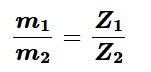
- Faraday Constant (F):
The Faraday constant is the amount of electric charge required to deposit or liberate one equivalent mass of a substance during electrolysis.
F = 96487 C/mol
- Examples:
- Electrolysis of Water (Hydrogen and oxygen gas formation)
- Metal Deposition (Electroplating)
- Purification of Copper
In Budget 2025, special plans have been announced for the promotion of religious and tourist destinations in Bihar. These initiatives will boost tourism in the state and ensure the preservation of historical heritage.
- Temple Corridor and Tourism Development
- Vishnupad Temple Corridor:
- Vishnupad Temple is located on the banks of the Falgu River in Gaya district, Bihar. It is dedicated to Lord Vishnu.
- The temple is approximately 100 feet tall, with 44 pillars made of Munger black stone (grey granite) and joined by iron plates.
- The temple is octagonal and faces east.
- The Vishnupad Temple Corridor will be developed along the lines of the Kashi Vishwanath Temple Corridor, offering enhanced connectivity and facilities for religious and tourist sites connected to the temple.
- Mahabodhi Temple Conservation and Expansion:
- Mahabodhi Temple is located at the sacred site where Gautama Buddha attained enlightenment under the Bodhi tree.
- The original temple was built by Emperor Ashoka in the 3rd century BCE, while the current structure dates back to the 5th-6th century.
- The temple includes a majestic 50-meter high structure (Vajrasana) and incorporates the sacred Bodhi tree and six other holy sites of Buddha’s enlightenment.
- Surrounded by well-preserved ancient stupas, it is safeguarded by inner, middle, and outer circular boundaries.
- The temple is one of the earliest brick temples from the Gupta period, influencing later brick architecture.
- It will be developed as a major World Heritage Site, preserving its historic value while enhancing tourist facilities at the site.
- Nalanda University Reconstruction:
- Nalanda University will be reinstated. Historically significant, the university will be developed into a major educational and tourist center.
- Natural and Cultural Heritage:
- Major religious and historical sites in the state will be preserved and developed, positioning Bihar on the global map for cultural tourism.
- Vishnupad Temple Corridor:
Development and preservation of Bihar's major religious sites will significantly boost religious tourism in the state. Iconic locations like Nalanda and the Mahabodhi Temple will gain international recognition, further establishing Bihar as a cultural tourism hub. This initiative will not only enhance the state’s cultural significance but also contribute to the improvement of its economy.
Small Industries Development Bank of India (SIDBI) was established on April 2, 1990, under an Act of Parliament as a principal financial institution. Its primary objective is to promote, finance, and develop the Micro, Small, and Medium Enterprises (MSME) sector and coordinate with institutions engaged in similar activities.
Scope and Importance of SIDBI:
- SIDBI focuses on the MSME sector, which plays a vital role in national production, employment generation, and exports.
- MSME sector is considered the backbone of the Indian economy, contributing significantly to economic growth.
- SIDBI aims to address both financial and non-financial gaps within the MSME ecosystem.
Financial Assistance by SIDBI:
SIDBI provides financial assistance in two ways:
1. Indirect Finance/Re-finance:
- SIDBI provides funds to banks, state financial corporations, and other financial institutions.
- These institutions further lend to MSMEs.
2. Direct Finance:
- Venture Capital – Investment in innovative startups and new businesses.
- Long-term Finance – Loans for MSME growth and expansion.
- Receivable Financing – Supports MSMEs in maintaining cash flow.
- Sector-specific Financial Support – Tailored financial solutions for MSME needs.
Role of SIDBI:
- Provides financial resources to MSMEs.
- Encourages innovation, technological advancement, and entrepreneurship.
- Acts as a bridge between the government and financial institutions.
- Ensures the sustainable development of small and medium enterprises.
SIDBI serves as a key pillar in the growth of the MSME sector in India. Through its financial assistance, small and medium enterprises can enhance their production capabilities, generate employment, and contribute to the country's economic development.
Central Bureau of Investigation (CBI) was established in 1963, and it operates under the Delhi Special Police Establishment (DSPE) Act. It was formed based on the recommendations of the Santhanam Committee (1962-1964), which recognized the need for a central agency to investigate corruption and other serious crimes in India. Currently, CBI functions under the Ministry of Personnel, Public Grievances and Pensions of the Government of India. It is the country’s leading investigative agency, authorized to investigate corruption, economic crimes, and other complex cases.
- Main Functions:
The primary functions of CBI are focused on the following areas:
-
- Investigation of Corruption and Bribery Cases: CBI investigates cases under the Prevention of Corruption Act involving government officials, public sector undertakings, corporations, and entities owned or controlled by the Government of India. It investigates corruption, bribery, and misconduct by central government employees with utmost seriousness.
- Investigation of Economic Crimes and Violations of Laws: CBI investigates violations of various fiscal and economic laws, including violations of import-export controls, customs duties, central excise duties, income tax laws, and foreign exchange regulations. It specifically handles cases related to counterfeit Indian currency, bank fraud, import-export violations, and foreign exchange violations.
- Investigation of International Crimes: CBI also has the authority to investigate international crimes, including human trafficking, money laundering, and crimes related to terrorism. It works closely with Interpol and other international law enforcement agencies.
- Key Issues:
- CBI vs. State Police: CBI needs to obtain approval from the state government to investigate cases in any specific state. Often, state governments deny permission to CBI due to political reasons, which affects the scope and effectiveness of investigations. In cases where investigations go against the political interests of the state government, concerns arise about CBI's autonomy.
- Overlap and Duplication: CBI and state police forces have concurrent investigative powers, particularly for crimes where both agencies can investigate. This overlapping jurisdiction sometimes leads to duplication of efforts and confusion in the investigative process. In such cases, investigations are carried out separately by both agencies, leading to a waste of time and resources.
- Political Interference: The Supreme Court of India has criticized the political interference in the functioning of CBI. Such interference raises questions about the agency’s impartiality and efficiency, as political pressure can sometimes lead CBI to deviate from its priorities and objectives.
Constant monitoring and efforts to improve CBI’s operations and impartiality are crucial for strengthening the democratic framework of India.
Constitution of India is the supreme law of the country, providing the framework for governance, fundamental rights, duties, and the structure of government. It was adopted on November 26, 1949, and came into effect on January 26, 1950.
- Lengthiest Written Constitution
- The longest written constitution in the world.
- Originally had 395 Articles, 22 Parts, and 8 Schedules.
- Now consists of 470 Articles, 25 Parts, and 12 Schedules due to amendments.
- Sovereign, Socialist, Secular, Democratic Republic
- Sovereign – Independent of foreign control.
- Socialist – Aims at social and economic justice.
- Secular – Equal treatment of all religions by the state.
- Democratic – Power rests with the people through elections.
- Republic – The head of state (President) is elected.
- Federal System with Unitary Features
- Division of power between the Union (Central Government), States, and Local Bodies.
- Has both federal and unitary characteristics.
- Parliamentary System of Government
- Bicameral Legislature:
- Lok Sabha (Lower House) – Members are directly elected through the First Past The Post (FPTP) system.
- Rajya Sabha (Upper House) – Members are indirectly elected through proportional representation..
- The Prime Minister leads the government, while the President is the constitutional head.
- Bicameral Legislature:
Modern classical Indian musicians have significantly contributed to the global recognition and evolution of India’s rich musical heritage. Here’s a brief overview of some prominent musicians:
- Ravi Shankar (1920–2012) – A legendary sitar virtuoso, Ravi Shankar is credited with popularizing Indian classical music in the West. His collaborations with global musicians, like George Harrison of The Beatles, brought the sitar to international audiences.
- Lata Mangeshkar (1929–2022) – She was a legendary Indian playback singer, known as the "Queen of Melody" and "Nightingale of India." With a career spanning eight decades, she recorded songs in over 36 languages. Honored with the Bharat Ratna, Dadasaheb Phalke Award, and multiple accolades, she left an indelible impact on Indian music.
- Zakir Hussain (b. 1951) – A tabla maestro, Zakir Hussain has been instrumental in blending Hindustani classical tabla with jazz fusion, and world music. His virtuosity has earned him worldwide acclaim.
- Bhimsen Joshi (1922–2011) – One of the most respected vocalists in Hindustani classical music, Bhimsen Joshi was a master of the Khayal style. His emotional renditions of ragas touched millions.
- MS Subbulakshmi (1916–2004) – An iconic Carnatic classical vocalist, MS Subbulakshmi was celebrated for her divine voice. She was the first musician to be awarded the Bharat Ratna.
- Pandit Birju Maharaj (1938–2022) – Known for his expertise in Kathak, Birju Maharaj was not just a dancer but also a distinguished musician, preserving and innovating within traditional Indian dance and music.
- T. N. Krishnan (1928–2020) – A master of the Carnatic violin, T. N. Krishnan's contributions enriched classical music through his deep understanding of rhythm and melody.
- Ustad Amjad Ali Khan (b. 1945) – A renowned sarod virtuoso, he is known for his soulful performances and efforts to blend classical and contemporary music.
- Anoushka Shankar (b. 1981) – Daughter of Ravi Shankar, Anoushka is a sitar virtuoso, known for mixing classical Indian music with jazz and world music influences.
- Ustad Rashid Khan (b. 1966) – A leading Hindustani classical vocalist, Rashid Khan is celebrated for his mastery of Khayal, captivating audiences with his emotional depth.
These musicians have played a vital role in preserving classical traditions while introducing fresh, innovative elements to Indian music.
Balshastri Jambhekar played a pivotal role in using journalism as a tool for social reform in 19th-century Bombay (now Mumbai). He is widely regarded as the "Father of Marathi Journalism." Jambhekar boldly challenged Brahminical orthodoxy and worked towards reforming popular Hindu practices.
- Journalism and Social Reform
In 1832, Jambhekar launched the weekly newspaper "Darpan," which was published in both Marathi and English. Through this publication, he raised awareness about widow remarriage, the adoption of scientific methods in daily life, and other critical social issues.
In 1840, he started "Digdarshan," a newspaper that focused on scientific subjects as well as historical topics. The objective of this publication was to promote rational thinking and modern ideas among the masses.
- Contributions to Education
Jambhekar established the Bombay Native General Library, which later evolved into the Native Improvement Society. This society included the "Student Library and Scientific Library," which aimed to connect young minds with knowledge and scientific advancements.
- Other Notable Achievements
- He served as the Director of the Colaba Observatory.
- Jambhekar was the first Hindi lecturer at Elphinstone College.
- His efforts laid the foundation for future social reform movements by fostering awareness and critical thinking.
Balshastri Jambhekar's life serves as an inspiration in the fields of social reform, education, and journalism, leaving an enduring legacy in Indian history.
Electric current is defined as the rate of flow of electric charge through a specific point in a conductor. It quantifies how much charge (q) passes through a given area per unit time (t). Mathematically, it is expressed as:
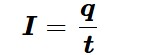
where:
-
- I is the electric current in amperes (A),
- q is the charge in coulombs (C),
- t is the time in seconds (s).
Electric current is a scalar quantity even though it has both magnitude and direction. This is because it does not obey the triangle law of vector addition. The SI unit of electric current is Ampere (A). One ampere corresponds to the flow of one coulomb of charge per second:
1 A = 1 C/s
Example:
If a charge of 12 C flows through a conductor in 4 s the current can be calculated as:
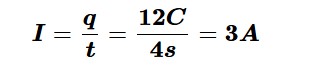
Thus, the current flowing through the conductor is 3 A.
- Electric Circuit
An electric circuit is a continuous and closed path through which electric current flows. It consists of components such as resistors, capacitors, switches, and a power source (like a battery).
-
- Direction of Current: In an electric circuit, the conventional direction of current is taken as the flow of positive charge, which is opposite to the actual flow of electrons (negative charge).
1. Objective and Formation
- Formation:
- Committee constituted by the Ministry of Commerce and Industry.
- Chairman: Baba Kalyani.
- Objective:
- Study India’s current Special Economic Zone (SEZ) policy.
- Assess SEZ policy in alignment with WTO standards.
- Suggest measures to ensure optimal utilization of unused SEZ land.
2. Responsibilities
- Policy Reforms:
- Recommend necessary changes based on international experiences.
- Integration Possibilities:
- Align SEZ policy with other government initiatives such as Coastal Economic Zones, Delhi-Mumbai Economic Corridor, National Industrial Manufacturing Zones, and Textile Parks.
3. Chairman’s Vision
- India’s Economic Goal (2025):
- Achieve a $5 trillion economy.
- Required Fundamental Changes:
- Enhance the competitiveness of the manufacturing sector.
- Improve the current framework related to services.
4. ‘Make in India’ and Manufacturing Targets
- 2022 Targets:
- Create 100 million jobs.
- Increase manufacturing contribution to 25% of GDP.
- 2025 Plan:
- Enhance manufacturing value to $1.2 trillion.
5. Broad Impact
- Investment and Employment:
- Policy reforms to boost investment and employment opportunities.
- International Compliance:
- Aligning with WTO standards for global competitiveness.
- Infrastructure and Scheme Integration:
- Synergy among various schemes for holistic development.
- Malacca Strait
- Location: Indonesia-Malaysia
- Connects: Andaman Sea & South China Sea
- Importance: Crucial for maritime trade between the Indian Ocean and the Pacific Ocean, handling one of the busiest shipping routes.
- Palk Strait
- Location: India-Sri Lanka
- Connects: Bay of Bengal & Palk Bay
- Importance: Vital for local trade between India and Sri Lanka, and serves as a natural boundary for these two nations.
- Sunda Strait
- Location: Indonesia
- Connects: Java Sea & Indian Ocean
- Importance: One of the key passages in Southeast Asia for navigation between islands, especially for ships traveling between Java and Sumatra.
- Yucatan Strait
- Location: Mexico-Cuba
- Connects: Gulf of Mexico & Caribbean Sea
- Importance: A significant maritime passage for trade and energy transportation, particularly oil and gas shipments.
- Messina Strait
- Location: Italy-Sicily
- Connects: Tyrrhenian Sea & Ionian Sea
- Importance: Historical passage and crucial for Mediterranean shipping, linking the eastern and western parts of the Mediterranean.
- Bab-el-Mandeb Strait
- Location: Yemen-Djibouti
- Connects: Red Sea & Gulf of Aden
- Importance: Vital for global trade, particularly in oil transportation, as it connects the Red Sea to the Arabian Sea.
- Cook Strait
- Location: New Zealand (North & South Islands)
- Connects: Tasman Sea & South Pacific Ocean
- Importance: Key for transportation between New Zealand's two main islands, with both passenger and cargo vessels using this route.
- Mozambique Channel
- Location: Mozambique-Madagascar
- Connects: Indian Ocean
- Importance: Critical for maritime trade routes between Africa and Asia, influencing shipping lanes for oil and natural resources.
- North Channel
- Location: Ireland-England
- Connects: Irish Sea & Atlantic Ocean
- Importance: One of the busiest shipping lanes for trade and passenger ships traveling between the UK and Ireland.
In India’s social reform movements, the freedom struggle, and after independence, women played an important role. The Indian Constitution included many rules to improve the condition of women. Social reformers worked hard to give women their rights and end the harmful traditions that affected them.
- Major Reforms and Contributions
1. Abolition of Sati (Self-immolation)
-
- Leader: Raja Ram Mohan Roy
- Legal Reforms:
- In 1829, Sati was declared illegal.
- It was made a punishable crime and was enforced in Bengal, Madras, and Bombay in 1830.
2. Ban on Female Infanticide
-
- First Laws:
- In 1795 and 1804, killing of girls was considered a crime equal to human murder.
- In 1870, stricter laws were passed to prevent it.
- First Laws:
3. Widow Remarriage Movement
-
- Key Reformer: Ishwar Chandra Vidyasagar
- Encouraged widow remarriage based on Vedic evidence.
- Key Events:
- In 1856, the ‘Hindu Widow Remarriage Act’ was passed.
- In 1893, Professor D.K. Karve married a widow.
- Key Reformer: Ishwar Chandra Vidyasagar
4. Control over Child Marriages
-
- Important Laws:
- 1872: ‘Native Marriage Act’ (Prohibited marriage under 14 years of age).
- 1891: ‘Consent Age Act’ (Prohibited marriage under 12 years of age).
- 1930: ‘Sharda Act’ (Set minimum marriage age: 18 years for boys and 14 years for girls).
- Amendment in 1978: The minimum marriage age was changed to 21 years for boys and 18 years for girls.
- Important Laws:
5. Contribution to Women’s Education
-
- 1819: Establishment of ‘Calcutta Tarun Stri Sabha’.
- 1849: J.E.D. Bethune established the ‘Bethune School’.
- 1854: Charles Wood's Dispatch emphasized women's education.
- 1916: D.K. Karve founded the Indian Women's University.
- 1880: Establishment of Dufferin Hospital.
6. Women’s Participation in the Freedom Movement
-
- Active Contribution:
- Women were actively involved in the Swadeshi Movement and the Bengal Partition Movement.
- Women also participated in trade unions and peasant movements.
- Key Leader: Sarojini Naidu
- 1925: First female president of the Indian National Congress.
- 1947-49: Governor of United Provinces.
- Active Contribution:
7. Role of Women’s Organizations
-
- Key Organizations:
- 1910: Sarala Devi Chaudhurani established the Bharat Stri Mahamandal.
- 1927: All India Women’s Congress was formed.
- Pandita Ramabai:
- Established the Arya Mahila Samaj.
- Worked for the improvement of women’s education.
- Key Organizations:
- Article 105:
- Article 105 of the Constitution addresses parliamentary privileges, focusing on two main aspects:
- Freedom of Expression [Article 105(1)]: Members of Parliament have the right to freely express themselves within the parliamentary proceedings.
- Right to Publish Proceedings (Article 105(2)): Empowers Parliament to regulate the right to publish its proceedings.
- Article 105 of the Constitution addresses parliamentary privileges, focusing on two main aspects:
- Collective Privileges:
- Right to Institute Proceedings: Parliament possesses the authority to initiate legal proceedings.
- Right to Debate and Publish Proceedings: Members have the right to discuss and publish parliamentary proceedings.
- Right to Withhold Publication: Parliament has the prerogative to withhold the publication of certain information.
- Right to Expel Outsiders: Parliament can expel non-members from the House.
- Right to Convert Meetings into Secret Sessions: Both Houses can convert their meetings into secret sessions.
- Individual Privileges:
- Immunity from Civil Arrest: Members of Parliament are immune from civil arrest during the parliamentary session or 40 days before and after it, limited to civil matters.
- Freedom from Appearing as a Witness: MPs are exempt from appearing as witnesses during a parliamentary session.
- Freedom of Speech or Expression within Parliament: MPs enjoy the freedom of speech within the parliamentary premises.
- Outside Parliament: MPs are subject to the same legal obligations as ordinary citizens beyond the parliamentary premises.
What is Dispersion?
When a ray of white light passes through a prism, it refracts and bends toward the base of the prism, splitting into seven distinct colors. This phenomenon is called dispersion of light. The division of white light reveals that it is a combination of multiple wavelengths, each corresponding to a specific color.
- Color Division and Wavelengths
- White light splits into red, orange, yellow, green, blue, indigo, and violet (ROYGBIV) upon passing through a prism.
- Red Light:
- Longest wavelength (approximately 700 nm).
- Least deviation and appears at the outer edge of the spectrum.
- Violet Light:
- Shortest wavelength (approximately 400 nm).
- Most deviation and is located at the inner edge of the spectrum.
- The other colors (orange, yellow, green, blue, and indigo) are arranged between red and violet in decreasing order of wavelength and increasing order of deviation.
- Significance and Applications
- Natural Phenomena:
- Rainbow: Water droplets act as tiny prisms, dispersing sunlight into its constituent colors and forming a rainbow.
- Scientific Instruments:
- Dispersion is used in spectroscopes, which analyze the component wavelengths of light.
- Optics and Lenses:
- Dispersion helps in lens design and aids in understanding problems like chromatic aberration, where different wavelengths focus at different points.
- Natural Phenomena:
Dispersion of light splits white light into its component colors, revealing the relationship between wavelength and refraction. This phenomenon is vital in both natural observations and technological advancements.
Public sector enterprises (PSEs) governed by the central government are granted Navratna status upon fulfilling specific eligibility criteria.
- Eligibility Criteria for Navratna Status
To qualify for Navratna status, a company must:
- Hold Miniratna Category-1 or Miniratna Category-2 status.
- Secure an “Excellent” or “Very Good” rating under the Memorandum of Understanding (MoU) system for at least 3 out of the last 5 years.
- Achieve a score of 60 or more out of 100 on six key performance parameters, which are:
-
- Net profit to total capital employed
- Net profit as a percentage of net worth
- Labor cost as a percentage of total production or service cost
- Cost of production of goods or services
- Earnings per share (EPS)
- Sector-specific performance comparison
- Autonomy of Navratna Companies
Navratna companies are granted substantial financial autonomy, allowing them to invest up to ₹1,000 crore or 15% of their project cost (whichever is lower) without needing prior government approval.
- Navratna Companies in India
Currently, there are 24 Navratna companies in India. These are:
-
- Bharat Electronics Limited (BEL)
- Container Corporation of India Limited (CONCOR)
- Engineers India Limited (EIL)
- Mahanagar Telephone Nigam Limited (MTNL)
- National Aluminium Company Limited (NALCO)
- National Buildings Construction Corporation Limited (NBCC)
- Neyveli Lignite Corporation Limited (NLCL)
- NMDC Limited (NMDC)
- Rashtriya Ispat Nigam Limited (RINL)
- Shipping Corporation of India Limited (SCIL)
- Rail Vikas Nigam Limited (RVNL)
- ONGC Videsh Limited (OVL)
- Rashtriya Chemicals & Fertilizers Limited (RCF)
- IRCON International Limited (IRCON)
- RITES Limited
- National Fertilizers Limited (NFL)
- Central Warehousing Corporation (CWC)
- Housing and Urban Development Corporation Limited (HUDCL)
- Indian Renewable Energy Development Agency Limited (IREDA)
- Mazagon Dock Shipbuilders Limited
- RailTel Corporation of India Limited
- Solar Energy Corporation of India (SECI) Limited
- NHPC Limited
- SJVN Limited
Sahitya Akademi announced its annual awards in 21 Indian languages. The awards honor outstanding literary works published between January 1, 2018, and December 31, 2022, in categories such as poetry, novels, short stories, essays, literary criticism, plays, and research.
Awards for Bengali, Dogri, and Urdu will be announced later.
- Approval Process
- Recommended by distinguished jury members in each language.
- Approved by the Executive Board chaired by Sri Madhav Kaushik, President, Sahitya Akademi.
- Award Categories and Winners
|
Category |
Language |
Winner |
|
Poetry |
Assamese |
Sameer Tanti |
|
Gujarati |
Dileep Jhaveri |
|
|
Hindi |
Gagan Gill |
|
|
Malayalam |
K. Jayakumar |
|
|
Manipuri |
Haobam Satyabati Devi |
|
|
Punjabi |
Paul Kaur |
|
|
Rajasthani |
Mukut Maniraj |
|
|
Sanskrit |
Dipak Kumar Sharma |
|
|
Novel |
Bodo |
Aron Raja |
|
English |
Easterine Kire |
|
|
Kashmiri |
Sohal Koul |
|
|
Short Stories |
Nepali |
Yuva Baral |
|
Sindhi |
Hundraj Balwani |
|
|
Essays |
Konkani |
Mukesh Thali |
|
Maithili |
Mahendra Malangia |
|
|
Odia |
Baishnab Charan Samal |
|
|
Literary Criticism |
Kannada |
K.V. Narayana |
|
Marathi |
Sudhir Rasal |
|
|
Telugu |
Penugonda Lakshminarayana |
|
|
Play |
Santali |
Maheswar Soren |
|
Research |
Tamil |
A.R. Venkatachalapathy |
- Selection Process
- Books were chosen based on recommendations by a three-member jury in each language.
- Awards were finalized by either unanimous decision or majority vote of the jury.
- Each award consists of an engraved copper plaque, a shawl, and ₹1,00,000 in cash.
1. Protector of Fundamental Rights and Final Interpreter of the Constitution:
- The Supreme Court acts as the protector of fundamental rights and the ultimate interpreter of the Constitution. It serves as the highest appellate court for civil and criminal cases nationwide.
2. Appeals on Constitutional Questions:
- Under Article 132, the Supreme Court handles appeals on substantial legal issues concerning the Constitution arising from High Court decisions, decrees, or final orders.
3. Advisory Jurisdiction:
- Article 143 allows the President to seek the Supreme Court’s advice on disputes or significant public matters. While its opinion is not binding, it holds great respect.
4. Judicial Review Power:
- Judicial review, a key element of the Constitution’s basic structure, is vested in the Supreme Court by Articles 13, 32, 132, and 133. Parliament cannot curtail or revoke this power.
5. Review and Curative Petitions:
- Under Article 137, the Supreme Court entertains review petitions filed within 30 days of a decision. If denied, a 'Curative Petition' can be submitted on substantial grounds.
6. Binding Authority of Decisions:
- As per Article 141, the Supreme Court’s rulings are binding on all courts across the country.
7. Power to Ensure Complete Justice:
- Article 142 enables the Supreme Court to issue orders or decrees to ensure complete justice in any matter before it.
8. Authority to Transfer Cases:
- The Supreme Court, under Article 139(a), introduced by the 42nd Amendment, has the power to transfer cases.
9. Constitutional Bench:
- Article 145(3) mandates that a bench of at least five judges, known as a Constitutional Bench, hears cases involving constitutional interpretation or questions referred by the President under Article 143.
10. Final Constitutional Interpretation:
- The Supreme Court has the ultimate authority to interpret the Constitution, primarily derived from Articles 13, 132, and 133.
11. Resolving Election Disputes:
- It has exclusive jurisdiction over disputes concerning the election of the President and Vice President.
Additional Key Points:
- Judges' salaries and administrative expenses are charged to the Consolidated Fund of India (Article 146).
- Article 121 prohibits Parliamentary debates on the conduct of Supreme Court or High Court judges in their official capacity.
- Retired Supreme Court judges cannot practice law in any Indian court or tribunal.
- The Chief Justice of India can appoint officers and staff of the Supreme Court under Article 146.
When a light ray strikes a smooth and shiny surface (such as a mirror, water surface, or metal) and changes its direction while remaining in the same medium, the phenomenon is known as reflection of light. During the phenomenon of reflection, a light ray incident on a surface is redirected back into the same medium, altering its direction while preserving its speed and wavelength.
The surface where the light ray strikes is called the reflecting surface. The process of reflection involves three main components:
-
- Incident Ray: The ray of light approaching the reflecting surface.
- Reflected Ray: The ray of light bouncing back from the surface after reflection.
- Normal: An imaginary line drawn perpendicular to the reflecting surface at the point where the incident ray strikes.
-
- Two important angles are associated with the reflection of light:
- Angle of Incidence (i): The angle between the incident ray and the normal.
- Angle of Reflection (r): The angle between the reflected ray and the normal.
- Two important angles are associated with the reflection of light:
- Laws of Reflection
-
- The angle of reflection (r) is always equal to the angle of incidence (i).
- The incident ray, the reflected ray, and the normal all lie in the same plane.
These laws apply universally to all reflecting surfaces, whether smooth or irregular.
Importance of Reflection:
The reflection of light plays a vital role in our daily lives. It is the foundational principle behind devices like mirrors, cameras, and telescopes. Naturally, it allows us to see reflections of objects on shiny surfaces.
In simple terms, reflection ensures that light rays change direction in a predictable way, enabling visibility and clarity in our surroundings. Without reflection, we wouldn’t perceive images or experience the functionality of reflective devices.
Functions of Underground Water
Underground water flows through the pores and cracks of rocks beneath the Earth's surface, performing processes like dissolution, erosion, and deposition. While its impact is less intense compared to rivers, glaciers, waves, or winds, it creates distinct landforms, especially in areas with soluble rocks like limestone and dolomite.
- Landforms Created by Underground Water
1. Lapies:
-
- Dissolution causes the rock surface to become rugged with sharp ridges and grooves.
- This feature is also known as Clint in certain regions.
2. Sinkholes:
-
- Dissolution of rocks leads to the formation of small pits or holes on the surface.
- Larger sinkholes are called Dolines, and several dolines merging together form Uvalas.
- When Uvalas expand further, they become Poljes, such as the ‘Livno Polje’ in the Balkan region.
3. Caverns:
-
- Caverns are hollow spaces beneath the surface created by the dissolution and abrasion of rocks.
- Water dripping inside these caverns forms Stalactites (hanging formations) and Stalagmites (rising formations on the floor).
- When stalactites and stalagmites meet, they form Cave Pillars.
4. Blind Valleys:
-
- In karst regions, river water seeps through sinkholes, leaving the valley ahead dry.
- The dried portion is called a Dry Valley, while the initial segment is termed a Blind Valley.
5. Terra Rossa:
-
- Rainwater dissolves portions of the rock, leaving behind a thin layer of red soil on the surface. This is called Terra Rossa.
The activities of underground water vary based on geological structure and climatic conditions, making these processes unique and significant in shaping the Earth’s surface.
1) Industrial Policy, 1969
- Key Legislation: The policy introduced the Monopolies and Restrictive Trade Practices Act (MRTP Act), 1969.
- Objective:
- To regulate business practices and commercial procedures.
- Prevent monopolies and centralization in the economy.
- Establishment of MRTP Commission:
- The government formed the MRTP Commission to monitor and regulate prohibited and restrictive trade practices.
- MRTP Limit:
- Initially, companies with assets of ₹20 crores or more needed government approval for expansion, known as the MRTP limit.
- The limit was increased to ₹50 crores in 1980 and ₹100 crores in 1985.
- In 1991, the MRTP limit was abolished.
2) Industrial Policy, 1973
- Core Industry Focus:
- The policy emphasized the Core Industry concept, which included industries like iron and steel, cement, coal, petroleum products, crucial for the development of other industries.
- Reserved Industries:
- Certain industries were reserved for the small and medium sectors, restricting larger-scale industries from operating in them.
- Concept of Joint Sector:
- The policy introduced the Joint Sector concept, encouraging participation from the central government, state government, and private sector in industries.
- Foreign Exchange Regulation Act (FERA):
- The policy led to the enactment of FERA, regulating the foreign exchange market and foreign investments in India.
Both policies aimed to regulate and promote industrial growth while ensuring that monopolistic practices were kept in check. The focus on core industries and joint sector participation reflected the need for balanced industrial development and strategic planning for the economy's growth.
The Ahom Revolt took place between 1828 and 1830, following the British annexation of northern Assam after the First Anglo-Burmese War (1824-1826). The Ahom dynasty’s heirs strongly opposed the British control and demanded that the East India Company leave Assam. When the company refused to comply, the local Assamese, led by Gomdhar Konwar, a prince of the Ahom dynasty, and his associates—Dhanjoy Bongohon and Jairam Khargoria Phukan—launched a revolt.
- Key Points of the Revolt:
- British Control over Assam: After the Burmese War, the British took control of Assam, which was previously ruled by the Ahom dynasty. This move was deeply resented by the local rulers and the people.
- Leadership of Gomdhar Konwar: The revolt was led by Gomdhar Konwar, who was formally declared the king by the insurgents. His leadership, along with that of Dhanjoy Bongohon and Jairam Khargoria Phukan, united the people of Assam in resistance against British rule.
- Revolt and British Response: The insurgents gathered at the region of Jorhat and challenged the British authority. Despite their efforts, the British government responded with military action.
- Resolution and British Policy: Ultimately, the British adopted a more conciliatory approach. They decided to hand over Upper Assam to Maharaja Purandar Singh Narendra and allowed the rest of Assam to remain under the local king’s control, while still under British influence.
In conclusion, the Ahom Revolt was a significant early resistance movement against British rule in Assam. It reflected the growing dissatisfaction of the local population and set the stage for future uprisings against colonial powers.
- National Commission for Scheduled Castes (Article 338A, Part XVI)
- A five-member constitutional body appointed by the President of India.
- Empowered to address cases of oppression and atrocities against Scheduled Castes.
- Responsible for inspecting the implementation of constitutional provisions and submitting annual reports.
- National Commission for Scheduled Tribes (Article 338A, Part XVI)
- Established by the 89th Constitutional Amendment Bill, 2003.
- A five-member commission with suo motu powers to address oppression and atrocities against Scheduled Tribes.
- Operates with six regional offices to enhance its outreach and effectiveness.
- National Commission for Backward Classes (Article 338B, Part XVI)
- Gained constitutional status through the 102nd Constitutional Amendment Act, 2018.
- A five-member body appointed by the President, responsible for safeguarding the interests of backward classes.
- Previously a statutory body under the Ministry of Social Justice and Empowerment, it was granted constitutional status in 2018.
Sound is a mechanical wave that requires a medium (solid, liquid, or gas) to propagate. Its speed is not uniform across mediums and varies significantly due to differences in the physical properties of the medium, primarily elasticity (the ability of a medium to resist deformation) and density (mass per unit volume).
- Factors Affecting the Speed of Sound
- Elasticity and Density:
- Higher Elasticity: Increases the speed of sound. Solids, being highly elastic, conduct sound faster than liquids or gases.
- Higher Density: Slows down sound propagation as denser mediums resist motion.
- Temperature:
- In gases, higher temperatures increase molecular energy, reducing density and increasing speed.
- State of the Medium:
- Sound travels fastest in solids, slower in liquids, and slowest in gases due to the molecular arrangement and bonding.
- Elasticity and Density:
- Speed of Sound at 25°C
|
State |
Material |
Speed (m/s) |
|
Solid |
Aluminum |
6420 |
|
Nickel |
6040 |
|
|
Steel |
5960 |
|
|
Iron |
5950 |
|
|
Brass |
4700 |
|
|
Glass (Flint) |
3980 |
|
|
Liquid |
Water (Sea) |
1531 |
|
Water (Distilled) |
1498 |
|
|
Ethanol |
1207 |
|
|
Methanol |
1103 |
|
|
Gas |
Hydrogen |
1284 |
|
Helium |
965 |
|
|
Air |
346 |
|
|
Oxygen |
316 |
|
|
Sulfur Dioxide |
213 |
- Important Insights
- Solids Lead in Speed:
- Sound waves travel faster in solids due to their high elasticity and closely packed molecules. For instance, in aluminum, the speed is 6420 m/s.
- Liquids as Intermediates:
- Liquids like seawater (1531 m/s) transmit sound faster than gases but slower than solids. This is because liquids are less elastic than solids but more so than gases.
- Gases Lag Behind:
- In gases, the speed is significantly lower. For example, sound in air at 25°C travels at 346 m/s. Hydrogen, due to its low density, has a higher sound speed (1284 m/s) compared to denser gases like sulfur dioxide (213 m/s).
- Solids Lead in Speed:
- Transition Between Mediums
When sound transitions between two different mediums:- Speed Changes: Due to differences in elasticity and density.
- Wavelength Adjusts: While the speed changes, the frequency remains constant, causing the wavelength to shift accordingly.
- Applications of Sound Speed Variation
- Sonar and Underwater Communication:
- Utilizing the high speed of sound in water to detect objects and communicate.
- Medical Ultrasonography:
- Leveraging the speed of sound in tissues for imaging internal organs.
- Material Testing:
- Sound speed in solids is used to evaluate the structural integrity of materials.
- Sonar and Underwater Communication:
Speed of sound is a fascinating physical property that varies across mediums due to fundamental differences in their molecular structure and physical states. Understanding these variations not only enhances our knowledge of wave mechanics but also drives critical applications in science, medicine, and industry.
Erosion is the process through which weathered materials are transported from one location to another. This process is primarily carried out by natural agents such as water, wind, and ice. The main erosion processes are as follows:
- Main Erosion Processes:
1) Abrasion:
When a flow (such as water, wind, or ice) carries materials like stones, pebbles, or sand, these materials come into contact with rocks, wearing them down over time.
2) Attrition:
When moving particles collide with each other, they break into smaller pieces as they continuously knock against one another.
3) Corrosion:
This is the breaking down of soluble rocks like dolomite or limestone by water, a process facilitated by underground water and flowing water.
4) Hydraulic Action:
When the intense flow of water causes rocks to break and fragment, it is called hydraulic action. This mainly occurs in rivers and ocean waves.
5) Water Pressure:
When the pressure exerted by water causes erosion in rocks, it is known as water pressure erosion. This process is commonly observed along coastlines.
6) Plucking:
This process occurs in glaciers, where the ice pulls and breaks rocks as it moves along its path.
7) Deflation:
This process involves the wind carrying away loose sediments from dry or semi-arid regions, causing erosion of the surface.
Agriculture has always been a cornerstone of India's economic development, playing a pivotal role in ensuring food security, employment, and industrial raw material supply. Over the years, various Five-Year Plans aimed to boost agricultural productivity and growth, adapting strategies based on the evolving challenges and priorities of the sector. The growth rates achieved in each plan reflect the effectiveness of these efforts.
|
Plan |
Growth Rate (in %) |
|
First Five-Year Plan (1951–56) |
2.71 |
|
Second Five-Year Plan (1956–61) |
3.15 |
|
Third Five-Year Plan (1961–66) |
-0.73 |
|
Three Annual Plans (1966–69) |
4.16 |
|
Fourth Five-Year Plan (1969–74) |
2.57 |
|
Fifth Five-Year Plan (1974–79) |
3.28 |
|
Sixth Five-Year Plan (1980–85) |
2.52 |
|
Seventh Five-Year Plan (1985–90) |
3.47 |
|
Two Annual Plans (1990–92) |
1.01 |
|
Eighth Five-Year Plan (1992–97) |
4.72 |
|
Ninth Five-Year Plan (1997–2002) |
2.44 |
|
Tenth Five-Year Plan (2002–07) |
2.30 |
|
Eleventh Five-Year Plan (2007–12) |
3.30 |
|
Twelfth Five-Year Plan (2012–17) |
4.00 (Target) |
The growth rates of agriculture during the various Five-Year Plans reflect the dynamic nature of India's agricultural sector. While significant progress has been made in many plans, challenges such as droughts, poor monsoons, and structural bottlenecks have also impacted growth. The Twelfth Five-Year Plan targeted a 4% growth rate, emphasizing the need for technological advancements, irrigation expansion, and market reforms to ensure long-term sustainability in the agricultural sector. This historical analysis underscores the importance of continuous policy interventions to strengthen the backbone of India's economy.
Civilian Struggle for Independence in South India
- Background and Causes of the Rebellion
- The Poligar Rebellion, a civilian uprising, took place between 1795 and 1805 in South India, led by the Poligars (Palayakkarars) against the British East India Company.
- The main regions affected were Thirunelveli, Ramanathapuram, Sivaganga, Sivagiri, Madurai, and Northern Arcot.
- The rebellion stemmed from the 1781 decision by the Nawab of Arcot to hand over control of Tamil Nadu and Karnataka to the British East India Company, angering the Poligars who had long been independent local rulers.
- The Poligars, who were civilian leaders of their communities, resisted the British imposition of taxes and their disrespectful treatment, as the Poligars had traditionally held power in their regions.
- First Phase of the Rebellion (1795-1799)
- The first phase of the revolt was driven by civilian unrest over taxation and British disdain for local leaders.
- Kattabomman, the Poligar of Panchalankuruchi, became the leader of this civilian revolt from 1795 to 1799.
- After several initial victories over British forces, Kattabomman emerged as a symbol of civilian resistance.
- The British placed a bounty on Kattabomman’s head, and with the help of the Raja of Pudukottai, who betrayed the rebels, the British captured and executed Kattabomman.
- Subramaniam Pillai, Kattabomman’s associate, was also executed, and another rebel leader, Soundara Pandiyan, was killed brutally.
- The British seized the lands of Panchalankuruchi and other Poligar territories, and several civilian leaders were either executed or imprisoned.
- Second Phase of the Rebellion (1801-1805)
- The second phase of the rebellion, which was even more violent, began in February 1801 when several imprisoned Poligars managed to escape from the Palamkotta fort.
- The civilian rebels captured several key forts, including Tuticorin, but the British quickly regained control of these areas.
- The escaped rebels joined the Marudu rebels in Ramanad, but they were crushed in October 1801.
- At the same time, the Nawab of Arcot ceded all civil, military, and administrative powers to the British Company.
- Rebellion in Northern Arcot (1803-1805)
- Between 1803 and 1805, the Poligars of Northern Arcot, led by local civilians, rose up due to the loss of their right to collect "Kawal" (a hereditary police office).
- The rebellion spread to regions like Chittoor and Chandragiri, where lawlessness became widespread as the British struggled to maintain control.
- The Poligar of Yedragunta, a courageous civilian leader, allied with other marginalized Poligars, continuing the resistance.
- By February 1805, the rebellion was suppressed, and leaders were ordered to remain in Madras while their estates were confiscated.
- Significance of the Rebellion
- The Poligar Rebellion was a major civilian-led uprising and one of the largest anti-colonial revolts in South India.
- It was not just a military struggle but a mass civilian resistance to British rule, demonstrating the widespread popular opposition to foreign domination.
- The Poligar’s declaration of independence reflected their desire to break free from British control, marking the rebellion as an important moment in India’s history of resistance to colonial rule.
- Constitutional Measures
The Constitution of India includes provisions aimed at ensuring equality and economic justice:
- The Preamble of the Constitution emphasizes the principle of economic justice.
- Article 39(b) and 39(c) advocate for the equitable distribution of material resources to prevent wealth concentration.
- Key Amendments Supporting Land Reforms
- In 1951, the First Constitutional Amendment introduced provisions supporting land reforms, including:
- Abolition of the Zamindari system.
- Making the right to property more rational and equitable.
- Inclusion of the Ninth Schedule in the Constitution, protecting land reform laws from judicial review to facilitate states' land reform initiatives.
Note: The 44th Constitutional Amendment reclassified the Right to Property as a legal right rather than a fundamental right.
- Statutory Measures
To implement land reforms effectively, over 280 land reform laws were enacted by the states. Additionally, the Central Government has introduced several critical amendments and laws over time:
- Land Acquisition Act of 1894 was amended periodically, with a new Land Acquisition Act passed in 2013.
- Laws were also established to regulate tribal lands, contract farming, and cooperative farming.
2013 Land Acquisition Act, titled "The Right to Fair Compensation and Transparency in Land Acquisition, Rehabilitation, and Resettlement Act", emphasized fair compensation, transparency, and rehabilitation measures. It has been amended as needed to address emerging requirements. These constitutional and statutory measures reflect a continued commitment to economic justice and equitable land distribution across India.
Thermal expansion refers to the increase in the dimensions of an object when it is heated. The expansion of length is termed as "Linear Expansion," the expansion in area is "Area Expansion," and the expansion in volume is called "Volume Expansion." When the same amount of heat is provided to different substances, their expansions occur at different rates. The extent of expansion depends on the coefficient of expansion of the material.
- Linear Expansion Coefficient: The increase in the length of a material per unit temperature rise of 1°C is known as the linear expansion coefficient (α).
- Area Expansion Coefficient: The increase in the area of a material per unit temperature rise of 1°C is called the area expansion coefficient (β).
- Volume Expansion Coefficient: The increase in the volume of a material per unit temperature rise of 1°C is referred to as the volume expansion coefficient (γ).
- Relationship between the coefficients of expansion
The relationship between the coefficients of linear, area, and volume expansion can be expressed as follows:
- β = 2α and γ = 3α
- Therefore, α:β:γ = 1:2:3
- Practical Applications of Thermal Expansion
- Corks and Glass Bottles: When a cork gets stuck in a glass bottle, warming the neck of the bottle causes it to expand, making it easier to remove the cork.
- Metal Caps on Glass Bottles: Metal caps on glass bottles can be removed by heating them in warm water. Metal expands more than glass, loosening the cap.
- Wooden Wheels and Iron Bands: In vehicles, iron or steel bands are heated and fitted onto wooden wheels. As they cool, they contract, tightly securing the wheel.
- Railroad Tracks: Gaps are left between railroad tracks to accommodate expansion during the summer heat. Without these gaps, the tracks could curve or buckle.
- Bimetallic Strips: When two metal strips with different expansion coefficients are heated, they bend due to unequal expansion. The strip with a higher expansion coefficient forms the convex side, and the strip with a lower coefficient forms the concave side.
- Rings and Holes: A ring expands when heated, making its diameter larger. Similarly, when a solid body with a circular hole is heated, both the body and the hole expand, causing the hole's size to increase.
Risks, Management, and Structural Safety Measures
Indian subcontinent is significantly earthquake-prone, with around 59% of India's landmass vulnerable to seismic activities. The high earthquake frequency is primarily due to the Indian tectonic plate's movement into Asia at about 47 mm/year. Minister of State for Science & Technology, Shri Jitendra Singh, noted that all states in India are affected by seismic activity to varying degrees, with four primary seismic zones across the country: Zone V, Zone IV, Zone III, and Zone II.
- Different Seismic Zones
- Zone V (Very High Damage Risk Zone)
Zone V, which covers about 11% of India’s area, is the most seismically active and includes regions at risk of earthquakes with an intensity of MSK IX or higher. The IS code assigns a zone factor of 0.36 for structural design, representing high seismic activity. Key areas include Kashmir, parts of the Himalayas, the Rann of Kutch, the Northeast, and the Andaman and Nicobar Islands. Major cities like Guwahati, Port Blair, and Imphal fall into this zone.
-
- Zone IV (High Damage Risk Zone)
Covering 18% of India, Zone IV experiences MSK VIII-level earthquakes. It has a zone factor of 0.24 and includes areas like Delhi, parts of Jammu and Kashmir, Ladakh, Himachal Pradesh, Uttarakhand, Sikkim, parts of Bihar, and West Bengal. Notable cities include Delhi, Chandigarh, and Gangtok.
-
- Zone III (Moderate Damage Risk Zone)
Comprising 30% of the country, Zone III is subject to MSK VII intensity earthquakes. It has a zone factor of 0.16 and includes major cities such as Mumbai, Chennai, Kolkata, and Ahmedabad, as well as the entire state of Kerala.
-
- Zone II (Low Damage Risk Zone)
Zone II covers the remaining parts of India, with a low risk of seismic activity at MSK VI or lower. The zone factor is 0.10, including cities like Bangalore, Hyderabad, Visakhapatnam, and Jaipur.
- Earthquake Preparedness and Mitigation Initiatives
- National Center for Seismology (NCS)The NCS, under the Ministry of Earth Sciences, is India’s nodal agency for earthquake monitoring, operating a National Seismological Network of 115 observatories nationwide. The NCS promptly disseminates earthquake information to central and state authorities to enable timely disaster response and preparedness.
- Seismic Microzonation
To reduce urban vulnerability, seismic microzonation of Indian cities with populations over 500,000 is undertaken. This process helps guide safer building design and urban planning, reducing structural damage and saving lives.
- National Disaster Management Authority (NDMA) Awareness
NDMA conducts regular campaigns through media to raise public awareness on earthquake preparedness and safety. Additionally, the Government of India follows design and construction guidelines from the Bureau of Indian Standards (BIS), Building Materials and Technology Promotion Council (BMTPC), and Housing and Urban Development Corporation (HUDCO) to promote earthquake-resistant infrastructure.
- Seismic Zoning Map and Guidelines
The seismic zoning map by the Bureau of Indian Standards (BIS) categorizes India based on probabilistic seismic hazards, with Zone V experiencing the highest risk (PGA > 0.36g) and Zone II the lowest. For example, West Bengal has areas in Zones IV, III, and II, while Uttar Pradesh spans Zones IV, III, and II. This map helps regional planners and engineers implement earthquake-resilient construction practices tailored to each region’s risk level.
- Major Sites Related to European Commerce
- Kozhikode (Calicut): Located on the Malabar Coast in Kerala, Kozhikode is historically significant as the port where Vasco da Gama first landed on May 17, 1498. This event marked the beginning of European maritime trade with India.
- Cochin (Kochi): Situated in Kerala, Cochin served as the initial capital of the Portuguese in India. It was a major center for Portuguese trade and influence during their early presence in the region.
- Goa: In the present-day Goa state, the Portuguese established their most important center in India. Goa became the hub of Portuguese administration and commerce in the Indian subcontinent.
- San Thome: Located in the southeastern region of India, San Thome was the only Portuguese settlement in this area. It played a role in Portuguese efforts to extend their influence in southern India.
- Pulikatt: A port in Tamil Nadu, Pulikatt was a key center for Dutch commercial activities in India. It served as an important hub for Dutch trade during their period of influence.
- Sutanati, Calcutta, and Govindpur: These three villages were merged to establish the city of Calcutta (now Kolkata), which became a significant commercial center in colonial India.
- Tranquebar: Located in Tamil Nadu, Tranquebar was where the Danish East India Company established its factory. It was a key site for Danish trade in the region.
- Serampore: In Bengal, Serampore became notable when the Danish East India Company established a factory there in 1676, further strengthening Danish commercial presence in India.
- Pondicherry (Puducherry): Situated on the Coromandel Coast, Pondicherry was the principal center of French activities in India. It became an important base for French trade and administration.
- Chaul: Located in Maharashtra on the Western Ghats, Chaul was a significant Portuguese trading center. It was vital for Portuguese commercial operations along the western coast of India.
- Patna: The capital of Bihar, Patna was renowned for its saltpeter production. The Dutch established a factory here, making it a strategic location for Dutch trade.
- Chittagong: In present-day Bangladesh, Chittagong was referred to as "Chattagaon" by the Portuguese. It was a key port in Portuguese trade routes.
- Kannur: In the Malabar coastal region, Kannur was the site where Vasco da Gama established a factory in 1501, marking an important point in Portuguese trade history.
- Bedara: In the battle of Bedara in 1759, the British defeated the Dutch, marking a significant moment in the struggle for control of trade routes in India.
- Swally: Near Surat, Swally was the site where Captain Best defeated the Portuguese, impacting Portuguese influence in the region.
- Harirapur: Located in Odisha, Harirapur saw the British establish a factory in 1633, expanding their commercial footprint in eastern India.
Different types of economic recovery illustrate the various ways economies rebound from downturns, each producing distinctive shapes on a graph that represents economic performance over time. In this section, we will explore the major recovery patterns, providing a comprehensive overview of each type and its implications for economic growth.
- V-Shaped Recovery
- Definition: Involves a steep decline in economic activity followed by an immediate and robust recovery.
- Characteristics:
- Quick rebound to pre-recession levels, reflecting sharp, rapid growth.
- Seen in India’s economy post-COVID-19, where activities resumed rapidly after an initial decline.
- Z-Shaped Recovery
- Definition: The most optimistic scenario where the economy not only recovers but grows faster than pre-recession levels.
- Characteristics:
- Reflects a quick and strong rebound beyond the pre-downturn level.
- A “Z” shape on a graph, showing recession followed by a surge in growth.
- U-Shaped Recovery
- Definition: A slower recovery pattern where the economy falls, remains in low growth for a time, then gradually recovers.
- Characteristics:
- Delayed return to normal levels after a prolonged period of low performance.
- Typically results in decreased savings due to extended downturn effects.
- W-Shaped Recovery (Double-Dip)
- Definition: The economy experiences a recovery followed by a second decline before achieving sustainable growth.
- Characteristics:
- High-risk pattern with alternating recovery and decline phases.
- Often triggered by external shocks or policy changes, creating a “W” shape in economic performance.
- L-Shaped Recovery
- Definition: A prolonged downturn where the economy fails to recover for an extended period.
- Characteristics:
- Growth remains low post-recession, with industries unable to regain previous productivity levels.
- Seen as an “L” shape, showing minimal growth after an initial sharp decline.
- 6. K-Shaped Recovery
- Definition: Different sectors recover at varying rates, leading to uneven economic improvement.
- Characteristics:
- Some sectors expand quickly, while others grow slowly or continue to struggle.
- The recovery diverges, forming a “K” shape on the graph, as industries and income groups recover at different paces.
- This type of recovery can lead to structural economic shifts, altering post-recession fundamentals.
Each recovery model represents distinct economic patterns and has varied impacts on industries, income, and growth. Recognizing these patterns allows policymakers and economists to anticipate post-recession challenges and better navigate economic rebuilding efforts.
- Founding and Expansion
- Established by: Chandragupta Maurya in 321 BCE.
- Overthrow of: Nanda Dynasty.
- Key Advisor: Chanakya (Kautilya).
- Initial Expansion: Northern India.
- Empire's Extent: Himalayas to Deccan Plateau, Assam to present-day Afghanistan.
- Administration and Governance
- Centralized System: Highly efficient and detailed in Chanakya’s Arthashastra.
- Provincial Division: Provinces governed by princes or royal officials.
- Capital: Pataliputra (modern Patna).
- Governance Tools: Network of spies and administrators.
- Emperor Ashoka
- Reign: 268-232 BCE.
- Significant Event: Kalinga War and subsequent conversion to Buddhism.
- Buddhist Promotion: Spread Buddhist values across Asia, erecting pillars and rock edicts.
- Governance Shift: Emphasis on non-violence, dharma (moral law), welfare, environmental preservation, and religious tolerance.
- Cultural and Economic Contributions
- Trade: Promoted both internal and external trade, connecting India to Central Asia, the Middle East, and the Mediterranean.
- Art and Architecture: Grand stupas, pillars, and advancements in art.
- Literature: Flourishing of Pali and Prakrit literature.
- Decline
- Post-Ashoka: Successive weak rulers and internal strife weakened the empire.
- End of Dynasty: Last ruler, Brihadratha, assassinated by general Pushyamitra Shunga in 185 BCE.
- Succession: Beginning of the Shunga Dynasty
- Significance: The Maurya Dynasty played a pivotal role in unifying the Indian subcontinent and fostering cultural and economic prosperity, leaving a lasting legacy in Indian history.
Bernoulli's Theorem, often called Bernoulli’s Principle, is a fundamental concept in fluid dynamics. It describes the relationship between the pressure, velocity, and potential energy in a moving fluid. The theorem is based on the law of conservation of energy for incompressible and non-viscous fluid flow.
- Statement of Bernoulli's Theorem :
For an incompressible, non-viscous, and steady-flowing fluid, the sum of the following quantities remains constant along any streamline :
- Pressure energy per unit volume : P
- Kinetic energy per unit volume : ½ ρv2
- Potential energy per unit volume : ρgh
Where :
- P = Pressure of the fluid
- ρ = Density of the fluid
- v = Velocity of the fluid
- g = Acceleration due to gravity
- h = Height of the fluid above a reference point
- Mathematical Expression :
P + ½ ρv2 + ρgh = constant
This equation shows that as fluid moves through different regions of varying velocity, pressure, and height, the total energy remains constant.
- Implications of Bernoulli’s Theorem :
- High Velocity → Low Pressure : When fluid moves faster, the pressure in that region decreases (e.g., an airplane wing generates lift because air moves faster over the top surface, reducing pressure).
- Low Velocity → High Pressure : In regions where fluid slows down, the pressure increases.
Applications :
- Airplane wings (aerodynamics) : Bernoulli's principle helps explain how lift is generated by differences in air pressure over the wing surfaces.
- Venturi effect : The reduction in fluid pressure that results when a fluid flows through a constricted section of a pipe.
- Fluid flow in pipes : Used to calculate pressure drops and flow rates in various piping systems.
Bernoulli's Theorem is a cornerstone of fluid mechanics and has wide-ranging applications in engineering, aviation, hydraulics, and more.
Geological activities such as earthquakes, volcanoes, and other tectonic events frequently occur at the edges of tectonic plates. These boundaries play a crucial role in geological processes. Generally, plate boundaries are categorized into three main types:
- Constructive Boundaries:
Constructive boundaries are situated above upward columns of convection currents that move two plates away from each other. This divergent motion creates a rift between the plates, allowing magma from the asthenosphere to rise and solidify, leading to the formation of new crust. As a result, these boundaries are referred to as "constructive boundaries," and the plates involved are termed "diverging plates." Such geological events commonly occur along mid-ocean ridges, with the Mid-Atlantic Ridge being a prominent example.
- Destructive Boundaries:
Destructive boundaries are located above downward thermal convection currents, where two plates converge and collide. During this process, the denser plate is subducted beneath the lighter plate, creating a region known as the Bend of Zone. Plates situated at these destructive edges are referred to as convergent plates. The interaction of these convergent plates can occur in three different scenarios:
- When one plate is continental and the other is oceanic, the heavier oceanic plate subducts beneath the continental plate, forming a trough. This leads to continuous sediment deposition and folding, resulting in the formation of folded mountains such as the Rocky and Andes Mountains.
- When both plates are oceanic, the larger and heavier plate subducts, resulting in a chain of oceanic trenche
- s and volcanic islands. This can be observed in the convergence of the Pacific Plate and the Japan Sea Plate.
- When both plates are continental, the pressure in the Bend of Zone is insufficient to generate volcanism. However, these areas are geologically unstable and give rise to large folded mountains. The Himalayas serve as an exemplary case of this phenomenon.
- Conservative Boundaries:
At conservative boundaries, two plates slide parallel to one another without any significant interaction, which is why they are termed "conservative boundaries." This leads to the formation of a transform fault. The 'San Andreas Fault' in California is a notable example of this type of boundary.
The inclusion of micro-plates and hot plumes concepts by Tuzo Wilson has further enhanced the utility of plate tectonic theory in understanding geological activities. This development has facilitated a better understanding of seismic and volcanic events occurring within plates, as well as the activity and dormancy of volcanoes.
The expansion and consolidation of British power in India from 1757 to 1857 involved a dual approach:
- Military Conquest
- Diplomatic and Administrative Strategies
While the British East India Company engaged in direct military conflict with major Indian powers like Bengal, Mysore, the Marathas, and the Sikhs, they also employed diplomatic policies to subjugate other regions. Key policies in this context include Warren Hastings' 'Ring-fence' Policy, Wellesley's 'Subsidiary Treaty', and Dalhousie's 'Doctrine of Lapse'.
- Policy of Ring-fence
- Governor-General: Warren Hastings
- Objective: To protect British interests by creating buffer zones around Company territories.
- Implementation:
- Aimed at safeguarding the Company's borders against threats from powerful entities like the Marathas, Mysore, and Hyderabad.
- Involved military support for states within the ring-fence against external aggression, with the understanding that these states would bear the costs of their defense.
- Extension: This policy set the groundwork for the later Subsidiary Treaty established by Lord Wellesley.
- Doctrine of Lapse
- Governor-General: Lord Dalhousie (1848-1856)
- Objective: To acquire princely states without a legitimate ruler or male heir.
- Dalhousie believed that maintaining indirect rule through princely states led to administrative failures and increased difficulties among subjects.
- Effects:
- Through this doctrine, Dalhousie acquired many states, expanding British territory and eliminating remnants of Mughal power.
- Acquired States: Satara (1848), Jaitpur and Sambalpur (1849), Baghat (1850), Udaipur (1852), Jhansi (1853), and Nagpur (1854).
- This policy stripped many Indian princely states of their independence and led to their permanent dissolution.
- The policy caused intense discontent among Indian princely states and was a major cause of the 1857 revolt.
Thus, during his eight-year tenure (1848-1856) as Governor-General, Dalhousie annexed eight states into the British Empire in India.
National income and Gross Domestic Product (GDP) data play a crucial role in understanding the economic status of any country. National income measures the total flow of goods and services in an economy, providing insights into the size and structure of the country's economy. These metrics help in gauging the health of the economy and are fundamental to crafting economic policies and decisions.
Various Concepts Related to National Income
- Gross Domestic Product at Market Price (GDPMP)
Gross Domestic Product at Market Price (GDPMP) is the total market value of all final goods and services produced within a country's domestic boundaries during a specific financial year. It includes the contributions of both resident and non-resident production units within the domestic economy. In India, the financial year runs from April 1 to March 31. Country’s domestic or economic boundary includes not just the geographical area but also political, maritime zones, the atmosphere, and even foreign embassies and military bases located within the territory.
- Final Goods and Services
GDPMP focuses solely on the market value of final goods and services. Intermediate goods, such as raw materials, are excluded from this calculation to prevent double counting. For example, if a farmer produces cotton worth ₹1000, which is sold to a company that makes thread and sells it for ₹2000, and the thread is used by a fabric company to produce cloth sold for ₹3000, which finally becomes a shirt sold for ₹4000, only the final ₹4000 will be counted in the national income calculation. This method ensures accurate measurement without inflating the value due to repeated inclusion of intermediate goods.
- Potential GDP
Potential GDP represents the maximum value of goods and services that an economy can produce when all resources are utilized optimally. It reflects the economy’s production capacity under ideal conditions, which provides a benchmark for assessing economic growth potential. This measure helps in estimating future output and identifying growth opportunities.
- Determinants of Potential GDP
Key factors that influence potential GDP include:
- Full utilization of physical capital
- Optimal use of human resources
- Efficient distribution of labor across various sectors
- Technological advancements
- Increased productivity of all production factors
- Competitive market conditions
- Political stability
Understanding these concepts provides a clearer picture of a country’s economic framework and assists in formulating strategies for growth and development. Proper measurement and analysis of national income and GDP help in identifying strengths and areas for improvement in an economy.
Comparative Analysis in the Indian Context
- Federal System
In a federal system, power is divided between the national and local governments. India is a federal country, though the term "federation" is not explicitly mentioned in the Constitution. Instead, it is referred to as a "Union of States." Federal Features of the Indian Constitution are as follows:
-
- Division of Powers: The Seventh Schedule of the Indian Constitution outlines three lists (Union, State, and Concurrent) that define how powers are shared between the central and state governments.
- Written Constitution: India has a written Constitution, with every provision clearly stated and thoroughly discussed.
- Supremacy of the Constitution: The Constitution is the supreme law of the land, and all must adhere to it.
- Independent Judiciary: The judiciary in India is independent and acts as the guardian of the Constitution.
- Bicameral Legislature: The Indian Parliament consists of two houses – the Lok Sabha (Lower House) and the Rajya Sabha (Upper House).
- Unitary System
In a unitary system, all powers are concentrated in a central government, and regional or local governments operate as per the central government's directions. Unitary Features of the Indian Constitution are as follows:
-
- Single Constitution: There are no separate constitutions for the states, whereas, in a true federal system, both the Union and states may have their constitutions.
- Legislative Dominance: Parliament holds control over the Union List, Concurrent List, and even influences the State List, ensuring uniformity in laws across the country.
- Administrative Dominance: The central government exercises authority over state governments, and under Article 356, can impose President's Rule, effectively taking control of a state’s administration.
- Financial Control: The central government has control over the distribution of tax revenue between the Centre and states, and it also provides financial aid and loans to the states. The Finance Commission and Comptroller and Auditor General of India, central agencies, oversee state finances.
- Control of Centre over States: States are required to follow laws made by the central government and cannot legislate on matters already covered by central laws.
- Unequal Representation in Rajya Sabha: In India, states do not have equal representation in the Rajya Sabha, while in a true federal system, constituent units typically have equal representation in the upper house.
- Dependence of States on Centre: The boundaries of states can be altered, and new states can be created by the central government.
- Single Citizenship: In India, citizens are granted only single citizenship, unlike in a federal system where dual citizenship (for both the country and the state) is provided.
- Unified Judiciary: India has an integrated judicial system, with the Supreme Court at the top and all subordinate courts under its authority.
- National Emergency: In a national emergency, the central government becomes all-powerful, and the state governments come under its complete control, losing their autonomy.
- Hence India is federal in nature, its functioning reflects unitary traits in several areas. The dominance of the central government is evident in legislative, administrative, and financial matters. The Sarkaria Commission emphasized cooperative federalism in India, highlighting that while the central government holds significant power, it should not interfere in state matters. Both levels of government should respect each other’s powers and work in harmony.
Throughout history, various scholars and institutions have contributed insights into the origin and age of the Earth. Initially, religious ideologies dominated the discourse. However, a significant shift occurred in 1749 when French scientist Georges-Louis Leclerc, Comte de Buffon, introduced a logical hypothesis, laying the groundwork for scientific inquiry in this area. Today, two major scientific perspectives explain the origin of the Earth and other celestial bodies.
2. Dualistic Concept
The dualistic concept contrasts with the non-dualistic theory, proposing that the origin of planets is attributed to the conjunction of two stars. This is why it is also referred to as the 'Bi-Parental Hypothesis.' This concept encompasses several important hypotheses, including Chamberlin's planetesimal hypothesis and James Jeans's tidal hypothesis.
- Chamberlin and Moulton’s Planetesimal Hypothesis
This hypothesis falls under the dualistic concept and was proposed by Chamberlin and Moulton in 1905. According to them, planets were formed not from a hot gaseous nebula but from solid bodies. Initially, there were two massive stars: the Sun and its companion star. When this companion star approached the Sun, its gravitational pull caused numerous particles to be ejected from the surface of the Sun. These particles came together to form the Earth and other planets. This theory attempts to explain the origin of the Earth, its structure, the formation of oceans and continents, and the creation of mountains.
- James Jeans and Jeffrey's Tidal Hypothesis
Proposed by James Jeans in 1919, this hypothesis is one of the modern theories that has gained considerable support. It suggests that the solar system was formed from the conjunction of the Sun and another star. As this star approached the Sun, tidal forces caused a portion of the Sun to be stretched into a filament, which later broke off and began to orbit the Sun. This filament became the basis for the formation of various planets in the solar system, including the Earth. This hypothesis also explains the arrangement, size, and structure of planets and satellites.
- Russell's Binary Star Hypothesis
This theory serves as a modification of Jeans and Jeffreys’s tidal hypothesis. It successfully explains the distance between the Sun and planets, as well as the current angular momentum of the planets.
- Otto Schmidt's Inter-Stellar Dust Theory
Proposed by Russian scientist Otto Schmidt in 1943, this hypothesis suggests that planets originated from gas and dust particles. According to Schmidt, when the Sun was passing through the galaxy, it attracted gas clouds and dust particles due to its gravitational force. These particles began to orbit the Sun collectively, and their aggregation and densification led to the formation of the Earth and other planets. This hypothesis effectively explains the angular momentum between the Sun and planets, differences in the structure of various planets, variations in their motion, and the current distances between the Sun and planets. However, it fails to explain how the Sun attracted small particles like gas and dust.
- Fred Hoyle and Littleton's Stellar Evolution Hypothesis
In 1939, in their book "Nature of the Universe," Fred Hoyle and Littleton modified Jeans's hypothesis using principles of nuclear physics. They proposed that the origin of planets involved not two but three stars. According to their theory, planets were formed not from the Sun but from the explosion of its companion star. This hypothesis is most capable of explaining the distances between planets, their distance from the Sun, the high angular momentum of the planets, and the greater density of planets compared to the Sun. However, it does not provide a satisfactory explanation for the emergence of planets and satellites.
Through these hypotheses, we gain insight into the complex and varied processes behind the formation and evolution of planets. The dualistic concept has introduced new perspectives and understandings in the field of astronomy.
Throughout history, various scholars and institutions have contributed insights into the origin and age of the Earth. Initially, religious ideologies dominated the discourse. However, a significant shift occurred in 1749 AD when French scientist Georges-Louis Leclerc, Comte de Buffon, introduced a logical hypothesis, laying the groundwork for scientific inquiry in this area. Today, two major scientific perspectives explain the origin of the Earth and other celestial bodies.
- Monistic Concept
This perspective is often referred to as the "Parental Hypothesis." According to this theory, planets, including Earth, originated from a single entity, commonly described as a star. Within the framework of monistic thought, the contributions of two key thinkers stand out: Immanuel Kant and Pierre-Simon Laplace.- Kant's Gaseous Hypothesis: In 1755 AD, German philosopher Immanuel Kant proposed the Gaseous Hypothesis based on Newton's laws of gravity. He suggested that a hot, dynamic nebula gave rise to several circular rings. As these rings cooled, they formed various planets in the solar system, including Earth. However, Kant’s theory faced criticism for applying incorrect mathematical principles, as it did not adhere to the law of conservation of angular momentum.
- Nebular Hypothesis of Laplace: In 1796 AD, French mathematician Pierre-Simon Laplace refined Kant's idea by presenting the Nebular Hypothesis. He posited that a single ring initially emerged from a vast, hot nebula, which later fractured into multiple rings. These rings began to rotate in a uniform direction around their parent mass, leading to the formation of various planets, including Earth. Nonetheless, Laplace's hypothesis implies that all planetary satellites should orbit in the same direction as their parent planets. Contrarily, some satellites of Saturn and Jupiter move in the opposite direction, posing a challenge to this theory.
These scientific theories create a rich tapestry of ideas about the origins of Earth and other celestial bodies. They not only provide crucial insights into the age and composition of our planet but also illuminate the mysteries surrounding the evolution of the solar system. By exploring these theories, we gain a deeper understanding of our cosmic heritage and the processes that shaped our world. Ultimately, the ongoing study of Earth’s origin and age reflects humanity’s quest to comprehend its place within the universe.
In the 18th century, Bengal, Bihar, and Orissa were among the most prosperous regions of the Indian subcontinent. Their economic prosperity and strategic trade significanc
e attracted the British, leading to a series of events that marked the beginning of British conquest in India. The pivotal Battles of Plassey (1757 AD) and Buxar (1764 AD) became turning points in this conquest, enabling the East India Company to gradually establish dominance over Bengal.
- Battle of Plassey (23 June 1757 AD) : The Battle of Plassey was fought between Siraj-ud-Daula, the Nawab of Bengal, and the British forces led by Robert Clive. Despite the overwhelming numerical advantage of Siraj's army, with 50,000 soldiers compared to the British force of just 3,000, betrayal played a key role in the outcome. Mir Jafar, Siraj's commander, conspired with the British, keeping his army inactive during the battle, which ultimately led to Siraj's defeat.
- Result:
- Siraj-ud-Daula was defeated and killed while attempting to flee. Following the battle, Mir Jafar (1757-1760 AD) was appointed as the Nawab of Bengal.. The British were rewarded with the zamindari of 24 Parganas and substantial financial benefits. However, tensions soon resurfaced due to the increasing interference of the British in the administrative affairs of Bengal.
- Displeased with Mir Jafar's incompetence, the British replaced him with Mir Qasim (1760-1763 AD), a more capable administrator. Mir Qasim shifted Bengal’s capital from Murshidabad to Munger and attempted to assert his authority.
- To curb the misuse of the tax-free trade privilege ("Dastak") by the British, Mir Qasim banned tax-exempt trade. This move angered the British, leading to open conflict. In 1763, Mir Qasim was defeated and fled to Awadh.
- Result:
- Battle of Buxar (1764 AD) : The Battle of Buxar saw Mir Qasim, in alliance with Nawab Shuja-ud-Daula of Awadh and Mughal Emperor Shah Alam II, take on the British. Despite the combined strength of these three powers, they were decisively defeated by the British forces in 1764 AD.
- Result:
- Following the Battle of Buxar, the British solidified their control over Bengal, Bihar, and Orissa. Mughal Emperor Shah Alam II granted the British Diwani rights, allowing them to collect revenue from these regions, thereby consolidating their administrative and economic power.
- This victory marked the beginning of direct British rule in Bengal, establishing the foundation for the expansion of the British Empire in India. The East India Company began exploiting Bengal's vast wealth, which significantly bolstered British revenues but severely weakened Bengal’s economy.
- Through the Battles of Plassey and Buxar, the British successfully established control over Bengal, utilizing the region’s resources and economic gains to gradually expand their dominance over India. This victory was driven by a combination of treachery, economic exploitation, and strategic military tactics, laying the groundwork for British imperial rule.
- Result:
Region of Bengal, Bihar, and Orissa was the wealthiest part of the Mughal Empire, driven by agriculture, trade, and craftsmanship, particularly in silk, indigo, salt, and textiles. Goods such as cotton and silk were exported to Britain and Europe, making Bengal crucial for British trade. By the mid-18th century, Bengal accounted for about 60% of Britain's total imports.
- Rule of the Nawabs of Bengal:
- Murshid Quli Khan (1717-1727 AD):
Appointed governor of Bengal during Mughal emperor Farrukhsiyar’s reign, Murshid Quli Khan strengthened Bengal's economy with efficient administration. - Alivardi Khan (1740-1756 AD):
Alivardi Khan brought stability and prosperity to Bengal, but repeated Maratha invasions weakened the region. After his death, his grandson Siraj-ud-Daulah became the Nawab.
- Murshid Quli Khan (1717-1727 AD):
- Conflict Between Siraj-ud-Daula and the British:
Siraj-ud-Daula began his rule in 1756 at the age of 24 and faced numerous internal court conflicts. The friction between Siraj and the British escalated for the following reasons:- Fortification dispute:
British began fortifying Fort William in Calcutta without Siraj’s consent, leading him to suspect they were strengthening their military presence in Bengal. - Misuse of trade privileges:
- The British misused the "Dastak" (tax-free trade exemption) granted by the Mughals to the East India Company, causing Bengal significant revenue losses.
- Siraj was enraged when the British sheltered Krishna Ballabh, son of Rajvallabh, despite his objections.
- Fortification dispute:
- Invasion of Calcutta by Siraj-ud-Daula (1756 AD):
In retaliation, Siraj-ud-Daula invaded Calcutta, defeating the British. This was followed by the infamous "Black Hole Tragedy," although the details of this event have been disputed and exaggerated by British historians. - Treaty of Alinagar (1757 AD):
After Calcutta's capture, the Treaty of Alinagar was signed between Siraj and the British. The British regained their trading rights, and Siraj compensated them. Despite this treaty, the British continued plotting to depose Siraj.
This period marked the beginning of a long and complicated series of conflicts that would ultimately result in British control over Bengal, reshaping India's political landscape permanently.
- Establishment of Dual Government:
- After the Battle of Buxar (1764 AD), Robert Clive introduced the Dual Government in Bengal.
- The company gained control over both Diwani (revenue collection) and Nizamat (police and judicial functions) Rights.
- Diwani rights were obtained from the Mughal emperor, while Nizamat powers were acquired from the Nawab of Bengal.
- Administrative responsibilities remained with the Nawab, but financial control (revenue collection) was in the hands of the British East India Company.
- Company's Control:
- With the acquisition of Diwani rights, the company’s influence and power significantly increased.
- Robert Clive assigned the management of Diwani to Muhammad Reza Khan in Bengal and Raja Shitab Rai in Bihar.
- The main Diwani offices were established in Murshidabad and Patna.
- The Nawab was granted an annual payment of 53 lakh rupees, but actual authority rested with the company.
- Flaws of the Dual Government:
- Administrative Failure: The Nawab was responsible for administration but was economically weak and under the company’s control, making effective governance difficult.
- Company’s Exploitation: The company’s primary objective was to maximize revenue collection without any responsibility for administrative governance.
- Exploitation of Farmers: Zamindars appointed by the company began exploiting farmers, leading to their worsening conditions.
- Impact on Trade: The oppressive actions of the company’s officers negatively impacted Bengal's cottage industries, leading to unemployment among artisans.
- End of the Dual Government:
- In 1772 AD, Warren Hastings brought an end to the Dual Government.
- Muhammad Reza Khan and Raja Shitab Rai were removed from their posts, and the company took full control of the administration.
- The revenue boards in Murshidabad and Patna were dissolved, and a Revenue Council was established in Calcutta.
- The Nawab was completely relieved of administrative duties and was granted a pension of 16 lakh rupees annually.
- The Regulating Act of 1773:
- This Act elevated the position of the Governor of Bengal to Governor-General.
- The governance of all Indian Presidencies was handed over to the Governor-General.
- In 1773, Warren Hastings became the first Governor-General of India.
Thus, with the end of the Dual Government, Bengal became the center of British politics in India, and the East India Company began its process of empire expansion from there.
Banking system in India is the cornerstone of the country's economic development. In recent years, significant changes have occurred in the banking system and its management, driven by advancements in te
chnology. The history of banking in India predates 1947, when India gained independence. Here, we discuss the development of the banking sector in India through three major phases.
- Phase III: Liberalization Era (1991-Present)
- After the establishment of banks in the country, it became essential to follow regular monitoring and regulation to sustain the profits provided by the banking sector. The final or ongoing phase of banking sector development plays a crucial role. To ensure stability and profitability of the nationalized public sector banks, the government decided to form a committee under the leadership of Mr. M. Narasimham to manage various reforms in the Indian banking industry.
- One of the most significant achievements was the introduction of private sector banks in India. The Reserve Bank of India (RBI) issued licenses to 10 private sector banks to establish themselves in the country. These banks include:
- Global Trust Bank
- ICICI Bank
- HDFC Bank
- Axis Bank
- Bank of Punjab
- IndusInd Bank
- Centurion Bank
- IDBI Bank
- Times Bank
- Development Credit Bank
- Other measures related to the upliftment of the banking sector post-liberalization include:
- Establishment of branches of various foreign banks in India.
- No further nationalization of banks.
- The committee announced that the RBI and the government would treat both public and private sector banks equally.
- Foreign banks are allowed to start joint ventures with Indian banks.
- With advancements in banking and technology, payment banks were introduced.
- Small finance banks were permitted to open branches across India.
- A significant portion of Indian banking has moved online with internet banking and apps for fund transfers.
Thus, the history of banking in India reflects that significant developments have been made to enrich the banking sector over time and in response to the needs of the people.
After the decline of the Mughal Empire, several large territories, including Hyderabad, Bengal, and Awadh, became independent states. These states did not formally renounce their allegiance to the Mughal Empire but gradually became autonomous, establishing their own political systems.
- Hyderabad
- Establishment: In 1724, Nizam-ul-Mulk, a prominent noble during the time of the Sayyid Brothers, founded the state of Hyderabad.
- Administrative Reforms: Nizam-ul-Mulk reorganized the administration and made the revenue system more efficient. He maintained tolerance toward Hindus and kept a check on the power of the landlords.
- Autonomy: Although Nizam-ul-Mulk continued to declare allegiance to the Mughal emperor, Hyderabad became a practically independent state.
- Succession Struggle: After Nizam-ul-Mulk's death in 1748, Hyderabad was exposed to Maratha invasions and European power struggles. His son, Nasir Jang, and grandson, Muzaffar Jang, fought a bloody battle for succession.
- French Intervention: The French, under Dupleix, took advantage of the succession struggle by supporting Muzaffar Jang. In return, he granted them significant wealth and territories as rewards.
- Bengal
- Autonomy: The Nawabs of Bengal gained practical independence, maintaining only formal allegiance to Delhi. Murshid Quli Khan was appointed governor of Bengal in 1717, but his connection with Delhi was limited to sending tributes.
- Administration: The Nawabs of Bengal did not discriminate based on religion and appointed Hindus to high positions in civil service and lucrative land holdings.
- Control over Foreign Companies: The Nawabs maintained strict control over foreign trading companies. Fortification of factories in Chandernagar and Calcutta (now Kolkata) was not allowed, and no special privileges were granted to the foreign companies.
- Battle of Plassey (1757): Bengal's Nawab Siraj-ud-Daulah underestimated the threat posed by the British East India Company, leading to his defeat at the Battle of Plassey. This marked the beginning of British dominance in India.
- Awadh (Oudh)
- Establishment and Independence: Saadat Khan Burhan-ul-Mulk, appointed as the governor of Awadh in 1722, gradually began asserting his independence from the Mughal Empire.
- Resistance from Landlords: In Awadh, local landlords (zamindars) refused to pay land revenue and behaved like autonomous rulers with their own forts and armies. Saadat Khan subdued them and introduced a new land settlement system that provided protection to peasants from exploitation.
- Jagirdari Reforms: The jagirdari (feudal land grant) system was reformed, and local elites were given jagirs (land grants) as well as high positions in the administration and army.
- Emergence of a Local Elite: A new "regional ruling class" emerged, consisting of Sheikhs, Afghans, and Hindus, who played a key role in the governance of Awadh.
States like Hyderabad, Bengal, and Awadh became practically independent following the decline of the Mughal Empire. These states introduced administrative reforms and faced challenges such as invasions and interference from foreign powers. Despite their autonomy and strength, they ultimately succumbed to the growing influence and military power of European forces, particularly the British East India Company.
- First Law (Law of Inertia)
An object at rest stays at rest, and an object in motion continues in motion with the same speed and in the same direction unless acted upon by an external force.- Applications:
- Ice Hockey: A hockey puck will continue to slide in a straight line until it encounters friction from the ice or is hit by a stick or player.
- Soccer: A soccer ball will remain stationary until kicked, and once in motion, it will keep moving in the direction of the kick until friction or another player alters its path.
- Basketball: A basketball will stay at rest on the court until a player dribbles or shoots it, and once in motion, it will keep moving until it hits the rim, backboard, or is affected by air resistance.
- Applications:
- Second Law (Law of Acceleration)
The force on an object is equal to its mass multiplied by its acceleration (F=ma).- Applications:
- Football: The acceleration of a football when thrown is dependent on the force applied by the quarterback and the mass of the football. A stronger throw results in greater acceleration.
- Tennis: A tennis racket hitting the ball applies a force that accelerates the ball. The harder the racket hits the ball, the faster the ball accelerates.
- Baseball: A baseball bat applies a force to the ball, and the acceleration of the ball after being hit depends on the force of the swing and the mass of the ball.
- Applications:
- Third Law (Action and Reaction)
For every action, there is an equal and opposite reaction.- Applications:
- Swimming: When a swimmer pushes against the water with their hands and feet, the water pushes back with an equal and opposite force, propelling the swimmer forward.
- Track and Field (Sprint Start): When a sprinter pushes against the starting blocks, the blocks push back with an equal and opposite force, helping the sprinter to accelerate forward.
- Diving: When a diver pushes off the diving board, the board exerts an equal and opposite force, launching the diver into the air.
- Applications:
Additional Sports Examples
- Golf: The club applies a force to the golf ball, which accelerates the ball based on the mass of the ball and the force of the swing. The ball will continue to move in the direction it was hit until it lands or is affected by factors like wind or terrain.
- Volleyball: When a player serves or spikes the ball, they apply a force that accelerates the ball. The ball’s trajectory is influenced by the force applied and its mass.
- Skiing: A skier accelerates downhill due to gravity. Their speed and direction are influenced by their stance and the forces of friction and air resistance.
- Boxing: When a boxer punches, they apply a force to their opponent. The opponent experiences an equal and opposite force, which can cause them to move backward or off balance.
- Newton’s laws provide a fundamental understanding of how forces interact with objects in various sports, helping athletes optimize their performance and technique.
Solar and lunar eclipses are remarkable astronomical phenomena that occur due to the alignment of the Sun, Earth, and Moon. Observing these events helps us understand how their positions influence the Sun's light.
- Sources of Light
- Sunlight Reception:
- Both Earth and the Moon receive light from the Sun.
- The Moon’s entire illuminated face is visible only during a full moon.
- The Moon’s entire dark side is visible during a new moon, when it is not visible from Earth.
- Sunlight Reception:
- Eclipse Conditions
- Conjunction (Syzygy):
- Occurs when the Sun, Earth, and Moon align in a straight line.
- This alignment causes a solar eclipse when the Moon is between the Earth and the Sun.
- During this time, the Moon’s shadow falls on Earth, blocking the Sun’s light.
- Opposition:
- Occurs when the Earth is between the Sun and the Moon.
- This alignment causes a lunar eclipse, as Earth’s shadow falls on the Moon, blocking sunlight from reaching it.
- Conjunction (Syzygy):
- Solar Eclipse:
- Happens when the Moon is positioned between the Earth and the Sun.
- The Sun’s light is obstructed from reaching the Earth, causing the Moon’s shadow to fall on Earth.
- Solar eclipses occur during a new moon.
- Lunar Eclipse:
- Happens when the Earth is positioned between the Moon and the Sun.
- Earth’s shadow falls on the Moon, blocking the Sun’s light from reaching it.
- Lunar eclipses occur during a full moon.
- Frequency of Eclipses:
- Eclipses are expected every new moon and full moon. However, this is not always the case due to the Moon’s orbit being tilted about 5 degrees relative to Earth’s orbit.
- The tilt causes the Moon to miss the exact alignment needed for an eclipse.
- Annual Number of Eclipses:
- Up to seven solar and lunar eclipses can occur in a single year.
- Total solar and total lunar eclipses are relatively rare events.
- Notable Eclipses:
- On July 22, 2009, the longest total solar eclipse of the 21st century was observed.
- During a solar eclipse, ultraviolet (UV) rays are emitted, making it dangerous to view directly with the naked eye.
- A total solar eclipse often features a diamond ring effect, where the Sun’s edges create a bright ring-like appearance.
- Key Points
- Geographical and Strategic Advantages:
- Located in the fertile Gangetic plains, providing agricultural wealth.
- Natural defenses like rivers and forests ensured security and stability.
- Political Innovations:
- Transition from tribal oligarchy to centralized monarchy.
- Implemented administrative reforms and efficient taxation systems.
- Military Expansion and Conquests:
- Conquered neighbouring regions like Anga and Kashi.
- Strengthened territorial boundaries through strategic military campaigns.
- Cultural and Religious Influence:
- Became a hub of intellectual and religious activities.
- Promoted Buddhism under Emperor Ashoka, advocating non-violence and social welfare.
- Legacy and Impact:
- Foundation for subsequent dynasties such as the Mauryas and Guptas.
- Influenced Indian political institutions, religious traditions, and societal norms.
- Geographical and Strategic Advantages:
- Important Facts:
- Foundational Location: Magadha's strategic location along the Ganges River facilitated agricultural prosperity and trade.
- Political Evolution: Shifted from tribal governance to centralized monarchy under Bimbisara and Ajatashatru.
- Military Prowess: Conquests of neighbouring territories enhanced Magadha's power and influence.
- Cultural Flourishing: Magadha became a centre of intellectual and religious activities, promoting Buddhism during Emperor Ashoka's reign.
- Enduring Influence: The empire's administrative innovations and cultural patronage shaped India's future dynasties and societal development.
- Founding and Expansion
- Established by: Chandragupta Maurya in 321 BCE.
- Overthrow of: Nanda Dynasty.
- Key Advisor: Chanakya (Kautilya).
- Initial Expansion: Northern India.
- Empire's Extent: Himalayas to Deccan Plateau, Assam to present-day Afghanistan.
- Administration and Governance
- Centralized System: Highly efficient and detailed in Chanakya’s Arthashastra.
- Provincial Division: Provinces governed by princes or royal officials.
- Capital: Pataliputra (modern Patna).
- Governance Tools: Network of spies and administrators.
- Emperor Ashoka
- Reign: 268-232 BCE.
- Significant Event: Kalinga War and subsequent conversion to Buddhism.
- Buddhist Promotion: Spread Buddhist values across Asia, erecting pillars and rock edicts.
- Governance Shift: Emphasis on non-violence, dharma (moral law), welfare, environmental preservation, and religious tolerance.
- Cultural and Economic Contributions
- Trade: Promoted both internal and external trade, connecting India to Central Asia, the Middle East, and the Mediterranean.
- Art and Architecture: Grand stupas, pillars, and advancements in art.
- Literature: Flourishing of Pali and Prakrit literature.
- Decline
- Post-Ashoka: Successive weak rulers and internal strife weakened the empire.
- End of Dynasty: Last ruler, Brihadratha, assassinated by general Pushyamitra Shunga in 185 BCE.
- Succession: Beginning of the Shunga Dynasty
- Significance: The Maurya Dynasty played a pivotal role in unifying the Indian subcontinent and fostering cultural and economic prosperity, leaving a lasting legacy in Indian history.
In an ecosystem, each species has a unique role and importance in maintaining its existence. Moreover, the greater the diversity in an ecosystem, the more likely it is that species will survive adverse conditions and maintain productivity. If the number of species declines, it could pose a threat to the entire system's existence. Therefore, ecosystems with a high diversity of species are more stable. In addition to environmental significance, biodiversity is also extremely important from an economic perspective. Food crops, livestock, forest resources, fisheries, and medicinal resources are some of the key economic products that humans obtain through biodiversity.
- Some Important Medicines Derived from Plants:
|
Medicine |
Source Plant |
|
Atropine |
Datura (Belladonna) |
|
Bromelain |
Pineapple |
|
Caffeine |
Tea, Coffee |
|
Camphor |
Camphor Tree |
|
Codeine |
Opium Poppy (Analgesic) |
|
Cocaine |
Cocoa (Analgesic) |
|
Colchicine |
Colchicum (Cancer-fighting) |
|
Digitoxin |
Common Foxglove |
|
Diosgenin |
Wild Yam |
|
L-Dopa |
Velvet Bean |
|
Glycyrrhizin |
Licorice Root |
|
Gossypol |
Cotton |
|
Menthol |
Mint |
|
Monocrotaline |
Crotalaria Sessiliflora (Cancer-fighting) |
|
Papain |
Papaya |
|
Penicillin |
Penicillium Fungus (Antibiotic) |
|
Quinine (Cinchona) |
Yellow Cinchona (Antimalarial) |
|
Reserpine |
Indian Snakeroot |
|
Scopolamine |
Thorn Apple |
|
Taxol |
Pacific Yew |
|
Vinblastine |
Rosy Periwinkle (Cancer-fighting) |
|
Vincristine |
Vinca (Periwinkle) |
Important Sources and Research Methods
The study of modern Indian history is based on a diverse array of sources, which can be categorized into primary and secondary types.
- Primary Sources:
- Official Documents and Government Reports:
- Reports from British-era commissions, such as the Simon Commission Report and the Hunter Commission Report.
- Records from the Indian Constituent Assembly debates.
- Government orders, legislative acts, and administrative records.
- Personal Documents:
- Autobiographies, diaries, and correspondence of key figures in the Indian independence movement, including Mahatma Gandhi's "My Experiments with Truth," Jawaharlal Nehru's "Discovery of India," and Subhas Chandra Bose's letters.
- Contemporary Newspapers and Magazines:
- Publications from the period, such as "Young India," "Harijan," "The Hindu," and "Times of India," as well as other Indian and international magazines.
- Natural and Physical Remains:
- Artifacts from the era, including paintings, photographs, clothing, and weapons used during the struggle for independence.
- Official Documents and Government Reports:
- Secondary Sources:
- Books and Articles by Historians and Scholars:
- Works by notable historians like Bipin Chandra, Ramachandra Guha, and Romila Thapar.
- Research papers and scholarly articles focused on modern Indian history.
- Educational Curriculum and Reference Books:
- Textbooks used in schools and universities.
- Reference books and encyclopedias that provide overviews and detailed analyses.
- Documentaries and Films:
- Visual media presenting historical events and personalities, providing vivid portrayals of the era.
- Interviews and Oral History:
- Interviews with witnesses and participants in the independence movement.
- Oral history projects that collect personal narratives from individuals who lived through significant historical events.
- Books and Articles by Historians and Scholars:
Effective use of these sources is essential for a thorough and accurate understanding of modern Indian history.
- Number of Tirthankaras and Symbols:
- Jainism has 24 Tirthankaras.
- Rishabhdev (1st Tirthankara): Symbol - Bull
- Arishtanemi (22nd Tirthankara): Symbol - Conch
- Parshvanath (23rd Tirthankara): Symbol - Serpent
- Mahavira (24th Tirthankara): Symbol - Lion
- Historic Evidence:
- The historicity of Tirthankaras before Parshvanath is uncertain.
- References to Rishabhdev and Arishtanemi are found in the Rigveda.
- Parshvanath was the son of Ashvasena, a king of the Ikshvaku dynasty in Kashi.
- Lord Mahavira:
- Birth: 540 BCE, in Kundagrama, Vaishali.
- Parents: Father - Siddhartha (chief of the Jnatrika clan), Mother - Trishala (sister of Licchavi king Chetaka).
- Family: Wife - Yashoda, Daughter - Anojja Priyadarshana, Elder brother - Nandivardhana.
- Mahavira's Austerity and Enlightenment:
- Renounced worldly life at the age of 30.
- Attained Kevalya after 12 years of penance.
- Place of enlightenment: Under a sal tree near the Rijupalika river in Jambhiyagrama.
- After enlightenment, known as: Kevalin, Jina, Arhat, Nirgrantha.
- Mahavira's Followers and Teachings:
- Referred to as Nigantha-Nataputta in Buddhist literature.
- Gave teachings in the Prakrit language.
- First disciple: Jamali (son-in-law).
- Divided followers into 11 groups, each led by a chief disciple (Ganadhara).
- Five Vows of Jainism:
- Ahimsa: Non-violence
- Satya: Truthfulness
- Asteya: Non-stealing
- Aparigraha: Non-possession
- Brahmacharya: Celibacy
- The first four vows were followed since Parshvanath’s time; Mahavira added the fifth.
- Purpose and Philosophy of Jainism:
- Aim: Liberation from worldly bonds.
- Path: Right knowledge, right meditation, and right conduct (known as the Jain Triratna).
- Philosophy: Syadvada or Saptabhangi Nay (the doctrine of the relativity of knowledge).
- Nature: Atheistic (Anishwaravadi).
- Division into Sects:
- Svetambara: Wear white clothes.
- Digambara: Renounce clothing.
- Jain Councils:
- First Council: Held in Pataliputra under the leadership of Sthulabhadra.
- Another Council: Held in Vallabhi, Gujarat, in the 6th century under Devardhigani Kshamashramana.
- Literature:
- Ancient literature: 'Purvas' (14 in number).
- Compilation: 'Agamas' (46 in number).
- Notable works: "Parishishtaparvan" by Hemachandra, "Anekantavijay" by Haribhadra Suri.
- Royal Patronage:
- Jainism was patronized by rulers like Chandragupta Maurya, Mahapadmananda, Amoghavarsha, and Kharavela.
- Nirvana of Mahavira:
- Year: 468 BCE.
- Place: Near Rajgir at Pava Puri, in the royal palace of King Sristipal.
Ancient Kingdoms of India and the Rise of Magadha
The Mahajanapada period (approximately 600 BCE to 300 BCE) in ancient India was marked by the rise and conflict among several regional kingdoms. By the end of this era, Magadha emerged as the most powerful state. There were several prominent Mahajanapadas, each with its own distinct capital and cultural identity.
- Major Mahajanapadas and Their Capitals
- Kashi - The capital was Varanasi, a significant religious and cultural center located on the banks of the Ganges River.
- Kosala - Its capital was Sravasti, with another prominent city being Ayodhya (now Faizabad). Kosala was situated in the fertile plains of the Ganges.
- Anga - The capital was Champa, located in what is now Bhagalpur and Munger in Bihar. Anga was an important commercial center.
- Magadha - The capital was Rajagriha (Girivraja), situated in southern Bihar. Magadha’s military and economic strength allowed it to dominate other Mahajanapadas.
- Vajji - Located in northern Bihar, its capital was Vaishali, known for its republican form of governance.
- Malla - It was divided into two parts, with Kushinagar as the first and Pava as the second part (in the Gorakhpur-Deoria region of eastern Uttar Pradesh). Malla was a significant center for Buddhism.
- Chedi/Cheti - Its capital was Sotthivati/Suktimati, located in modern Bundelkhand. Chedi was a prominent state.
- Vatsa - The capital was Kausambi, near modern-day Prayagraj (Allahabad) and Banda.
- Panchala - Northern Panchala’s capital was Ahichhatra (Ram Nagar, Bareilly), while Southern Panchala’s capital was Kampilya (Farrukhabad).
- Matsya - The capital was Virat Nagar, located in the modern Alwar and Bharatpur regions of Rajasthan.
- Surasena - Its capital was Mathura, part of the present-day Braj region.
- Assaka/Asmaka - The only Mahajanapada located in southern India, with its capital at Potana or Potali.
- Avanti - It had two capitals: Ujjayini in the north and Mahishmati in the south.
- Gandhara - The prominent city was Taxila, located in present-day Peshawar and Rawalpindi in Pakistan.
- Kamboja - The capital was Rajpur or Hatak, situated in the Kashmir region.
- Kuru - Its capital was Indraprastha, located in the areas of modern-day Meerut and southeast Haryana.
The interactions, conflicts, and political dynamics among these Mahajanapadas shaped the political landscape of ancient India, ultimately leading to the dominance of Magadha. Magadha's political, economic, and cultural influence persisted over the Indian subcontinent for several centuries to come.
Safeguarding Rights and Promoting Justice
Public Interest Litigation (PIL) is an important legal mechanism in the Indian judicial system aimed at protecting the interests of the weaker sections of society and the general public. A PIL is filed in cases where there is a need to address issues related to the larger public interest. Its purpose is to prompt the court to act on such issues, which often go unnoticed or are ignored by the government or administrative bodies. The basis of PIL lies in various articles of the Indian Constitution, which guarantee citizens' fundamental rights and social justice.
- Relevant Laws and Articles
- Article 32 of the Indian Constitution:
- Article 32 grants citizens the right to approach the Supreme Court in case of violation of their fundamental rights. It is often referred to as the 'heart and soul of the Constitution' as it provides a guarantee for judicial remedies.
- PILs are primarily filed under Article 32 when there is a violation of citizens' fundamental rights, necessitating intervention by the court.
- Article 226 of the Indian Constitution:
- Article 226 empowers the High Courts to hear petitions in the public interest. The High Court has the authority to adjudicate on matters concerning the violation of fundamental rights.
- This article allows for judicial intervention at the state level, enabling PILs to be filed on state-specific issues.
- Article 32 of the Indian Constitution:
- Guidelines from the Supreme Court and High Courts
- Hussainara Khatoon vs. State of Bihar (1979): In this case, the court clarified that the right to life and personal liberty under Article 21 is not limited to physical freedom but includes the right to live with dignity. This case laid the foundation for PILs.
- S. P. Gupta vs. Union of India (1981): In this case, the Supreme Court broadened the scope of PIL, stating that any individual or organization could file a petition on issues of public interest, even if they are not directly affected.
- Features of Public Interest Litigation
- Focus on Public Welfare: The primary objective of a PIL is to address problems that affect a large segment of society. It is especially for those who are unable to reach the court due to their economic or social circumstances.
- No Need for Direct Impact: To file a PIL, the petitioner does not need to be directly affected. It can be filed by any citizen or organization that believes there is a harm to public interest.
- Wide Range of Issues: PILs cover a wide range of issues, such as environmental protection, human rights violations, government policy flaws, rights of the poor, and corruption.
- Role of the Judiciary: Through PILs, the judiciary can direct administrative authorities to fulfill their responsibilities and pay attention to issues related to public interest.
- Importance of Public Interest Litigation
- Protection of Citizens' Rights: PILs empower the common people to hold the government accountable through the judiciary and demand appropriate action on public interest issues.
- Social Justice: PILs promote social justice, especially for marginalized and exploited sections of society. They are a significant tool for reducing social inequalities.
- Environmental Protection: PILs have become an effective medium for addressing environmental issues. Judicial intervention compels the government and industrial entities to be more conscious of environmental protection.
Public Interest Litigation has become an essential part of the Indian judicial system, aiding in protecting the interests of the general public and promoting social justice. It is based on Articles 32 and 226 of the Indian Constitution, providing citizens with the opportunity to protect their rights through judicial intervention. The guidelines and judgments of the courts make PILs even more effective, helping bring about positive change in society.
- India-Pakistan Border (Radcliffe Line):
- Length: Approximately 3,323 km.
- States: Jammu & Kashmir, Punjab, Rajasthan, Gujarat.
- Key Facts: Created after the partition of India in 1947, this border has witnessed several conflicts and wars. The Wagah border in Punjab is notable.
- Line of Control (LOC):
- Length: Approximately 740 km.
- State: Jammu & Kashmir.
- Key Facts: The LOC is the de facto military control line between India and Pakistan in the disputed region of Kashmir. It was established after the 1947-48 war and reaffirmed in the 1972 Shimla Agreement.
- India-China Border (McMahon Line):
- Length: Approximately 3,488 km.
- States: Jammu & Kashmir (Ladakh), Himachal Pradesh, Uttarakhand, Sikkim, Arunachal Pradesh.
- Key Facts: This border, which was a major factor in the 1962 India-China war, remains disputed, especially in Arunachal Pradesh.
- Line of Actual Control (LAC):
- Length: Approximately 3,488 km.
- States: Ladakh, Himachal Pradesh, Uttarakhand, Sikkim, Arunachal Pradesh.
- Key Facts: The LAC is the demarcation line that separates Indian-controlled territory from Chinese-controlled territory. It has been a frequent source of tension, such as the 2020 Galwan Valley clash.
- India-Nepal Border:
- Length: Approximately 1,751 km.
- States: Uttarakhand, Uttar Pradesh, Bihar, West Bengal, Sikkim.
- Key Facts: This open border allows for free movement of people and goods. It is significant for the cultural and familial ties between the two countries.
- India-Bhutan Border:
- Length: Approximately 699 km.
- States: Sikkim, West Bengal, Assam, Arunachal Pradesh.
- Key Facts: Bhutan is a crucial strategic and cultural partner for India. India plays a significant role in Bhutan’s security and economic development.
- India-Bangladesh Border:
- Length: Approximately 4,096 km (the longest international border).
- States: West Bengal, Assam, Meghalaya, Tripura, Mizoram.
- Key Facts: This border is vital for trade and cultural relations. The 2015 border agreement resolved several disputed areas.
- India-Myanmar Border:
- Length: Approximately 1,643 km.
- States: Arunachal Pradesh, Nagaland, Manipur, Mizoram.
- Key Facts: This border facilitates cultural and trade relations between the tribal communities of Northeast India and Myanmar.
- India-Afghanistan Border (Durand Line):
- Length: Approximately 106 km (in Pakistan-occupied Kashmir).
- State: Jammu & Kashmir (POK).
- Key Facts: This border is not directly under Indian control but holds geopolitical importance.
India's borders are diverse and complex, shaped by its geographical location, strategic importance, cultural ties, and political context. These borders involve various disputes and challenges that play a significant role in the country's security and foreign policy.
Major Waterways, Infrastructure, and Benefits
- Importance of Water Transport
Water transport is the most cost-effective mode of transportation for any country. Its inherent benefits—such as low fuel consumption, environmental friendliness, and cost efficiency—make it an attractive option. The Government of India is focused on developing water transport as a significant complement to rail and road transport. Currently, India boasts approximately 14,500 kilometers of navigable waterways, including rivers, canals, lakes, and creeks. - Inland Waterways Authority of India
To oversee the development, maintenance, and regulation of inland waterways, the 'Inland Waterways Authority of India' was established in 1986 and was designated as a corporation the following year. Its headquarters is located in Noida, with regional offices in Patna, Kolkata, Guwahati, and Kochi. The 'National Institute of Inland Navigation' is based in Patna, while the 'Central Water Transport Corporation' operates from Kolkata. Additionally, the 'National Institute of Water Sports' is situated in Goa. - Major National Waterways
- National Waterway-1:
- Announced: 27 October 1986
- Route: Allahabad to Haldia (1,620 km)
- Rivers: Ganga-Bhagirathi and Hooghly river systems
- National Waterway-2:
- Announced: 1 September 1988
- Route: Sadiya to Dhubri in Assam (891 km)
- River: Brahmaputra
- National Waterway-3:
- Announced: 1 February 1993
- Route: Western coastal areas of Kerala (205 km)
- Canals: West Coast Canal, Udyogmandal Canal, and Champakara Canal
- National Waterway-4:
- Announced: 24 November 2008
- Route: Godavari and Krishna rivers, and the canal between Kakinada and Puducherry (1,095 km)
- National Waterway-5:
- Announced: 24 November 2008
- Route: Talcher to Dhamra, Jiankhali to Charbatia, and Mangalgadhi to Paradip (623 km)
- National Waterway-6:
- Announced: 14 August 2013
- Route: Barak River in Assam (121 km)
- National Waterway-1:
- Kaladan Multi-Modal Transit Transport Project
This project aims to connect the Kolkata port in eastern India with the Sittwe port in Myanmar via maritime transit. It also involves linking the Sittwe port to Mizoram in India through Kaladan river navigation and road transport.
Once all the national waterways are fully developed, it is estimated that 35 million tonnes of cargo could be transported via these waterways. This will enhance the role of water transport as a crucial, cost-effective mode of transportation in India.
The Nobel Prize, established by the will of Alfred Nobel in 1895, is awarded annually for outstanding contributions in six categories: Peace, Literature, Chemistry, Physics, Physiology or Medicine, and Economic Sciences. These prestigious awards recognize individuals and organizations worldwide who have made significant advancements in their respective fields, contributing to the betterment of humanity. In October every year the new Nobel Prizes and laureates are announced. The Nobel Prize ceremonies take place on December 10th, the anniversary of Alfred Nobel's death, and each laureate receives a medal, diploma, and a monetary grant.
- Nobel Prize Winners 2023
| Category | Name With Country | Awarded For |
| Nobel Prize Winners 2023 For Physiology or Medicine | Katalin Karikó (Hungary) and Drew Weissman (USA) | "For their discoveries concerning nucleoside base modifications that enabled the development of effective mRNA vaccines against COVID-19" |
| The Nobel Prize 2023 In Physics | Pierre Agostini (France), Ferenc Krausz (Hungary), and Anne L’Huillier (France) | “For experimental methods that generate attosecond pulses of light for the study of electron dynamics in matter” |
| The Nobel Prize in Chemistry 2023 | Moungi G. Bawendi (USA), Louis E. Brus (USA), and Alexei I. Ekimov (Russia) | “For the discovery and synthesis of quantum dots” |
| Nobel Prize For Literature 2023 | Jon Fosse (Norway) | “For his innovative plays and prose which give voice to the unsayable” |
| Nobel Peace Prize 2023 Winner | Narges Mohammadi (Iran) | “For her fight against the oppression of women in Iran and her fight to promote human rights and freedom for all” |
| Nobel Prize in Economics 2023 | Claudia Goldin (USA) | "For having advanced our understanding of women’s labour market outcomes" |
- By Area (Square Kilometers)
- Rajasthan: 342,239 km²
Rajasthan, known for its deserts and palaces, was formed on March 30, 1949. It's the largest state in India. - Madhya Pradesh: 308,252 km²
Known as the "Heart of India," Madhya Pradesh was formed on November 1, 1956. It boasts rich cultural heritage. - Maharashtra: 307,713 km²
Maharashtra, a major industrial and cultural hub, was formed on May 1, 1960. It's home to Mumbai, the financial capital. - Uttar Pradesh: 243,286 km²
Uttar Pradesh, the most populous state, was formed on January 24, 1950. It's known for its historical and cultural sites. - Gujarat: 196,024 km²
Gujarat, known for its diverse culture and coastline, was formed on May 1, 1960. It's an industrial and economic powerhouse. - Karnataka: 191,791 km²
Karnataka, known for its IT industry and rich heritage, was formed on November 1, 1956. Bengaluru is its capital.
- Rajasthan: 342,239 km²
- By Population(2011 Census)
- Uttar Pradesh: 199,581,477
Uttar Pradesh, formed on January 24, 1950, is known for its dense population, historical sites, and vibrant culture. - Maharashtra: 112,372,972
Maharashtra, with Mumbai as its capital, was formed on May 1, 1960. It's a leading state in industry and culture. - Bihar: 103,804,637
Bihar, an ancient cultural centre, was formed on March 22, 1912. It's known for its historical significance and cultural heritage. - West Bengal: 91,347,736
West Bengal, with Kolkata as its capital, was formed on January 1, 1874. It's renowned for its cultural and literary heritage. - Andhra Pradesh: 84,665,533 (Note: this includes Telangana, which was part of Andhra Pradesh until 2014) Andhra Pradesh, known for its rich cultural heritage and coastal economy, was formed on November 1, 1956.
- Madhya Pradesh: 72,597,565
Madhya Pradesh, known for its central location and cultural diversity, was formed on November 1, 1956.
- Uttar Pradesh: 199,581,477
Fevers are a common symptom of various infectious diseases, caused by both viruses and bacteria. They serve as a natural response of the immune system to infections. Different types of fevers are associated with specific pathogens and affect various organs. Here’s an overview of some prominent fever types:
- Viral Fevers
- Dengue Fever:
- Pathogen: Dengue virus (DENV, Flaviviridae family)
- Affected Organs: Liver, blood vessels
- Symptoms: High fever, severe headache, pain behind the eyes, joint and muscle pain, rash
- Transmission: Mosquito bites (Aedes aegypti, Aedes albopictus)
- Chikungunya:
- Pathogen: Chikungunya virus (CHIKV, Togaviridae family)
- Affected Organs: Joints, muscles, skin
- Symptoms: High fever, severe joint pain, headache, muscle pain, rash
- Transmission: Mosquito bites (Aedes aegypti, Aedes albopictus)
- Yellow Fever:
- Pathogen: Yellow fever virus (Flaviviridae family)
- Affected Organs: Liver, kidneys, heart
- Symptoms: High fever, headache, jaundice, muscle pain, vomiting
- Transmission: Mosquito bites (Aedes aegypti)
- Japanese Encephalitis:
- Pathogen: Japanese encephalitis virus (Flaviviridae family)
- Affected Organs: Brain
- Symptoms: Fever, headache, altered mental status, drowsiness, seizures
- Transmission: Mosquito bites (Culex species)
- Influenza (Flu):
- Pathogen: Influenza virus (Orthomyxoviridae family)
- Affected Organs: Respiratory system (lungs, throat)
- Symptoms: High fever, chills, cough, sore throat, muscle aches
- Transmission: Airborne droplets, direct contact
- Dengue Fever:
- Bacterial Fevers
- Typhoid Fever:
- Pathogen: Salmonella enterica serotype Typhi
- Affected Organs: Intestines, spleen, liver
- Symptoms: High fever, weakness, stomach pain, headache, loss of appetite
- Transmission: Contaminated food and water
- Rheumatic Fever:
- Pathogen: Group A Streptococcus (Streptococcus pyogenes)
- Affected Organs: Heart, joints, skin, brain
- Symptoms: Fever, joint pain, chest pain, rash
- Transmission: Complication of untreated strep throat
- Typhoid Fever:
- Parasitic Fevers
- Malaria:
- Pathogen: Plasmodium species (Plasmodium falciparum, Plasmodium vivax, Plasmodium ovale, Plasmodium malariae)
- Affected Organs: Liver, red blood cells
- Symptoms: Cyclical high fevers, chills, sweating, headache, vomiting
- Transmission: Mosquito bites (Anopheles species)
- Malaria:
Each type of fever involves a distinct pathogen and impacts specific organs, leading to various symptoms and complications. Understanding the cause and characteristics of different fevers is crucial for effective diagnosis, treatment, and prevention strategies.
India's administrative structure includes several mechanisms designed to promote cooperation and coordination among its states. One such mechanism is the Zonal Councils. These councils play a vital role in fostering interstate cooperation and ensuring balanced regional development.
- Historical Background
The concept of Zonal Councils was recommended by the States Reorganization Commission in 1956. The main objective was to address the challenges arising from the reorganization of states on linguistic lines and to promote regional cooperation. Consequently, the States Reorganisation Act of 1956 provided for the creation of five Zonal Councils.
Structure and Composition
There are six Zonal Councils in India, each representing a specific zone:
- Northern Zonal Council: Includes the states of Haryana, Himachal Pradesh, Jammu & Kashmir, Punjab, Rajasthan, and the National Capital Territory of Delhi.
- Central Zonal Council: Comprises the states of Chhattisgarh, Madhya Pradesh, Uttarakhand, and Uttar Pradesh.
- Eastern Zonal Council: Includes Bihar, Jharkhand, Odisha, Sikkim, and West Bengal.
- Western Zonal Council: Consists of Goa, Gujarat, Maharashtra, and the Union Territories of Dadra & Nagar Haveli and Daman & Diu.
- Southern Zonal Council: Comprises Andhra Pradesh, Karnataka, Kerala, Tamil Nadu, and the Union Territories of Puducherry, Lakshadweep, and Andaman & Nicobar Islands.
- North-Eastern Council: Though not a part of the original five Zonal Councils, the North-Eastern Council Act of 1971 created this council, which includes all the eight North-Eastern states: Arunachal Pradesh, Assam, Manipur, Meghalaya, Mizoram, Nagaland, Sikkim, and Tripura.
Objectives and Functions
The Zonal Councils aim to promote cooperation and coordination among the states in their respective zones. Their key functions include:
- Interstate Cooperation: Facilitating discussions and cooperation on matters of common interest, such as border disputes, linguistic minorities, and regional planning.
- Policy Coordination: Ensuring uniformity in policies and programs across states, particularly in areas like transport, industries, and social welfare.
- Resolving Disputes: Acting as a forum for resolving interstate disputes and promoting harmonious relationships.
- Promoting Economic and Social Planning: Encouraging balanced regional development by addressing economic and social issues specific to each zone.
- Infrastructure Development: Coordinating efforts for the development of infrastructure facilities like roads, railways, and communication networks.
Organizational Framework
Each Zonal Council consists of:
- The Union Home Minister as the Chairman.
- The Chief Ministers of the states in the zone.
- Two other ministers from each state.
- The Administrators of Union Territories in the zone.
The council meetings are held periodically, and each council has a Standing Committee to ensure continuity between the meetings. These committees review and implement decisions taken during the council meetings.
Zonal Councils are a unique feature of India's federal structure, aimed at promoting cooperation and coordination among states. By addressing regional issues and fostering balanced development, these councils play a crucial role in strengthening the unity and integrity of the country. As India continues to evolve, the importance of these councils in facilitating interstate cooperation and regional development remains paramount.
- Summoning of Parliament (Article 85(1)): According to Article 85(1), the President is mandated to summon each House of Parliament periodically, determining the time and place for the meeting.
- Frequency of Sessions: There should not be a gap exceeding 6 months between two Parliament sessions, requiring a minimum of two sessions annually.
- Parliament Sessions: The session of Parliament spans from the first meeting to its prorogation. Typically, Parliament holds sessions three times a year:
- Budget session
- Monsoon session
- Winter session
Note: Lame Duck Session: A 'Lame Duck Session' refers to the sitting of the old Lok Sabha for the last session after the election of the new Lok Sabha. Members not elected to the new Lok Sabha are termed 'lame ducks.'
- Adjournment:
- Temporary suspension of a meeting.
- Adjournment doesn't impact pending bills or proposals.
- 'Indefinite adjournment' or 'sine die adjournment' occurs when the Presiding Officer adjourns the House without announcing a specific reassembly date.
- Prorogation:
- Prorogation signifies the conclusion of a Parliament session.
- Unlike adjournment, prorogation is declared by the President, not the presiding officer.
- Dissolution:
- Dissolution terminates the entire House; it is distinct from prorogation. Rajya Sabha is not dissolved; only Lok Sabha undergoes dissolution.
- Effect of Bills on Dissolution of Lok Sabha:
- Pending bills in the Lok Sabha, regardless of origin, lapse on dissolution.
- Bills passed by the Lok Sabha but pending in the Rajya Sabha also lapse.
- Bills originating in the Rajya Sabha, pending in the Rajya Sabha, and not passed by the Lok Sabha, do not lapse.
- If a Bill is passed by both Houses and sent to the President for assent, it does not lapse.
- A Bill returned by the President to Parliament for reconsideration does not lapse.
- Deadlocked bills with a presidential intention to call a joint meeting of both Houses do not lapse on Lok Sabha dissolution.
The Southwest Monsoon, also known as the Indian Summer Monsoon, is a crucial seasonal event for the Indian subcontinent. It is characterized by heavy rainfall and a change in wind patterns, typically occurring between June and September. Here is a detailed overview of the arrival and withdrawal of the Southwest Monsoon :
- Arrival of the Monsoon
- Onset of the Monsoon :
- Date : June 1
- Region : Kerala, Southern India
- The monsoon usually makes its first landfall on the Kerala coast around June 1. This is considered the official onset of the Southwest Monsoon. The arrival is marked by heavy showers and a significant drop in temperatures.
- Progression Across India :
- Early June : The monsoon advances northward and covers the entire southern peninsula.
- Mid-June : The monsoon reaches the central parts of India, including Maharashtra, Madhya Pradesh, and Chhattisgarh.
- Late June : It extends to eastern India, covering states like West Bengal, Odisha, Bihar, and Jharkhand.
- Monsoon in North India :
- Early July : The monsoon reaches major parts of North India, including Delhi, Uttar Pradesh, and Rajasthan.
- Mid-July : The monsoon becomes active in Punjab, Haryana, Himachal Pradesh, and Jammu & Kashmir.
- Late July : The monsoon covers the entire northern region of India.
- Peak of the Monsoon :
- Date : July to August
- Region : Across India
- During these months, the monsoon is at its peak across the country. Most of the annual rainfall occurs during this period, and agricultural activities are at their highest.
- Onset of the Monsoon :
- Withdrawal of the Monsoon
- Commencement of Withdrawal :
- Date : September 1
- Region : Northwest India
- The monsoon begins to retreat from the northwest regions of India, starting with Rajasthan. This phase is marked by a reduction in rainfall and a shift in wind patterns from southwesterly to northeasterly.
- Progressive Withdrawal :
- Early to Mid-September :
- Approximate Dates : September 5 - September 15
- Regions : Punjab, Haryana, Delhi, Western Uttar Pradesh, and Gujarat
- The monsoon withdrawal progresses southeastward, with the northern and western parts of India experiencing a cessation of monsoon rains.
- Late September :
- Approximate Dates : September 20 - September 30
- Regions : Madhya Pradesh, Eastern Uttar Pradesh, Bihar, Jharkhand, and Chhattisgarh
- The withdrawal continues to the central and eastern parts of the country. By this time, most of North and Central India are largely free from monsoon rains.
- Early to Mid-September :
- Southern Peninsula :
- Early October :
- Approximate Dates : October 1 - October 10
- Regions : Maharashtra, Telangana, Andhra Pradesh, and Odisha
- The monsoon starts retreating from the southern parts of the country, moving towards the peninsular regions.
- Early October :
- Final Withdrawal from Southern India :
- Mid-October :
- Approximate Dates : October 10 - October 15
- Regions : Karnataka, Tamil Nadu, and Kerala
- The last regions to experience the withdrawal of the monsoon are the southern states, including Kerala. By mid-October, the Southwest Monsoon has usually retreated completely from the Indian subcontinent, giving way to the Northeast Monsoon, which brings rain to the southeastern coast of India, particularly Tamil Nadu and parts of Andhra Pradesh.
- Mid-October :
- Commencement of Withdrawal :
The Southwest Monsoon is a lifeline for millions in the Indian subcontinent, influencing agriculture, water resources, and daily life. Its arrival typically begins around June 1 in Kerala and progresses across the country, peaking in July and August. The withdrawal starts around September 1 in northwest India and concludes by mid-October in Kerala. Monitoring and understanding the monsoon's phases and timing is crucial for effective planning and preparedness in various sectors like agriculture and disaster management impacted by the monsoon.
Formation and Purpose:
- Formation: Established in 1999 to address global economic crises.
- Purpose: To promote global economic stability, financial reform, and sustainable development.
Member Countries:
- Total Members: 19 countries and two regional bodies the European Union and the African Union (as of 2023).
- Countries: Argentina, Australia, Brazil, Canada, China, France, Germany, India, Indonesia, Italy, Japan, Mexico, Russia, Saudi Arabia, South Africa, South Korea, Turkey, the United Kingdom, and the United States.
Contributions of All Member Countries:
- Global GDP: 85%
- Global Trade: 75%
- Global Population: 60%
Annual Summit:
- Purpose: To discuss major issues and coordinate policies.
- Representatives: Heads of state, finance ministers, and central bank governors of member countries.
Key Issues:
- Economic Policy : Economic growth, global trade, and financial stability.
- Financial Reforms : Banking regulation, financial supervision, and tax policy.
- Development and Inclusion : Aid for developing countries, poverty eradication, and job creation.
- Climate Change : Green technology, environmental protection, and sustainable development.
- Health : Addressing global health crises.
Major Achievements:
- 2008 Financial Crisis : Coordinated efforts to stabilize financial markets.
- Climate Action : Efforts to combat climate change under the Paris Agreement.
- Global Tax Reforms : Revisions to tax rules for multinational corporations.
Current Challenges:
- Geopolitical Tensions : Conflicts among major countries and their impacts.
- Health Crises : Economic recovery post-COVID-19.
- Technological Changes : Digital economy and cybersecurity.
Significance:
- Global Leadership : Leading role in decision-making on important global issues.
- Policy Coordination : Collaboration in international policy formulation and implementation.
Upcoming Summit:
- Next G20 Summit : The next G20 summit is scheduled to be held in Brazil in 2024, focusing on sustainable development, global health, and technological innovation.
The G20 plays a crucial role in stabilizing and enriching the global economy. This platform not only discusses economic policies but also makes important decisions on social and environmental issues.
- Union List : The Central government holds exclusive authority to legislate on matters of national significance, including national security, armed forces, war and peace, international relations, railways, telegraph, and postal services. Originally containing 97 entries, amendments have increased this number to 100.
- State List : State legislatures have the authority to enact laws on matters of local importance, such as police, land, public order, and entertainment. The Parliament generally cannot intervene in this list. Initially, there were 66 entries, but after the 7th and 42nd amendments, it now stands at 61 entries.
- Concurrent List : Both the Parliament and State Legislatures can legislate on subjects in this list. In case of a conflict, only the "Parliament's law" prevails. It includes subjects like criminal law, criminal procedure code, and education. Originally comprising 47 entries, it currently has 52 entries.
Additional provisions beyond the Seventh Schedule grant legislative powers to the Parliament and the Legislatures :
- Article 248 allocates residual powers to the Center and provides taxation powers not specified in the lists, indicating the strength of the Central government.
- Article 250 stipulates that during a National Emergency proclamation, the Parliament can legislate on State List subjects for India or any part thereof. These laws expire six months after the emergency proclamation ends.
- Article 252 allows Parliament to legislate on a State List subject if legislatures of two or more states pass a resolution and request Parliament to do so.
- Under Article 253, Parliament has the special authority to implement treaties, agreements, conventions, or decisions made by the Indian government with other countries or in international conferences, organizations, or bodies. States can enact laws for their territory or any part thereof.
Process
- Simple Majority: Amendments requiring only the consent of more than half of the members present and voting in both houses. These amendments are not considered under Article 368 and include actions like creating new states or changing their names, areas, and boundaries.
- Special Majority: Pertains to provisions not related to the federal structure. Requires a majority of the total strength of each house and at least two-thirds support of members present and voting in each house.
- Special Majority with State Ratification: Applies to amendments related to the federal structure. Requires a special majority in both houses and ratification by legislatures of at least half the states. Examples include amendments to Articles 54, 55, 73, 162, 241, etc.
Important Constitutional Amendments
- First Constitutional Amendment Act (1951):
- Legalized backward class reservation and safeguarded land reforms from judicial review.
- 7th Constitutional Amendment Act (1956):
- Reorganized states, eliminated their classification into four categories, and introduced union territories.
- 31st Constitutional Amendment Act (1973):
- Expanded Lok Sabha seats and diminished representation of Union Territories.
- 36th Constitutional Amendment Act (1975):
- Granted full-fledged state status to Sikkim within India.
- 42th Constitutional Amendment Act (1976):
- Added Socialist, Secular, and Integrity to the Preamble and introduced fundamental duties.
- 44th Constitutional Amendment Act (1978):
- Altered the basis for national emergency proclamation and outlined conditions for suspending Article 19 during emergencies.
- 52th Constitutional Amendment Act (1985):
- Introduced provisions related to defection through the Tenth Schedule.
- 61th Constitutional Amendment Act (1988):
- Lowered the voting age in general elections from 21 to 18 years.
- 73rd Constitutional Amendment Act (1992):
- Provided constitutional status and protection to Panchayati Raj institutions and introduced the 11th Schedule.
- 74thConstitutional Amendment Act (1992):
- Granted constitutional status and protection to urban local bodies and introduced the 12th Schedule.
- 84th Constitutional Amendment Act (2001):
- Ensured no change in the number of seats in the Lok Sabha and Legislative Assemblies until 2026.
- 86th Constitutional Amendment Act (2002):
- Established free and compulsory education as a fundamental right for children aged 6–14 years.
- 104th Constitutional Amendment Act (2019):
- Extended the reservation of seats for Scheduled Castes and Scheduled Tribes in Lok Sabha and State Assemblies until January 25, 2030, and eliminated the provision for Anglo-Indian community representation through nomination.
Jainism, one of the world's oldest religions, venerates 24 spiritual leaders known as Tirthankaras, who exemplify the path to spiritual liberation.
- Lord Rishabhanatha: The First Tirthankara
- Origin and Symbolism: Lord Rishabhanatha, also known as Adinatha, lived millions of years ago and is symbolized by a bull, representing strength and gentleness.
- Teachings and Contributions: He introduced fundamental human institutions like marriage, agriculture, and social orders, emphasizing principles such as non-violence (ahimsa).
- The Spiritual Legacy of the Tirthankaras
- Attainment of Enlightenment: Through rigorous spiritual practices like meditation and self-discipline, each Tirthankara attained enlightenment, guiding followers towards righteousness.
- Teachings and Scriptures: Their life stories, encapsulated in scriptures known as "Charitra," offer moral guidance and inspire acts of charity among Jain communities.
- Mahavira: The Twenty-Fourth Tirthankara
- Renunciation and Enlightenment: Born as Vardhamana, Mahavira renounced worldly comforts to achieve spiritual enlightenment, becoming the final Tirthankara of the cosmic era.
- Impact and Reverence: Mahavira's teachings continue to inspire millions, emphasizing self-realization, compassion, and ethical conduct as the path to liberation.
The Tirthankaras of Jainism serve as guiding lights, inspiring devotees to transcend worldly attachments and seek spiritual enlightenment through compassion and ethical living.
Geographical Extent
- Spans five countries: India, Nepal, Bhutan, China, and Pakistan.
- Stretches approximately 2,400 KM (1,500 miles) from the Indus River in Pakistan to the Brahmaputra River in the east.
Sub-Ranges
- Ladakh Range
- Known for its stark, arid landscapes and high-altitude deserts.
- Karakoram Range
- Straddles the borders of Pakistan, India, and China.
- Features K2, the second-highest peak in the world at 8,611 meters (28,251 feet).
- Pir Panjal Range
- Lies to the south of the main Himalayan range.
- Features lush forests and important hill stations.
- Zanskar Range
- Located in the northern part of India.
- Characterized by remote valleys and challenging trekking routes.
Geology
- Formed around 50 million years ago due to the collision of the Indian tectonic plate with the Eurasian plate.
- The region is seismically active, leading to frequent earthquakes and the continuous rise of the mountains.
Major Peaks
- Mount Everest: 8,848 meters (29,029 feet) – the highest peak in the world.
- K2: 8,611 meters (28,251 feet) – located in the Karakoram Range.
- Kangchenjunga: 8,586 meters (28,169 feet).
- Lhotse: 8,516 meters (27,940 feet).
- Makalu: 8,485 meters (27,838 feet).
Ecology
- Climate Range: From tropical at the base to permanent snow and ice at the highest elevations.
Biodiversity:
- Rich in unique flora and fauna.
- Forests, alpine meadows, and tundra ecosystems at different altitudes.
- Notable species: Snow leopard, red panda, Himalayan tahr, and various endemic birds.
Hydrology
- Acts as a barrier to monsoon winds, creating wet and dry seasons in the Indian subcontinent.
- Known as the "Water Tower of Asia" due to the source of major rivers:
- Ganges
- Brahmaputra
- Indus
- These rivers provide water for millions and support extensive agricultural activities.
Cultural Significance
- Important to several religions, including Hinduism, Buddhism, and Sikhism.
- Home to many pilgrimage sites:
- Mount Kailash
- Amarnath
- Various monasteries and temples.
The Himalayan range, including sub-ranges like Ladakh, Karakoram, Pir Panjal, and Zanskar, is a physical marvel. It is an ecological, cultural, and hydrological treasure, crucial to millions of people and the planet's environmental systems.
Formation of Panchayats, Article-243B
Every state shall constitute Panchayats at the village, intermediate, and district levels. Intermediate Panchayats will be formed in those states with a population of 20 lakh or more.
Structure of Panchayats,
- Article-243C The Legislature of a State may, by law, make provisions regarding the composition of Panchayats.
| Level | Structure | Officer | Election |
| Village Level | Gram Panchayat | Pradhan/Mukhiya/Sarpanch | Direct (Procedure prescribed by the State Legislature) |
| Block Level | Area Panchayat | Chief | Indirect |
| District Level | District Panchayat | President/Chairman | Indirect |
Reservation of places, Article-243D
Provisions related to reservation in Panchayats are outlined in Article 243D:
- Mandatory reservation for Scheduled Castes, Scheduled Tribes, and women.
- Decision on reservation for backward classes is at the discretion of the state legislature.
- At least 1/3 seats in each Panchayat area are reserved for women, which can be increased but not reduced by the state legislature.
- Reservation of seats for Scheduled Castes and Scheduled Tribes in each Panchayat area proportionate to their population. (Reserved seats allotted on a rotation basis)
- At least 1/3 of seats reserved for Scheduled Castes and Scheduled Tribes to be reserved for women of the same category.
- Similar reservation arrangements apply to village and other levels. Reservation for posts based on the total state population, distinct from the basis at the Panchayat level for seat reservation.
Duration, Article-243E
- Every Panchayat, unless dissolved before the expiry of its term under any law, shall continue for five years from the date appointed for its first meeting. In case of dissolution, re-election will be held within 6 months.
State Finance Commission, Article-243I
- The Governor of each state will constitute a State Finance Commission every 5 years to review the financial position of the Panchayats. The Governor submits the commission's report to the State Legislature.
State Election Commission, Article-243K
- The State Election Commission conducts and supervises all Panchayat elections. A State Election Commissioner, appointed by the Governor, can be removed in the same manner and on the same grounds as a Judge of a High Court.
Note: The minimum age to contest Panchayat elections is 21 years.
India has a total of 106 national parks spread across its diverse landscapes. These parks protect a wide range of ecosystems and wildlife, including iconic species like Bengal tigers, Asiatic lions, Indian one-horned rhinoceroses, and snow leopards, contributing significantly to the country's conservation efforts and biodiversity. Here’s a brief overview of some of the most notable national parks across different states:
Northern India
- Jim Corbett National Park (Uttarakhand) - The oldest national park in India, established in 1936, famous for Bengal tigers and diverse landscapes.
- Hemis National Park (Ladakh) - Known for its snow leopards and high-altitude terrain.
Eastern India
- Kaziranga National Park (Assam) - UNESCO World Heritage Site, home to the largest population of Indian one-horned rhinoceroses.
- Manas National Park (Assam) - UNESCO World Heritage Site, rich in wildlife including tigers, elephants, and pygmy hogs.
- Sundarbans National Park (West Bengal) - UNESCO World Heritage Site, famous for the Bengal tiger and its mangrove forests.
Western India
- Gir National Park (Gujarat) - The only place in the world where Asiatic lions are found in their natural habitat.
- Ranthambore National Park (Rajasthan) - Renowned for its tiger population and historic Ranthambore Fort.
- Sariska Tiger Reserve (Rajasthan) - Known for its tiger reintroduction program.
Central India
- Kanha National Park (Madhya Pradesh) - Inspiration for Rudyard Kipling’s "The Jungle Book," home to Bengal tigers, leopards, and Barasingha deer.
- Bandhavgarh National Park (Madhya Pradesh) - High tiger density and historic Bandhavgarh Fort.
- Pench National Park (Madhya Pradesh) - Known for its tiger population and mentioned in "The Jungle Book."
Southern India
- Periyar National Park (Kerala) - Famous for its elephant population and scenic Periyar Lake.
- Bandipur National Park (Karnataka) - Part of the Nilgiri Biosphere Reserve, known for tigers and elephants.
- Nagarhole National Park (Karnataka) - Rich in wildlife including tigers, elephants, and Indian bison.
- Mudumalai National Park (Tamil Nadu) - Biodiversity hotspot, part of the Nilgiri Biosphere Reserve.
- Silent Valley National Park (Kerala) - Known for its undisturbed tropical rainforest and endemic species.
Northeastern India
- Namdapha National Park (Arunachal Pradesh) - Known for its extensive biodiversity, including snow leopards, clouded leopards, and tigers.
- Nameri National Park (Assam) - Home to tigers, elephants, and a rich variety of bird species.
Western Ghats
- Eravikulam National Park (Kerala) - Famous for the endangered Nilgiri Tahr.
- Anamalai Tiger Reserve (Tamil Nadu) - Diverse habitats supporting tigers, elephants, and leopards.
Andaman and Nicobar Islands
- Mahatma Gandhi Marine National Park (Andaman and Nicobar Islands) - Known for its marine biodiversity, including coral reefs and sea turtles.
- India's national parks are essential for the conservation of its unique and diverse wildlife. Each park offers a glimpse into the country's natural heritage, from the dense mangroves of Sundarbans to the arid landscapes of Gir. These protected areas are crucial for the preservation of endangered species and serve as important sites for ecological research, education, and eco-tourism.